
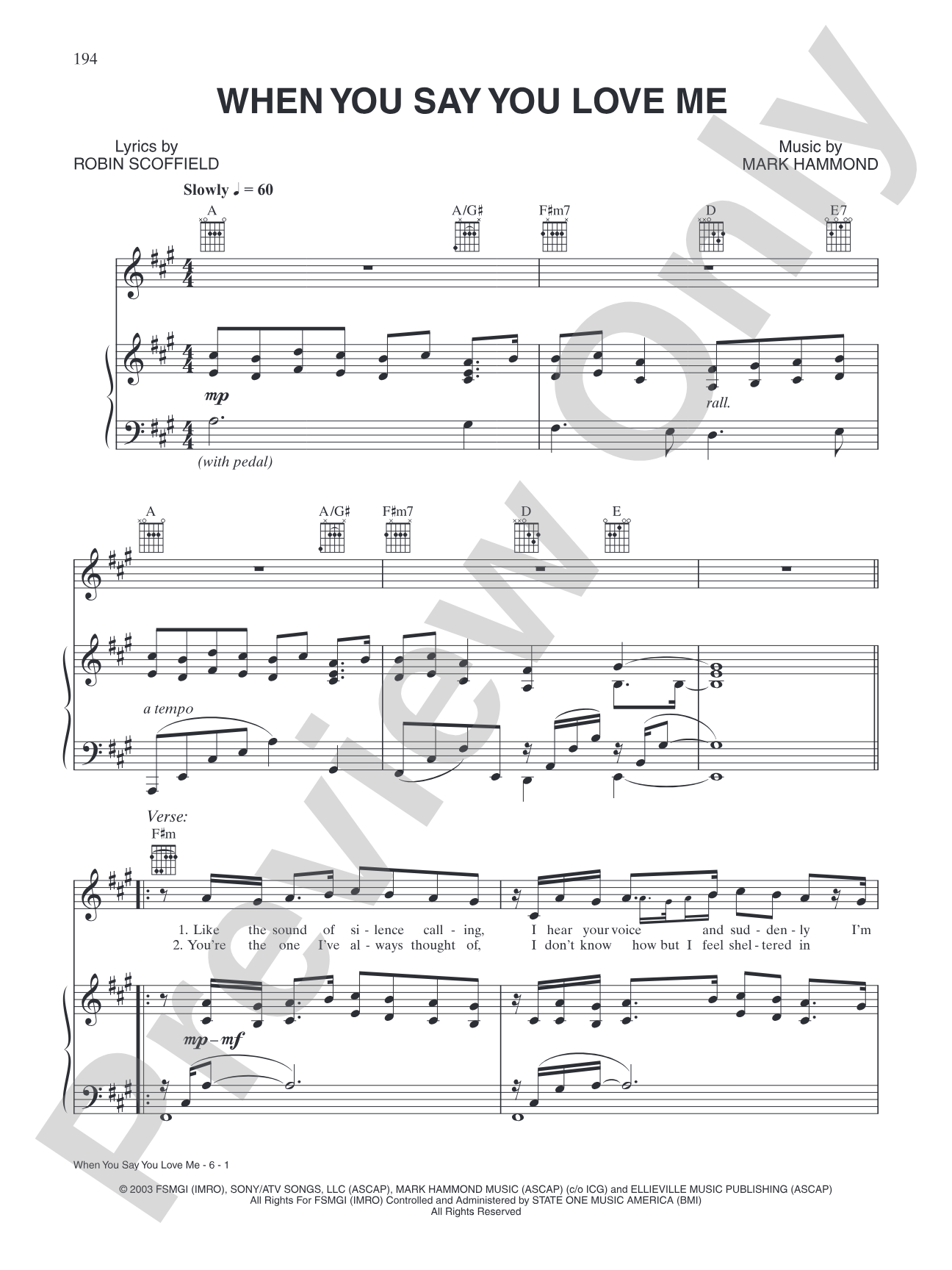
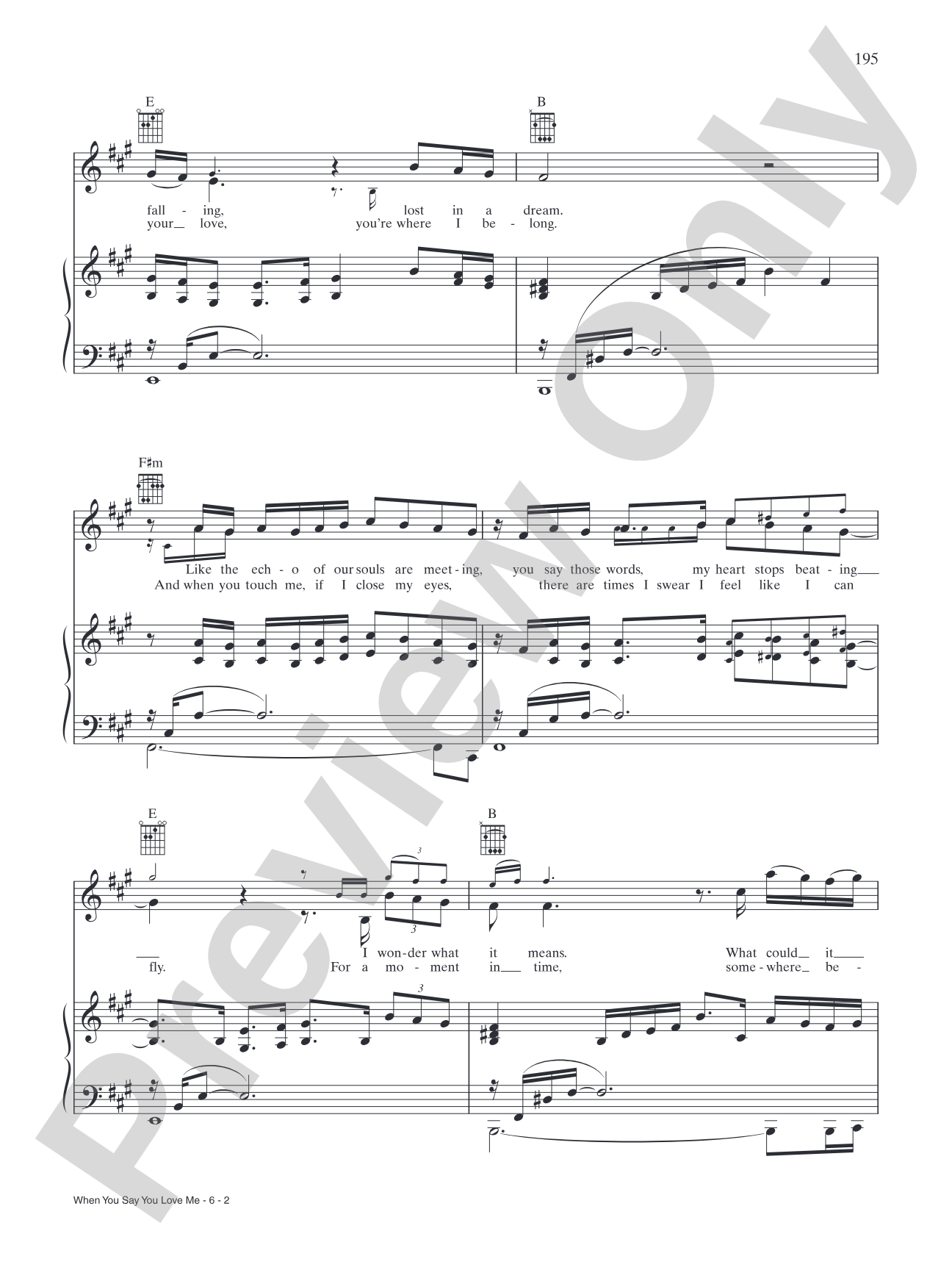

When You Say You Love Me: Piano/Vocal/Chords
43 of the Most Requested Wedding Songs and Solos
Item: 00-PS-0000080
$5.99
Pickup currently not available
Related Items
Ave Maria: Piano/Vocal/Chords |
$5.99
|
View |
Description
Piano/vocal arrangements of 29 top-requested popular and traditional wedding songs, plus 14 piano solo renditions of processionals, recessionals, and prelude music ranging from classical to new age.
Titles: Amazed (Lonestar) * Angel Eyes (Jim Brickman) * At Last (Etta James) * Ave Maria (Franz Schubert) * Because You Loved Me (Celine Dion) * Bless the Broken Road (Rascal Flatts) * The Blessing (Celtic Woman) * Bridal Chorus (Richard Wagner) * Endless Love (Diana Ross and Lionel Richie) * Everything (Michael Bublé) * I Don't Want to Miss a Thing (Aerosmith) * Irish Wedding Song (Traditional) * Jesu, Joy of Man's Desiring (Johann Sebastian Bach) * Just to Hear You Say That You Love Me (Faith Hill and Tim McGraw) * Ode to Joy (Beethoven) * Open Arms (Journey) * The Prayer (Josh Groban) * The Rose (Bette Midler) * Truly, Madly, Deeply (Savage Garden) * Valentine (Jim Brickman) * Wedding March (Felix Mendelssohn) * You Raise Me Up (Josh Groban) * and more.


Titles: Amazed (Lonestar) * Angel Eyes (Jim Brickman) * At Last (Etta James) * Ave Maria (Franz Schubert) * Because You Loved Me (Celine Dion) * Bless the Broken Road (Rascal Flatts) * The Blessing (Celtic Woman) * Bridal Chorus (Richard Wagner) * Endless Love (Diana Ross and Lionel Richie) * Everything (Michael Bublé) * I Don't Want to Miss a Thing (Aerosmith) * Irish Wedding Song (Traditional) * Jesu, Joy of Man's Desiring (Johann Sebastian Bach) * Just to Hear You Say That You Love Me (Faith Hill and Tim McGraw) * Ode to Joy (Beethoven) * Open Arms (Journey) * The Prayer (Josh Groban) * The Rose (Bette Midler) * Truly, Madly, Deeply (Savage Garden) * Valentine (Jim Brickman) * Wedding March (Felix Mendelssohn) * You Raise Me Up (Josh Groban) * and more.
When You Say You Love Me: Piano/Vocal/Chords isn't in MakeMusic Cloud just yet...but it could be. Let us know you'd like to see it, and you'll help shape what comes next. In the meantime, start a free trial and dive into thousands of interactive titles your students can play along with today.
Request This Title
Tell us you want it.
Start Your Free Trial
Explore everything that's ready to play right now.
Sample Audio
No sample audio found.
Sample Video
No sample videos found.
Additional Details
Series:
World's Greatest
Publisher:
Alfred Music
Page Count:
208
SKU:
00-PS-0000080
More about this title
Why we love this
This collection spans the full spectrum of wedding music needs with genuine variety. You get 29 vocal arrangements covering everything from classical standards to contemporary hits, plus 14 piano solos for ceremony moments when singers aren't involved. The mix of traditions (Bach, Mendelssohn, Beethoven) with modern pop and country songs means you can build a ceremony that feels personal without sacrificing musical substance.
What to expect
Moving between intimate and grand, personal and timeless. Opening with a Bach prelude sets reverence; transitioning into a contemporary pop love song acknowledges modern romance. The collection honors tradition while celebrating what today's couples actually want to hear.
Who it's for
Wedding musicians who need flexibility and breadth in a single resource. Pianists accompanying singers at ceremonies will find both the vocal arrangements and solo pieces essential; music directors planning interfaith or multicultural weddings will appreciate the mix of classical, traditional, and contemporary options.
How to get the most out of it
- Balance the melody line between vocal and piano parts. The vocal arrangements lean heavily on the piano's role, so resist the urge to play the accompaniment as mere background; it carries harmonic and textural information the vocalist needs.
- For the piano solos, tempo should reflect the emotional tenor of the ceremony moment. Processionals need steadiness and forward motion; preludes benefit from a slightly more relaxed pace that invites guests to settle in.
- When accompanying, pay close attention to the chord symbols provided, especially in the contemporary songs. These voicings are specific enough to shape the modern pop sound without sounding overwrought.
- Test the vocal range of your singer against each arrangement before finalizing selections. This collection offers variety, but keys are fixed, so confirm comfort across your chosen repertoire early.
How to use it
Use the piano solo pieces to frame your ceremony: a Bach or Mendelssohn arrangement during the prelude, then vocal selections during the processional and signing. The recessional works well with an uptempo solo or a joyful vocal arrangement that lets the couple and guests leave on energy rather than formality.
Skills your students will build
- Accompanying vocalists across multiple genres (classical, pop, country, contemporary)
- Reading and executing chord symbols in contemporary arrangements
- Tempo flexibility and emotional pacing in ceremonial contexts
- Sight-reading mixed notation (melody, lyrics, and chord symbols simultaneously)
- Transposition and key selection for vocal comfort