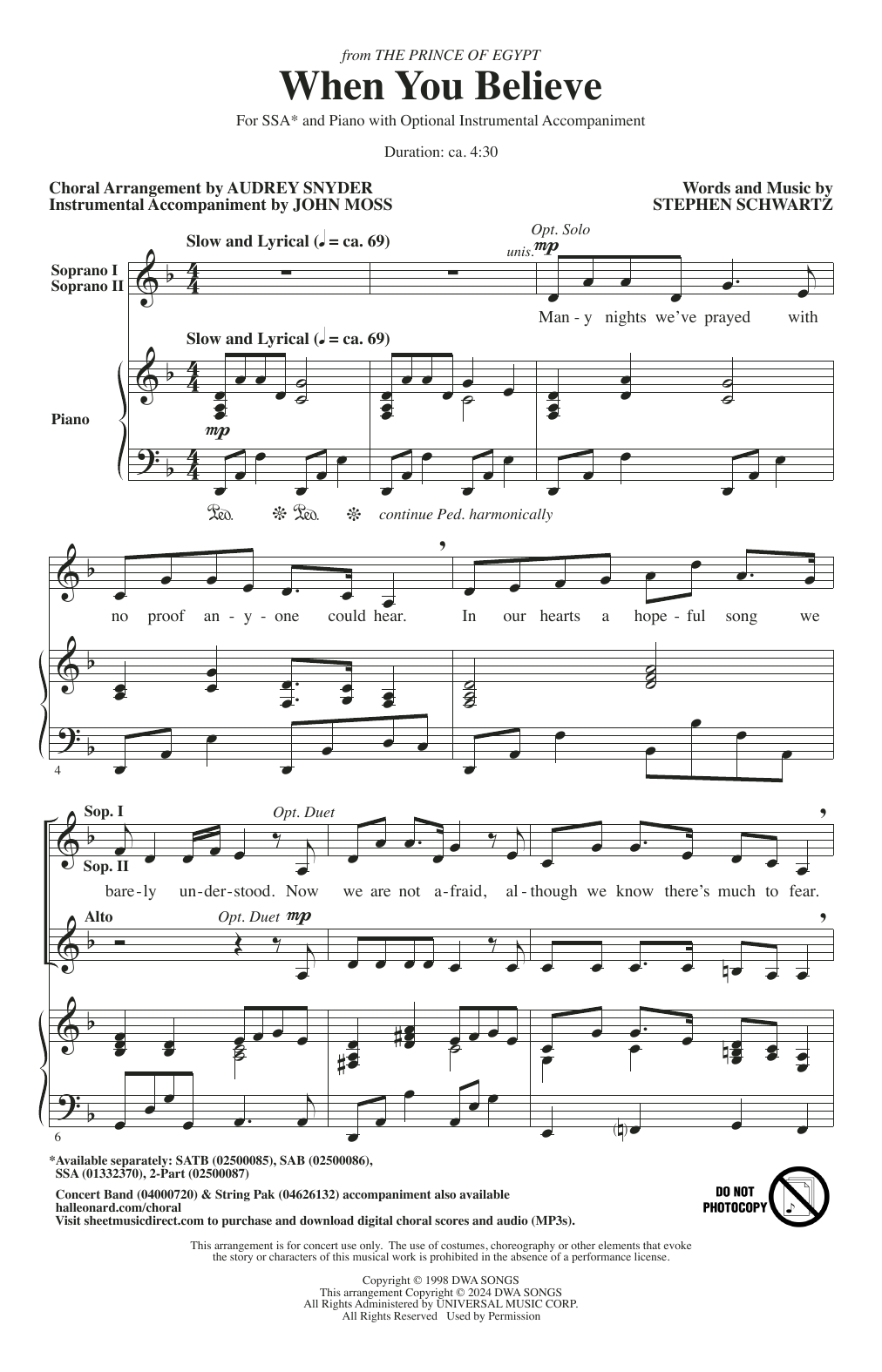
When You Believe (from The Prince Of Egypt) (arr. Audrey Snyder) Sheet Music Preview

When You Believe (from The Prince Of Egypt) (arr. Audrey Snyder): SSA Choral Octavo

As performed by Whitney Houston and Mariah Carey / Arranged by Audrey Snyder

Item: 35-DS01518028

Digital Download
$2.50
Description

When You Believe (from The Prince Of Egypt) (arr. Audrey Snyder): SSA Choral Octavo isn't in MakeMusic Cloud just yet...but it could be. Let us know you'd like to see it, and you'll help shape what comes next. In the meantime, start a free trial and dive into thousands of interactive titles your students can play along with today.

Sample Audio
No sample audio found.
Sample Video
Additional Details
Publisher: Hal Leonard
Page Count: 11
SKU: 35-DS01518028

More about this title

About the Artist: Whitney Houston and Mariah Carey

Whitney Houston and Mariah Carey originated this duet for the 1998 animated film The Prince of Egypt, a collaboration that paired two of pop music's most technically gifted vocalists. Houston's powerhouse contralto and Carey's crystalline soprano created a signature recording that became a cultural touchstone, earning a Grammy Award and introducing millions of listeners to a song about faith and perseverance. Both artists brought their characteristic vocal control and emotional depth to material that transcended typical pop crossover territory.

Their performance established "When You Believe" as a modern standard suitable for concert arrangements across multiple musical contexts. The song's universal message and accessible melodic writing have made it a fixture in educational choral programs, where it continues to inspire students to explore contemporary vocal music with serious artistic intent.

Why we love this

Audrey Snyder's arrangement unlocks this Oscar-nominated anthem for SSA ensembles without diluting its emotional impact or dramatic arc. The writing honors the original's power while offering flexible voicing options that let singers at different ranges find secure, satisfying lines. Directors will appreciate how the arrangement builds momentum through the second half while remaining technically achievable for high school and community choirs.

What to expect

The piece moves from introspective vulnerability in the opening phrases to a swelling, triumphant affirmation by the final chorus. Singers experience the arc of doubt transforming into conviction, with moments of soaring lyricism that reward careful attention to phrasing and breath control. The overall effect is inspiring without becoming saccharine, contemporary without sacrificing musicality.

Who it's for

High school, college, and community choirs looking for contemporary material with genuine emotional substance and strong audience connection. Ensembles comfortable with SSA or SSAA voicing who want to explore a song that balances accessibility with artistic credibility.

How to get the most out of it

  • Shape the verse with restraint; save the dynamic intensity for the soaring refrain so the emotional payoff lands with full force.
  • Balance the solo moments carefully if you're assigning them to individual singers. Those passages need presence without overshadowing the ensemble's entrance.
  • Establish a consistent vowel sound across all three parts during the longer sustained notes to maximize blend and resonance.
  • Let the accompaniment guide your tempo choices in the bridge section; resist the urge to rush as the harmony deepens.

How to use it

This works beautifully as a concert closer that sends audiences out on an uplifting note, or as a bridge piece connecting a more serious thematic program to lighter material. Its recognizable melody makes it an excellent selection for recruiting newer singers into the ensemble while challenging more experienced voices with nuanced harmonic writing.

Skills your students will build

  • Singing sustained high passages with consistent tone and breath management
  • Balancing solo and ensemble textures in the same arrangement
  • Interpreting contemporary vocal music with musical maturity
  • Blending three-part harmony across different voice weights
  • Building and releasing dramatic tension over longer musical phrases

You May Also Like