
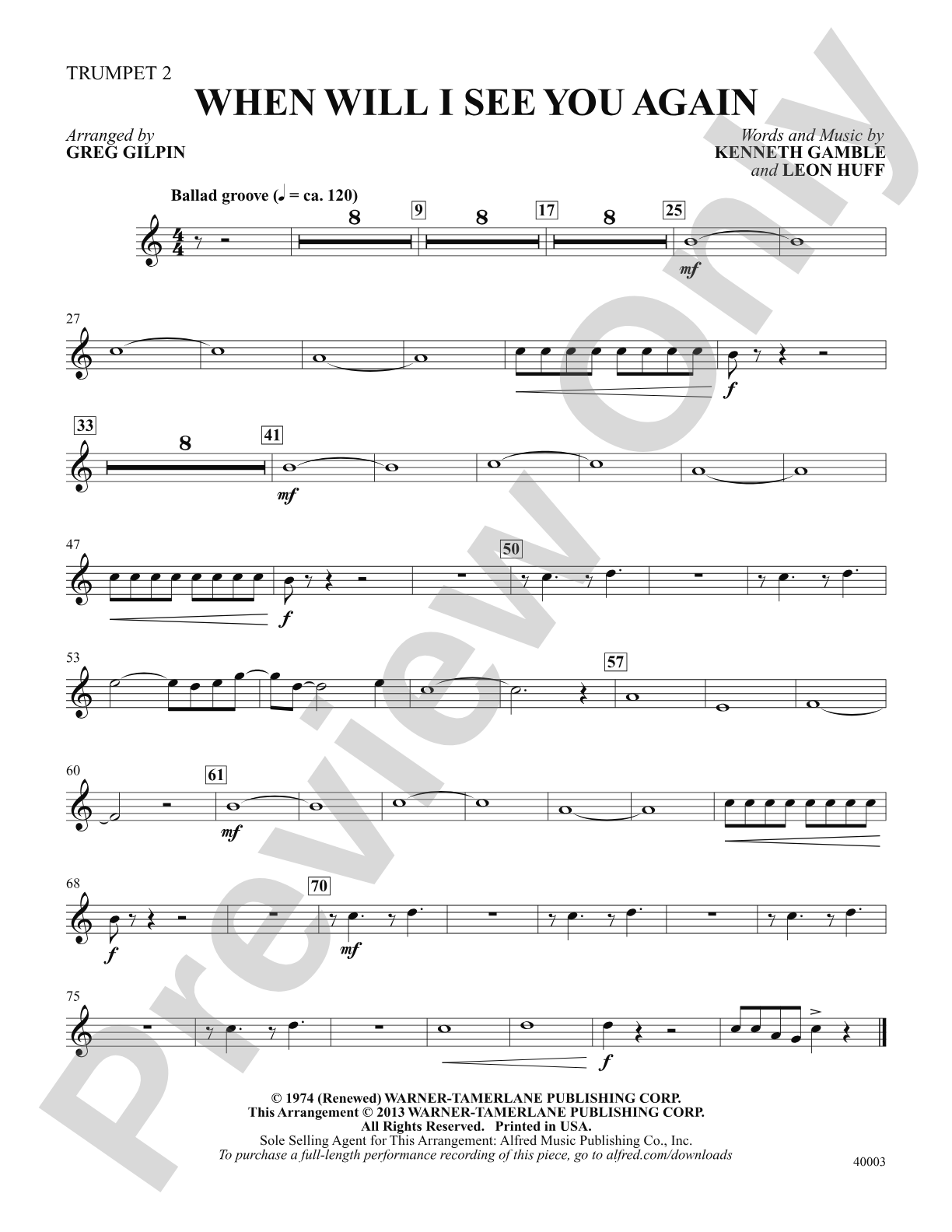

When Will I See You Again: 2nd B-flat Trumpet: Choral SoundPax
Words and music by Kenneth Gamble and Leon Huff / arr. Greg Gilpin
Item: 00-PC-0015938_T2
$4.00
Pickup currently not available
Description
A signature song from the 1970s group The Three Degrees, this soulful hit works for ladies' ensembles of any size. Add the instrumental parts for that special touch!


Don't just read it, hear it, play along with it, and watch your students grow with it. In MakeMusic Cloud, When Will I See You Again: 2nd B-flat Trumpet: Choral SoundPax comes alive with professional accompaniment, adjustable tempo, and built-in practice tools that turn solo practice into real progress.
Open in the Player
Jump straight in and assign it today.
Start Your Free Trial
Open this title and explore the full library in minutes.
Sample Audio
1
Audio File
--:--
0:00
0:00
Sample Video
No sample videos found.
Additional Details
Series:
Alfred Pop Choral Series
Publisher:
Alfred Music
Page Count:
24
SKU:
00-PC-0015938_T2
Instrumentation:
SoundPax
More about this title
About the Composer: Kenneth Gamble
Kenneth Gamble stands among the most prolific and successful songwriters of the 1970s soul and R&B era. Working alongside Leon Huff as part of the legendary Philadelphia International Records production team, Gamble crafted some of the decade's most enduring hits, earning multiple Grammy Awards and inductions into the Songwriters Hall of Fame. His work defined the sound of Philadelphia soul and continues to anchor popular music curricula in schools worldwide.
Gamble's compositions balance sophisticated harmonic language with immediate melodic hooks, making them ideal vehicles for teaching arrangement and ensemble singing. His ability to write for vocal groups of varying sizes and skill levels has made his catalog a cornerstone of contemporary choral programming.
Why we love this
This arrangement preserves every ounce of the original's soulful warmth while remaining accessible to developing ensembles. Greg Gilpin's orchestration captures that lush 1970s soul sound without overcomplicating the vocal lines, and the optional instrumental parts let you build from a cappella simplicity to a fully realized production. Choirs love performing music their audiences actually know and love, and this delivers both the recognition and the musical substance to justify programming it.
What to expect
When Will I See You Again carries the signature smoothness of 1970s soul: rich harmonies, a memorable hook, and lyrics that resonate with genuine emotion. The arrangement wraps you in warmth without sentimentality, balancing sophistication with accessibility. Singing it feels like stepping into a time capsule that somehow remains utterly current.
Who it's for
Ladies' choirs and treble-voiced ensembles at intermediate to advanced levels will find this arrangement both singable and musically satisfying. Solo singers and small groups can also draw from this material, and the flexibility in ensemble size means it works whether you have 12 singers or 50. This is an ideal choice for directors building a contemporary choral program that reaches beyond classical repertoire.
How to get the most out of it
- Anchor the piece in a relaxed, conversational tone rather than a formal classical approach. The Three Degrees' original thrives on warmth and intimacy, so encourage singers to think about how they'd share this lyric with a friend rather than projecting to the back row.
- Balance the recorded accompaniment carefully during rehearsal. Use it to lock harmonies and phrasing early, then gradually pull back on volume so the ensemble can own the sonority by performance time.
- Pay attention to the sustains and rests as rhythmic gestures. Soul music often breathes through silence, and respecting those moments creates space for the emotional core of the lyric to land.
- If adding the instrumental parts, rehearse them separately first so the rhythm section can nail the groove before layering in vocals. The pocket matters as much as pitch accuracy here.
How to use it
This works beautifully on a concert celebrating popular music across decades, paired alongside other contemporary arrangements or as a solo feature for your ladies' ensemble. It's also an excellent choice for spring concerts, pops nights, or any program seeking to engage audiences with repertoire that bridges classical and commercial music worlds. The optional instruments allow you to scale the production up or down depending on your concert context.
Skills your students will build
- Singing in jazz-influenced harmony with blend focus on upper and middle voices
- Interpreting swing rhythm and rhythmic phrasing in a contemporary vocal style
- Balancing ensemble sound while maintaining individual voice independence
- Working with recorded accompaniment and click tracks in rehearsal and performance
- Building confidence with popular music and non-classical repertoire