
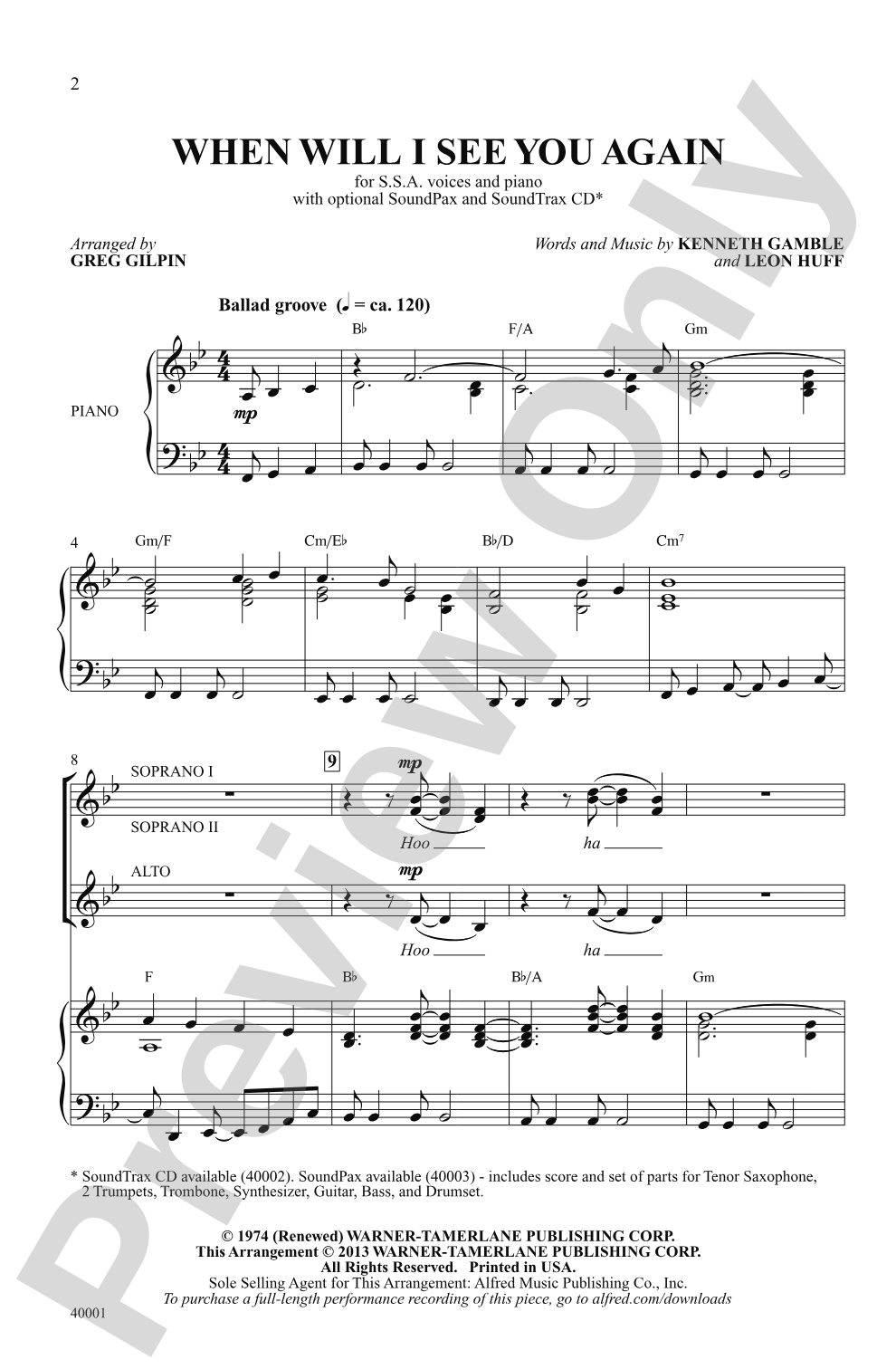
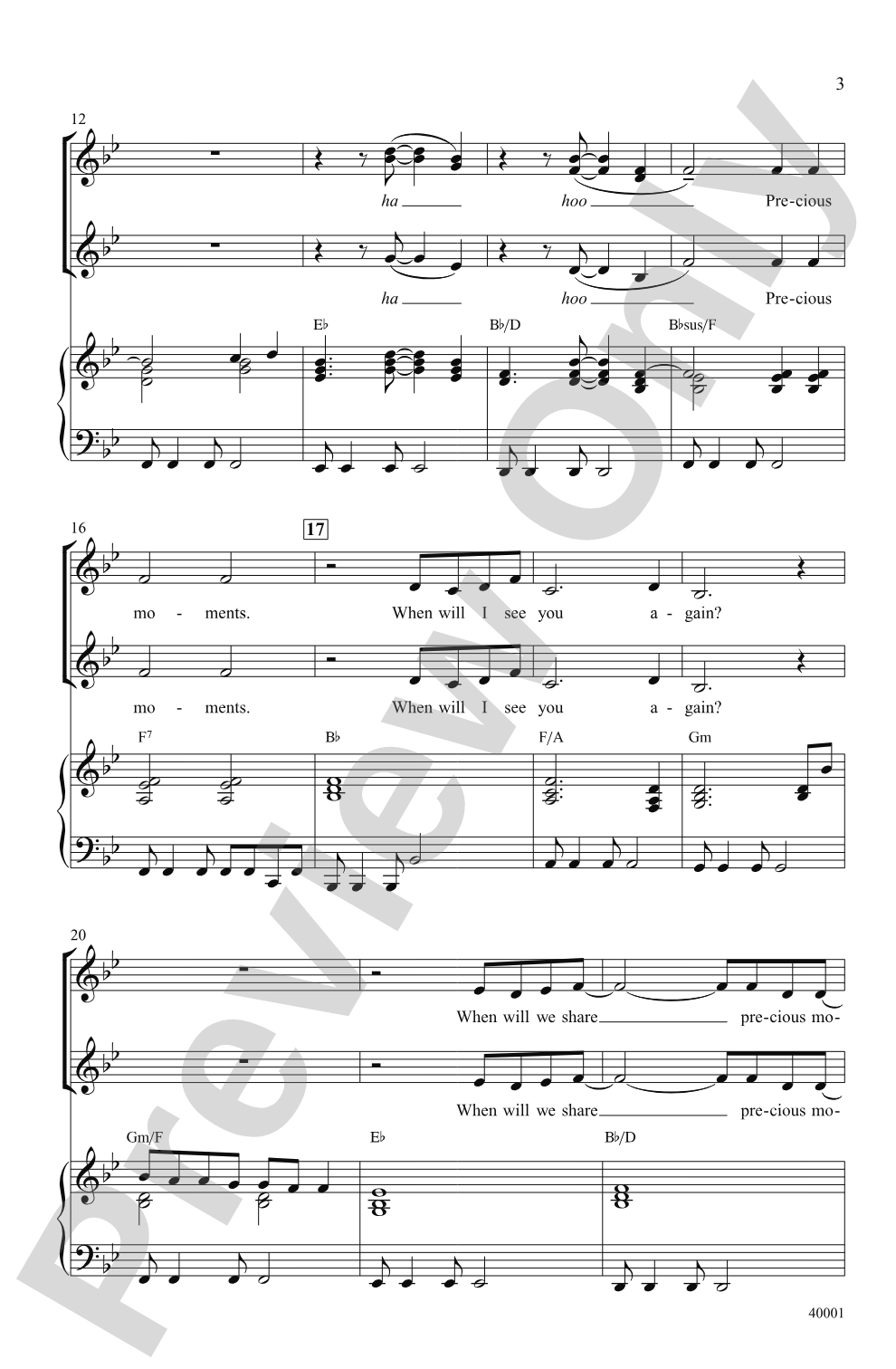

When Will I See You Again: SSA Choral Octavo
Words and music by Kenneth Gamble and Leon Huff / arr. Greg Gilpin
Item: 00-PO-0001737
$1.90
Minimum order quantity: 20 copies
One moment…
Related Items
When Will I See You Again: SoundTrax Digital Audio Download |
$27.99
|
View | |
When Will I See You Again: Choral SoundPax |
$35.00
|
View | |
When Will I See You Again: SSA Choral Octavo |
$1.90
|
View | |
When Will I See You Again: Choral Octavo SoundTrax CD |
$27.99
|
View | |
When Will I See You Again: Choral SoundPax |
$35.00
|
View |
Description
A signature song from the 1970s group The Three Degrees, this soulful hit works for ladies' ensembles of any size. Add the instrumental parts for that special touch!


When Will I See You Again: SSA Choral Octavo isn't in MakeMusic Cloud just yet...but it could be. Let us know you'd like to see it, and you'll help shape what comes next. In the meantime, start a free trial and dive into thousands of interactive titles your students can play along with today.
Request This Title
Tell us you want it.
Start Your Free Trial
Explore everything that's ready to play right now.
Sample Audio
1
Audio File
--:--
0:00
0:00
Sample Video
No sample videos found.
Additional Details
Series:
Alfred Pop Choral Series
Publisher:
Alfred Music
Page Count:
12
SKU:
00-PO-0001737
More about this title
About the Composer: Kenneth Gamble
Kenneth Gamble is a legendary Philadelphia soul producer and songwriter who, alongside Leon Huff, shaped the sound of 1970s R&B and pop music. As a founding member of the songwriting and production team behind Philadelphia International Records, Gamble crafted some of the decade's most enduring hits, working with artists like The O'Jays, Harold Melvin and the Blue Notes, and The Three Degrees. His melodic sensibility and sophisticated harmonic arrangements became blueprints for soul music education and continue to inspire performers across genres.
For music educators, Gamble's catalog offers accessible entry points into authentic soul and R&B idioms. His songs balance singability with harmonic interest, making them ideal for developing ensemble blend, phrasing, and stylistic awareness in choral settings.
Why we love this
Greg Gilpin's arrangement respects the song's soulful DNA while opening it up for treble voices of any experience level. The piece captures what made the original unforgettable: a yearning melody, warm harmonies, and the kind of emotional directness that resonates in any choir room. You'll find your singers connecting to this music immediately because it's built on genuine feeling, not technique for its own sake.
What to expect
The piece carries the soul and yearning of its original while living naturally in the treble range. There's an intimacy here, a conversational quality that invites singers into the emotional landscape of missing someone deeply. The arrangement wraps that longing in lush harmony without ever feeling overwrought.
Who it's for
This arrangement suits high school and adult SSA choirs, as well as mixed ensembles performing the SSA version. Singers at any level can access the emotional core of the piece, though directors will appreciate how the harmonic language offers depth for more experienced ensembles to explore.
How to get the most out of it
- Shape the melody with long, connected phrases rather than stopping at bar lines. Let the text drive the phrasing, especially in the chorus where 'When will I see you again' needs space to breathe.
- Balance the inner voices carefully so they support rather than overshadow the top line. The arrangement's strength lies in its harmonic fullness, but the lead melody must always sing through.
- Bring out the rhythmic pocket characteristic of soul music. A gentle swing on eighth notes in places lifts the energy without losing the song's intimate quality.
- Use the instrumental parts to frame your performance. Adding them transforms the piece from a cappella warmth into a fuller production that rewards both singers and audience.
How to use it
This works beautifully as a ballad anchor in a concert that touches multiple genres, or as the emotional heart of a program built around 1970s pop classics. The optional instrumental parts let you decide whether you want the piece to stand alone or take on a more produced feel alongside other selections. Consider programming it where you need a moment of genuine connection between choir and audience.
Skills your students will build
- Sustaining long phrases with proper breath control and line continuity
- Balancing three-part harmony while maintaining melodic prominence
- Interpreting soul and R&B style elements including swing eighth-notes and blues-influenced phrasing
- Blending vowels and finding harmonic resonance across the treble voice ranges
- Responding to text-driven musicality and emotional interpretation