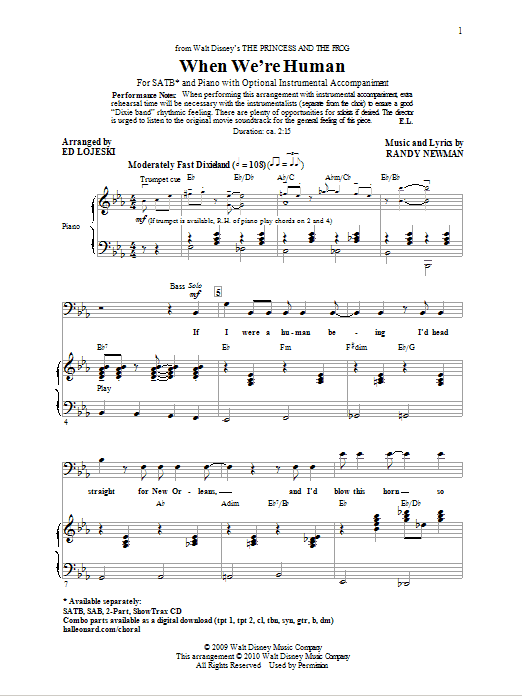
When We're Human (from The Princess And The Frog) Sheet Music Preview

When We're Human (from The Princess And The Frog): SATB Choral Octavo

By Randy Newman / Arranged by Ed Lojeski

Item: 35-DS00145484

Digital Download
$2.99
Description

When We're Human (from The Princess And The Frog): SATB Choral Octavo isn't in MakeMusic Cloud just yet...but it could be. Let us know you'd like to see it, and you'll help shape what comes next. In the meantime, start a free trial and dive into thousands of interactive titles your students can play along with today.

Sample Audio
No sample audio found.
Sample Video
Additional Details
Publisher: Hal Leonard
Page Count: 11
SKU: 35-DS00145484

More about this title

About the Composer: Randy Newman

Randy Newman stands apart among film composers for his ability to write songs that function as complete dramatic moments. His work across decades of cinema has earned him multiple Academy Award nominations, and his songs possess a distinctly American sensibility: conversational melodies, sophisticated harmonies, and lyrics that reveal character through specificity rather than sentiment.

Newman's gift for understatement serves storytelling brilliantly. He writes for the voice as a narrative instrument, which makes his songs especially rewarding for choral arrangements. Directors and conductors value his work because it trusts singers to find authenticity in restraint.

Why we love this

Ed Lojeski's arrangement captures the song's quiet wisdom without sentimentalizing it. The piece asks your singers to inhabit a moment of genuine reflection, which means strong musicianship in service of understatement. Choirs at this level benefit enormously from repertoire that rewards emotional maturity over technical flash.

What to expect

The music moves with the unhurried quality of genuine thought, as if someone is working through an idea in real time. Newman's characteristic warmth lives here, but without sweetness. The arrangement invites your singers into a private moment.

Who it's for

SATB choirs seeking repertoire that develops maturity and restraint. This work suits ensembles comfortable with contemporary harmonic language and singers who can sustain attention in a reflective piece.

How to get the most out of it

  • Shape the phrases to mirror speech patterns rather than purely musical arcs. Newman's melodies follow conversational cadence, so listen for where a lyric naturally breathes and let that guide your phrasing.
  • Keep dynamics restrained. The power of this arrangement lives in clarity and intimacy, not volume. A well-balanced pianissimo will cut farther than pushing for grandeur.
  • Address the harmonic language directly in rehearsal. Lojeski likely uses contemporary jazz voicings that require precision tuning. Mark any moment where voices move by half-step and work those passages slowly.
  • Trust the lyrical content to do emotional work. Singers who understand what the text means will make better musical choices than those given interpretive direction alone.

How to use it

Consider pairing this with other contemporary film songs or with repertoire exploring themes of humanity and connection. It works especially well in mixed programs where you want to shift the room's energy toward contemplation. The 11-page length makes it substantial enough to anchor a program section without overwhelming it.

Skills your students will build

  • Singing contemporary harmonic language with secure intonation
  • Phrasing based on text and speech rhythm rather than bar lines
  • Balancing ensemble sound across close, sophisticated voicings
  • Musical storytelling through subtlety and understatement

You May Also Like