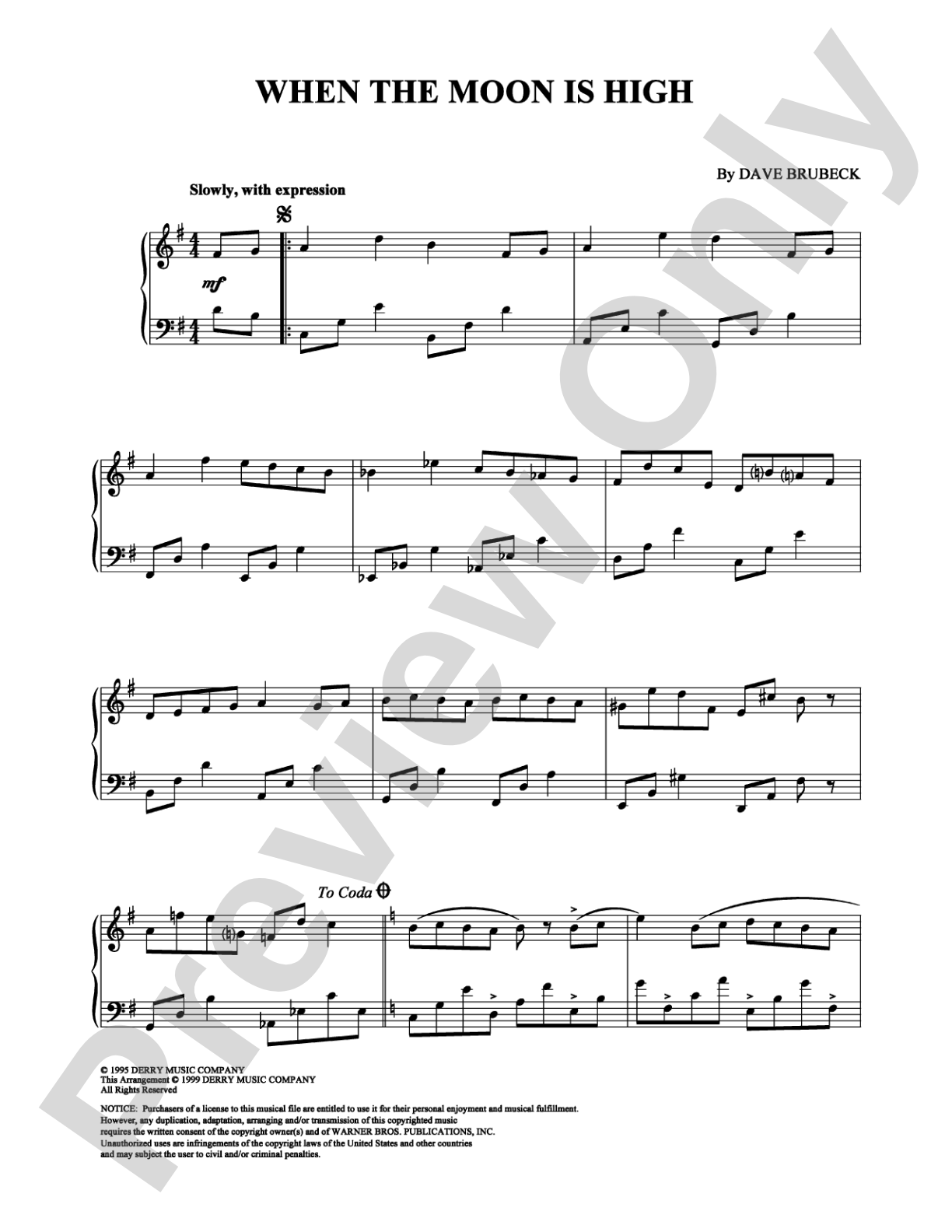
When the Moon is High: Piano Digital Sheet Music

When the Moon is High: Piano Digital Sheet Music

Dave Brubeck

Item: 00-PS-0001593

Digital Download
$3.99
Description

When the Moon is High: Piano Digital Sheet Music isn't in MakeMusic Cloud just yet...but it could be. Let us know you'd like to see it, and you'll help shape what comes next. In the meantime, start a free trial and dive into thousands of interactive titles your students can play along with today.

Sample Audio
No sample audio found.
Sample Video
Additional Details
SKU: 00-PS-0001593

More about this title

About the Artist: Dave Brubeck

Dave Brubeck

Dave Brubeck stands as one of jazz's most consequential pianist-composers, equally fluent in improvisation and fully notated composition. His catalog spans choral works, orchestral pieces, chamber music, ballet suites, and large-scale works for chorus and orchestra, all shaped by his studies with Darius Milhaud at Mills College. Milhaud's influence encouraged Brubeck to weave jazz language into classical forms, a synthesis that defined his artistic voice.

Beyond his musical innovations, Brubeck broke significant racial barriers as a performer and bandleader during the mid-twentieth century. His album "Time Out" became the first jazz recording to sell over a million copies, while works like "To Hope!" and his oratorios have been performed and recorded internationally by prestigious ensembles including the London Symphony Orchestra and the Cathedral Choral Society. He received the Grammy Lifetime Achievement Award for his jazz contributions, the Presidential Medal of the Arts, and election to the American Classical Music Hall of Fame in 2003.

Why we love this

This piece captures Brubeck's gift for writing composed jazz that sounds spontaneous without sacrificing structural clarity. The notated melody and harmony give students insight into how a master improviser thought about melody and form, making it an excellent study piece for pianists developing jazz language alongside classical technique.

What to expect

The piece unfolds with a quiet, contemplative quality, evoking the image of a moonlit moment. Brubeck's harmonic language brings a sophisticated, slightly impressionistic color while maintaining the forward momentum of jazz phrasing.

Who it's for

Pianists who are comfortable with both classical notation and jazz vocabulary, and who want to study how Brubeck bridged these languages. It suits intermediate to advanced students exploring jazz composition and pianists preparing recital repertoire that goes beyond the standard classical canon.

How to get the most out of it

  • Treat the written melody as a framework, not a rigid constraint. Brubeck's notation leaves room for interpretive flexibility in phrasing and timing, especially in how you voice the chords.
  • Pay attention to the harmonic movement underneath the melody line. Understanding the chord changes as a jazz musician would hear them will deepen your interpretation.
  • Balance linear clarity with the underlying swing feel. The piece should breathe with the relaxed pocket of jazz even within notated sections.

How to use it

Program this alongside classical twentieth-century piano works to demonstrate how jazz informed concert music during the era. It works equally well in a jazz recital or as part of a program exploring American composers who crossed genre boundaries.

Skills your students will build

  • Jazz harmonic analysis and voice-leading
  • Interpreting composed jazz notation with appropriate swing feel and phrasing
  • Melodic shaping over chord changes
  • Bridging classical technique with jazz articulation and touch

You May Also Like