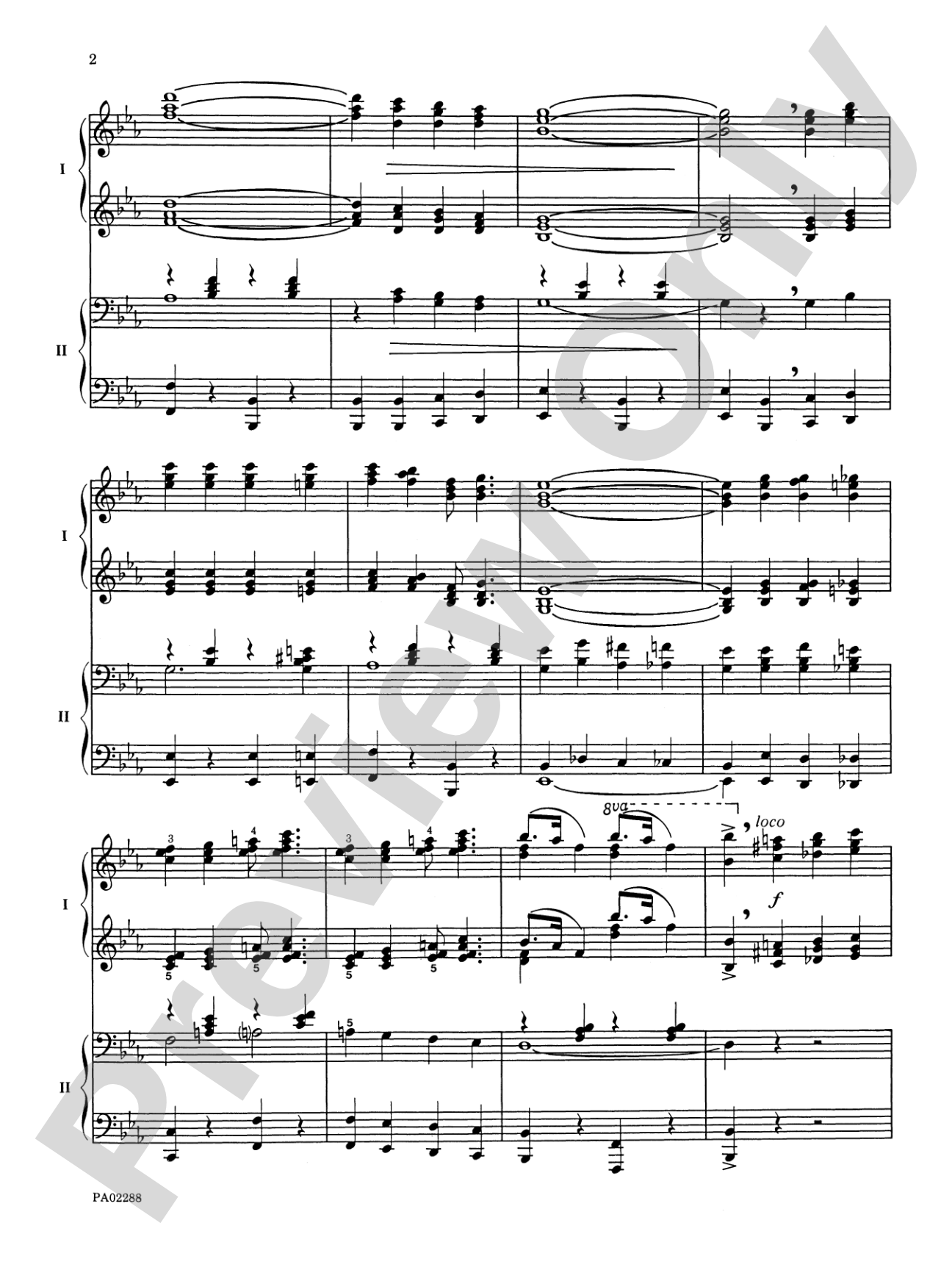
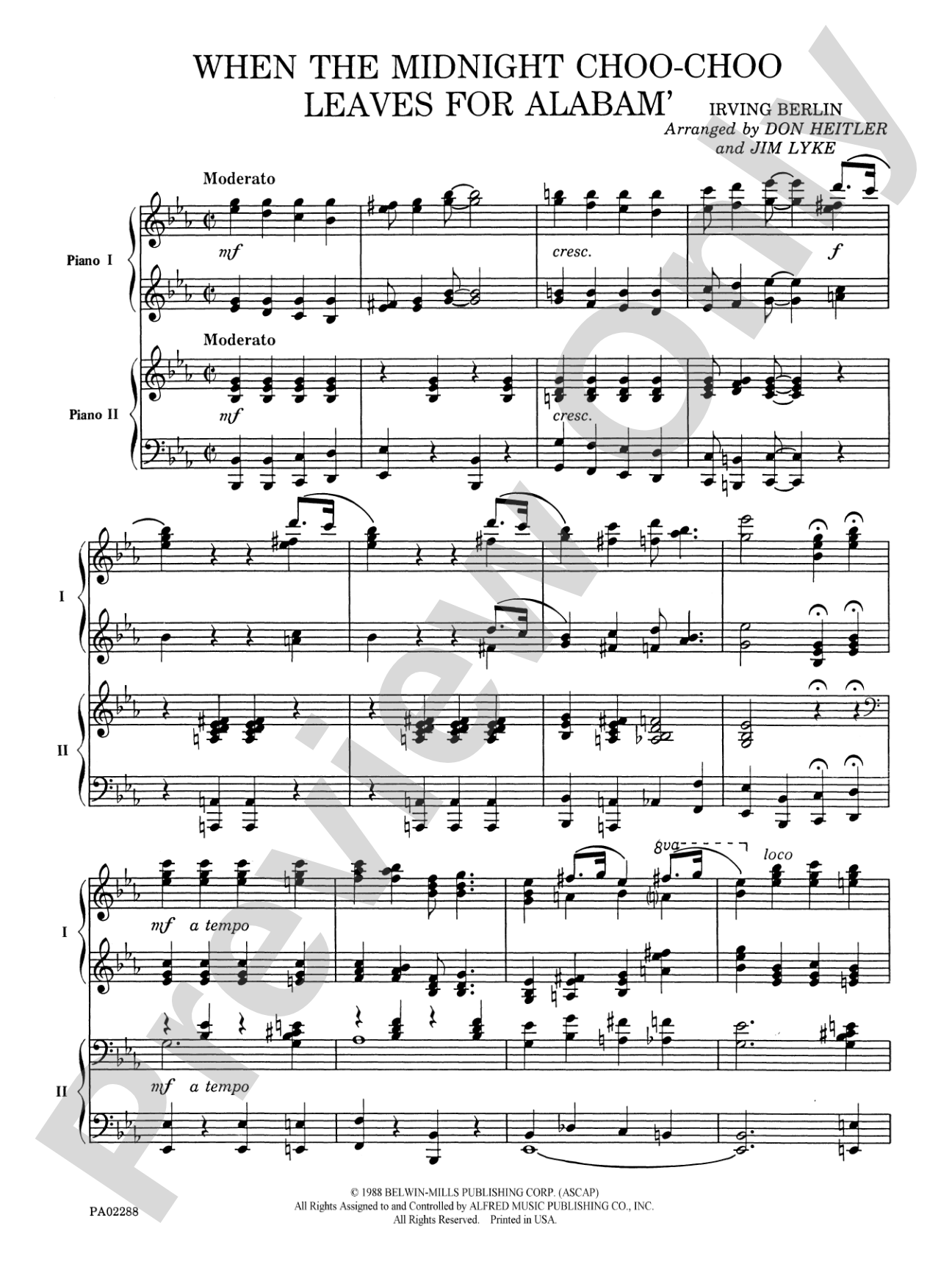
When the Midnight Choo-Choo Leaves for Alabam' - Piano Duo (2 Pianos, 4 Hands) Sheet Music Preview

When the Midnight Choo-Choo Leaves for Alabam' - Piano Duo (2 Pianos, 4 Hands): Piano Duets & Four Hands

By Irving Berlin / arr. Don Heitler and Jim Lyke

Level: Late Intermediate

Item: 00-PB-0000664

Digital Download
$6.99
Description
Irving Berlin's 1912 classic song was recorded and performed many times over the years in vaudeville, Broadway, movies and radio, having an infectious, upbeat, ragtime style. This arrangement for two pianos, two performers, captures all the rhythmic flavor and rich harmonies of an orchestrated arrangement while still being within reach of late intermediate pianists. Two scores are included. A Federation Festivals 2024-2028 selection.

When the Midnight Choo-Choo Leaves for Alabam' - Piano Duo (2 Pianos, 4 Hands): Piano Duets & Four Hands isn't in MakeMusic Cloud just yet...but it could be. Let us know you'd like to see it, and you'll help shape what comes next. In the meantime, start a free trial and dive into thousands of interactive titles your students can play along with today.

Sample Audio
No sample audio found.
Sample Video
Additional Details
Series: Keyboard Ensemble Series
Publisher: Alfred Music
Page Count: 16
SKU: 00-PB-0000664

More about this title

About the Composer: Irving Berlin

Irving Berlin (1888, 1989) composed more than 1,000 songs across five decades, establishing himself as one of America's most prolific and commercially successful songwriters. Self-taught at the piano, Berlin developed an instinctive ear for melody and an uncanny ability to capture the spirit of contemporary American life in his music, whether through ragtime, jazz-inflected numbers, or tender ballads.

Berlin's catalog shaped the Great American Songbook and dominated vaudeville, Broadway, Hollywood, and radio throughout the 20th century. His songs remain essential repertoire for musicians studying American popular music history and the evolution of songwriting craft.

Why we love this

Heitler and Lyke preserve the infectious energy and syncopated drive of Berlin's 1912 hit while crafting something genuinely pianistic. The orchestrated textures are built from what two players can actually deliver, making this a rewarding workout for late intermediate pianists who want to experience ensemble playing with real harmonic sophistication.

What to expect

Bright, propulsive, and rhythmically sophisticated. The ragtime foundation gives this piece an irresistible forward drive, while Berlin's deft harmonies add warmth and color beneath the bouncy surface. It's the sound of early American vernacular music played with confidence and style.

Who it's for

Late intermediate piano students ready to step into ensemble work and experience the textures of early 20th-century popular music. Directors seeking approachable yet musically substantial duets for recitals, competitions, or collaborative programming.

How to get the most out of it

  • Establish the ragtime swing before rehearsal begins. The rhythmic style demands a light touch and forward momentum; overly strict timekeeping will flatten the character.
  • Balance articulation between the two pianos so neither player dominates the melodic line. The interplay is what makes this arrangement sing.
  • Work the syncopated passages together as a unit. Mark potential entry points and breathing spots so you're always moving as one instrument split across two benches.
  • Let the harmonic color shine in the middle sections. Rich voicings are only effective when both players understand the vertical architecture they're building.

How to use it

This works equally well in a competition setting (it's on the 2024-2028 Federation Festivals list) or as a showstopper on a recital alongside other Great American Songbook selections. Its relatively compact scope and infectious character make it an excellent concert opener or the kind of piece that reminds audiences why American popular music remains so vital.

Skills your students will build

  • Ragtime rhythmic subdivision and swing feel
  • Two-piano coordination and ensemble listening
  • Reading independent yet interdependent musical lines
  • Balancing melody, harmony, and accompaniment across two instruments
  • Interpretation of early 20th-century popular music idioms

You May Also Like