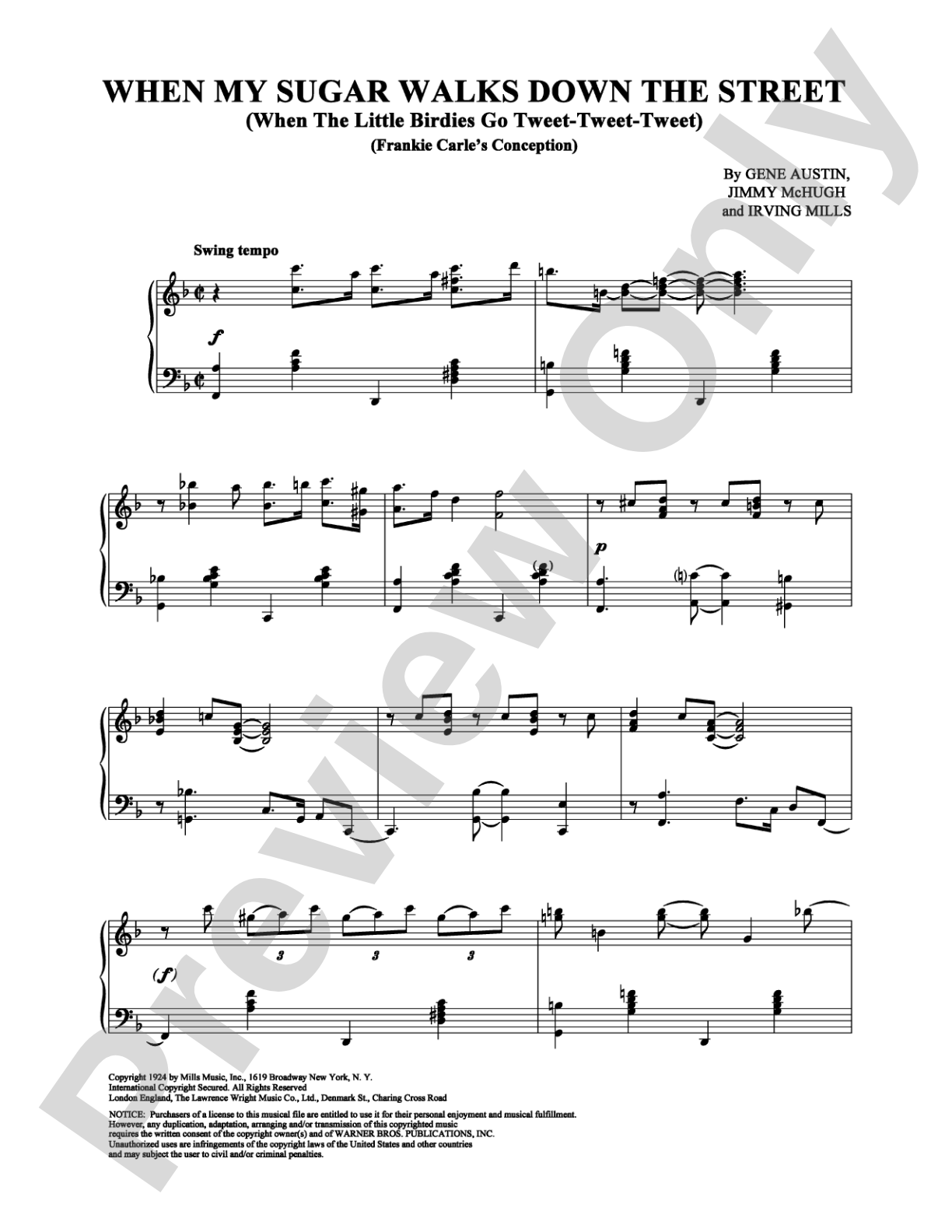
When My Sugar Walks Down the Street (When the Little Birdies Go Tweet - Tweet - Tweet): Piano Digital Sheet Music

When My Sugar Walks Down the Street (When the Little Birdies Go Tweet - Tweet - Tweet): Piano Digital Sheet Music

Irving Mills, Jimmy McHugh, Frankie Carle, Gene Austin

Item: 00-PS-0003586

Digital Download
$3.99
Description

When My Sugar Walks Down the Street (When the Little Birdies Go Tweet - Tweet - Tweet): Piano Digital Sheet Music isn't in MakeMusic Cloud just yet...but it could be. Let us know you'd like to see it, and you'll help shape what comes next. In the meantime, start a free trial and dive into thousands of interactive titles your students can play along with today.

Sample Audio
No sample audio found.
Sample Video
Additional Details
SKU: 00-PS-0003586

More about this title

About the Artist: Frankie Carle

Frankie Carle (1903, 1987) was a pianist and bandleader who became one of the most recognizable voices in American popular music during the 1940s and 1950s. His sophisticated touch at the keyboard and gift for arranging made him a fixture on radio and in recording studios, where he helped define the sound of the swing era's more refined, keyboard-forward side.

Carle's style bridged the gap between jazz improvisation and popular song interpretation. His recordings remain touchstones for pianists interested in the art of accompaniment, the craft of vocal support, and the particular rhythmic language of swing-era standards.

Why we love this

This standard sits at the sweet intersection of jazz idiom and popular song form, giving pianists a genuine taste of swing-era repertoire without the demands of bebop complexity. The melody is memorable enough to anchor a performance while the harmonic foundation rewards pianists who explore improvisation, walking bass lines, and rhythmic flexibility. It's a piece that sounds polished in a student recital but remains endlessly rewarding for more advanced players seeking authentic jazz material.

What to expect

Sunlit and propulsive, with the kind of rhythmic buoyancy that made 1940s dance floors irresistible. The melody tumbles forward with playful urgency, supported by harmonies warm enough to embrace but modern enough to suggest real jazz thinking underneath the accessibility.

Who it's for

This digital sheet music serves pianists comfortable with jazz standards and swing vocabulary who want a piece from the golden age of American popular music. Students exploring jazz piano beyond method-book exercises and adult learners returning to piano with an ear for classic repertoire will find this accessible and genuinely enjoyable.

How to get the most out of it

  • Shape the melody with a light touch; this tune breathes best when it's conversational rather than grandiose, so let phrasing guide dynamics more than volume.
  • Establish a steady swing feel in the left hand before adding complexity; a solid rhythmic foundation makes the tune's charm audible from the first phrase.
  • Experiment with voicing choices in the accompaniment, particularly how you voice the changes underneath the main theme, as this opens the door to personal interpretation.
  • Consider the interplay between written melody and harmonic improvisation; this era of jazz valued both clarity and spontaneity in equal measure.

How to use it

Program this in a jazz or standards recital where it anchors a set of swing-era favorites, or use it as a bridge piece in a concert mixing classical and popular repertoire. For students in piano studios, it offers a natural conversation starter about how jazz vocabulary entered mainstream American music and why that fusion still matters today.

Skills your students will build

  • Reading and executing swing rhythms and syncopation
  • Understanding jazz chord progressions and harmonic movement
  • Building left-hand independence through bass line and chord accompaniment
  • Developing interpretive choices within a lead sheet or arrangement
  • Phrasing and articulation choices that honor both melody and rhythm

You May Also Like