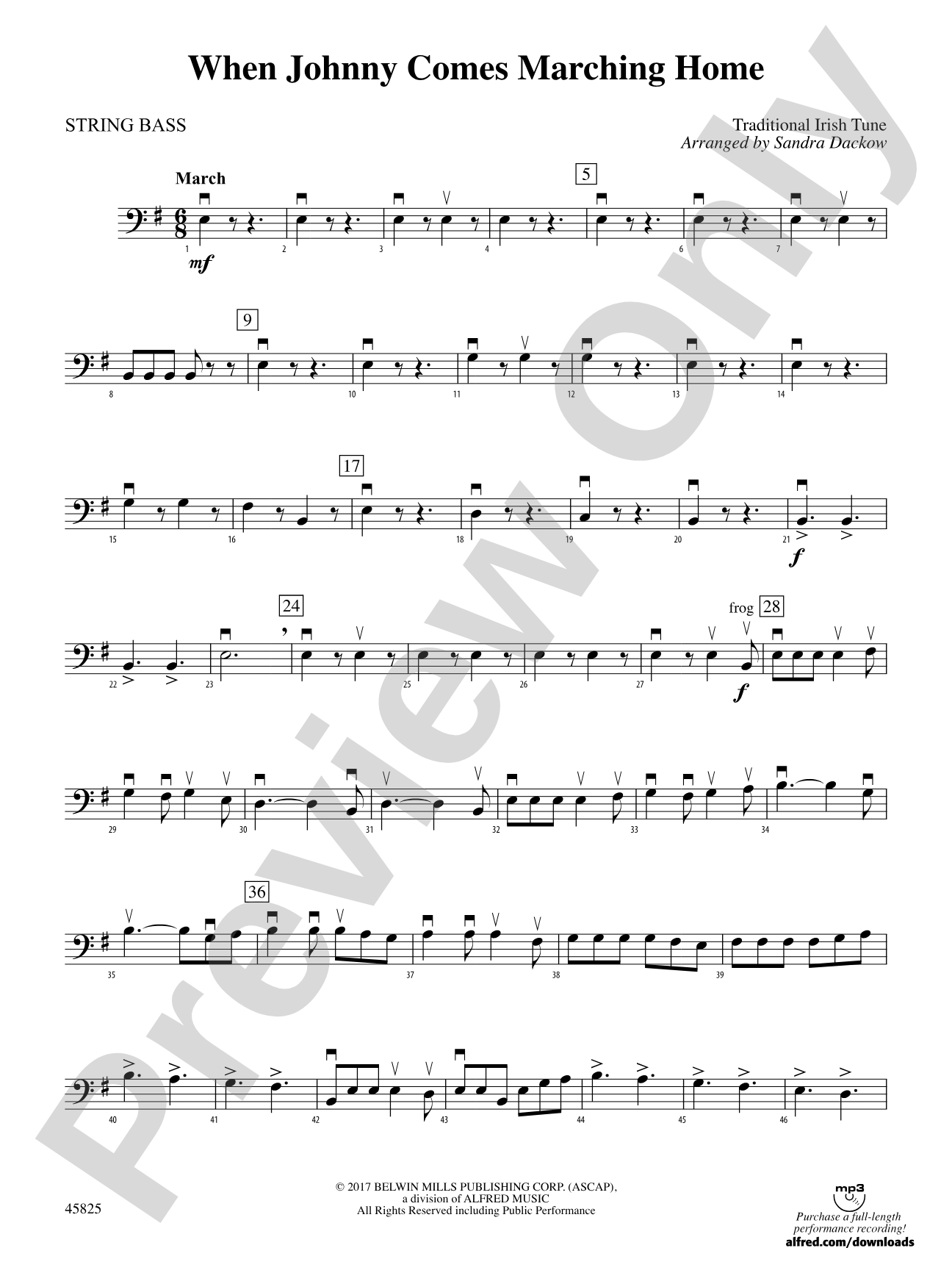
When Johnny Comes Marching Home: String Bass Sheet Music Preview

When Johnny Comes Marching Home: String Bass

Traditional Irish Tune / arr. Sandra Dackow

Grade: 2.5

Item: 00-PC-0017627_SB

Digital Download
$5.99
Description
An exciting arrangement by Sandra Dackow that students will love to play that remains in first position with strong eighth-note passages and great parts for all. This piece appears in the 1800s and is embraced as traditional folk music by both Ireland and the United States, where it is popularly known as When Johnny Comes Marching Home. The original words "Johnny I Hardly Knew Ye" are sung by the song's narrator, a young Irish woman who watched her loved one run away to soldier in a war far away. When he finally does return home to her and his child, he is broken, but she still takes him in and loves him. In more recent times the song has become, in some ways, an anti-war anthem. The American words of the song were popular with both the Confederate and Union Armies during the US Civil War. (1:30)

Don't just read it, hear it, play along with it, and watch your students grow with it. In MakeMusic Cloud, When Johnny Comes Marching Home: String Bass comes alive with professional accompaniment, adjustable tempo, and built-in practice tools that turn solo practice into real progress.

Sample Audio
0:00
0:00
Sample Video
Additional Details
Series: Orchestra Expressions
Publisher: Alfred Music
Page Count: 148
SKU: 00-PC-0017627_SB

More about this title

About the Arranger: Sandra Dackow

Sandra Dackow is a composer and arranger whose work focuses on making substantial, engaging music accessible to developing orchestras. Her arrangements balance musical integrity with practical pedagogy, ensuring that students encounter rich harmonic and rhythmic content without sacrificing playability at their level.

Why we love this

Dackow's treatment of this beloved tune gives it genuine orchestral weight while respecting the technical limits of Grade 2.5 players. The eighth-note passages are active and satisfying rather than tedious, and the part writing ensures that every section has something meaningful to contribute. This is the kind of folk arrangement that makes students feel like they're playing something real.

What to expect

The arrangement captures both the march-like energy of the tune and the bittersweet narrative beneath it. Bright, forward-moving, and anchored by strong rhythmic drive, yet capable of conveying the tender undertone of reunion and resilience that defines the original song.

Who it's for

String orchestras at the Grade 2.5 level who want to perform a piece with historical weight and emotional resonance. This works equally well for ensembles preparing for festival or contest settings and for those seeking substantial repertoire that connects students to folk traditions.

How to get the most out of it

  • Shape the eighth-note passages with clear articulation and consistent bow pressure; these figures carry the energy of the piece, so keep them buoyant and connected rather than choppy.
  • Balance the melody between first and second violins (or whichever voices carry it) so the tune sings through the accompaniment without drowning it out.
  • Use the 1:30 duration as a guide for pacing; maintain forward momentum through phrase connections, especially at the transitions between sections.
  • Since all players remain in first position, focus rehearsal energy on intonation and rhythmic precision rather than technical complications. These fundamentals will shine here.

How to use it

Program this as a centerpiece of a folk music or Americana concert, or pair it with other traditional arrangements to create a thematic set. Its moderate length and clear structure also make it ideal for festival competitions where you want a piece that sounds ambitious without requiring virtuosic technique.

Skills your students will build

  • First position intonation and consistent tone quality across the ensemble
  • Rhythmic precision in sustained eighth-note figurations
  • Balancing melody and accompaniment across multiple voices
  • Phrasing and interpretation within an arranged traditional melody
  • Reading conductor cues and coordinating entries across parts

You May Also Like