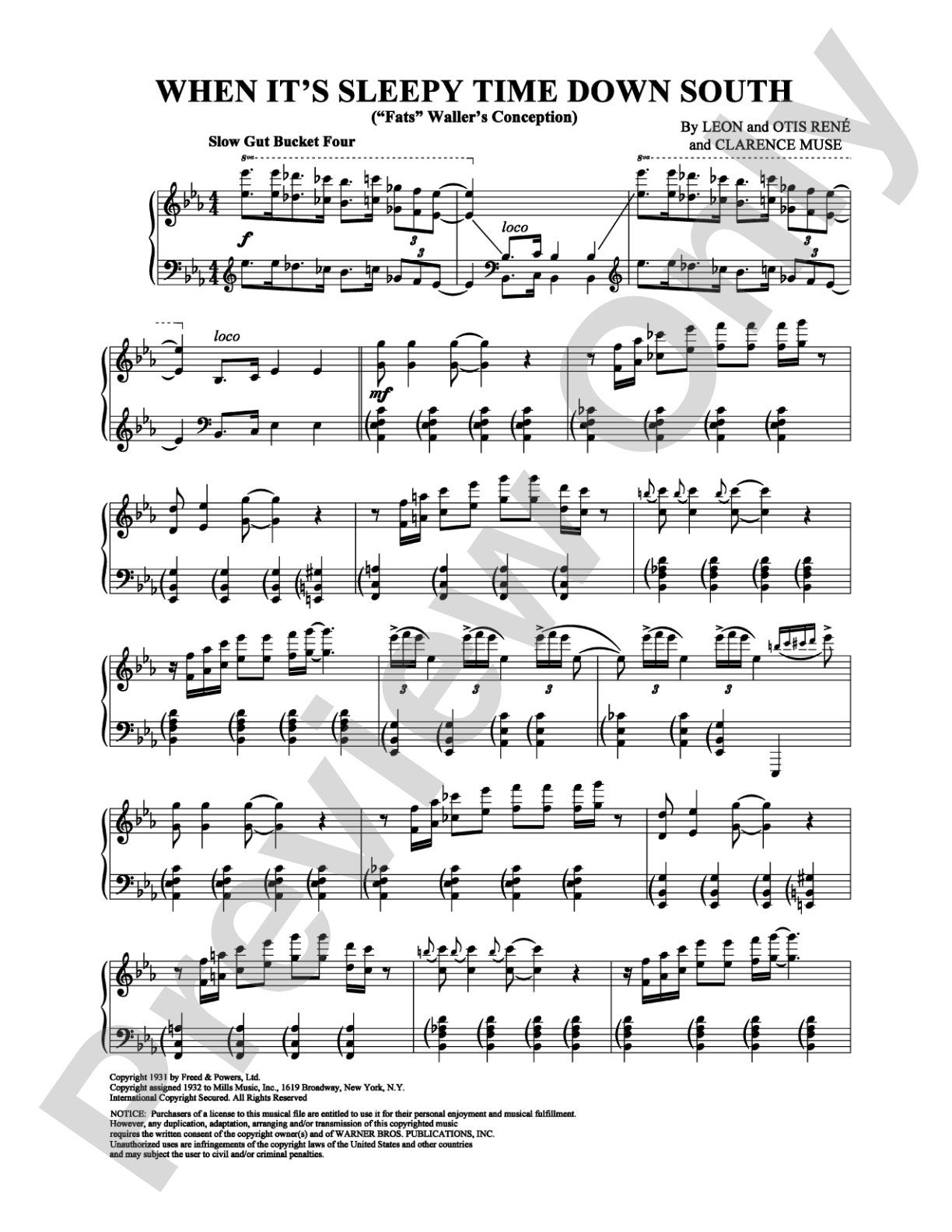
When It's Sleepy Time Down South (''Fats'' Waller's Conception): Piano Digital Sheet Music

When It's Sleepy Time Down South (''Fats'' Waller's Conception): Piano Digital Sheet Music

Leon Rene, Otis Rene, Clarence Muse

Item: 00-PS-0002537

Digital Download
$3.99
Description

When It's Sleepy Time Down South (''Fats'' Waller's Conception): Piano Digital Sheet Music isn't in MakeMusic Cloud just yet...but it could be. Let us know you'd like to see it, and you'll help shape what comes next. In the meantime, start a free trial and dive into thousands of interactive titles your students can play along with today.

Sample Audio
No sample audio found.
Sample Video
Additional Details
SKU: 00-PS-0002537

More about this title

About the Creator: Thomas "Fats" Waller

Thomas "Fats" Waller (1904-1943) was a pianist, organist, and composer who became one of jazz's most influential figures. His harmonic sophistication and stride piano technique set the standard for a generation of players, while his wit and showmanship made him a beloved entertainer on both stage and screen.

Waller's compositions, including "Ain't Misbehavin'" and "Honeysuckle Rose," remain standards in the jazz repertoire. His conception of "When It's Sleepy Time Down South" showcases his gift for reharmonization and his ability to reimagine familiar melodies with fresh harmonic and rhythmic ideas.

Why we love this

Waller's arrangement reveals how a master improviser approaches a standard. The reharmonization moves beyond predictable changes, offering students a masterclass in voice leading and jazz harmony. Pianists at intermediate levels and beyond gain insight into the craft of arrangement by studying how Waller respects the original melody while building something entirely his own.

What to expect

Warm, nostalgic, and gently swinging. The harmonic reharmonization creates surprising moments of richness beneath a melody that floats easily over the changes. There's an intimate quality, as though Waller is sharing a personal interpretation rather than playing for applause.

Who it's for

Jazz pianists ready to dig into the real conception of a standard, not a generic lead sheet version. Teachers can use this to show students how arrangement and improvisation intersect, and how a strong understanding of harmony opens doors to creative reinterpretation.

How to get the most out of it

  • Maintain the groove's relaxed swing feel; rushing through the rhythm undermines the piece's sleepy character and makes the harmonic sophistication disappear.
  • Voice the left hand comfortably within your reach. Waller's stride patterns are idiomatic to the piano, not transcriptions from horn writing.
  • Listen closely to the reharmonization and let your ear guide the balance between melody and accompaniment. Some changes land quietly; others need space to breathe.
  • Build the dynamics gradually across repeated sections rather than staying at one dynamic level throughout.

How to use it

Feature this in a jazz standards unit or use it as a solo piece in a jazz showcase. Pianists preparing for auditions benefit from studying it alongside other classic stride-based standards, as it demonstrates both technical facility and musical maturity.

Skills your students will build

  • Interpreting jazz reharmonization and understanding voice leading across extended harmonies
  • Stride piano technique and left-hand independence
  • Recognizing and executing swing feel and rubato in jazz context
  • Analyzing how melody and harmony interact in jazz arrangement

You May Also Like