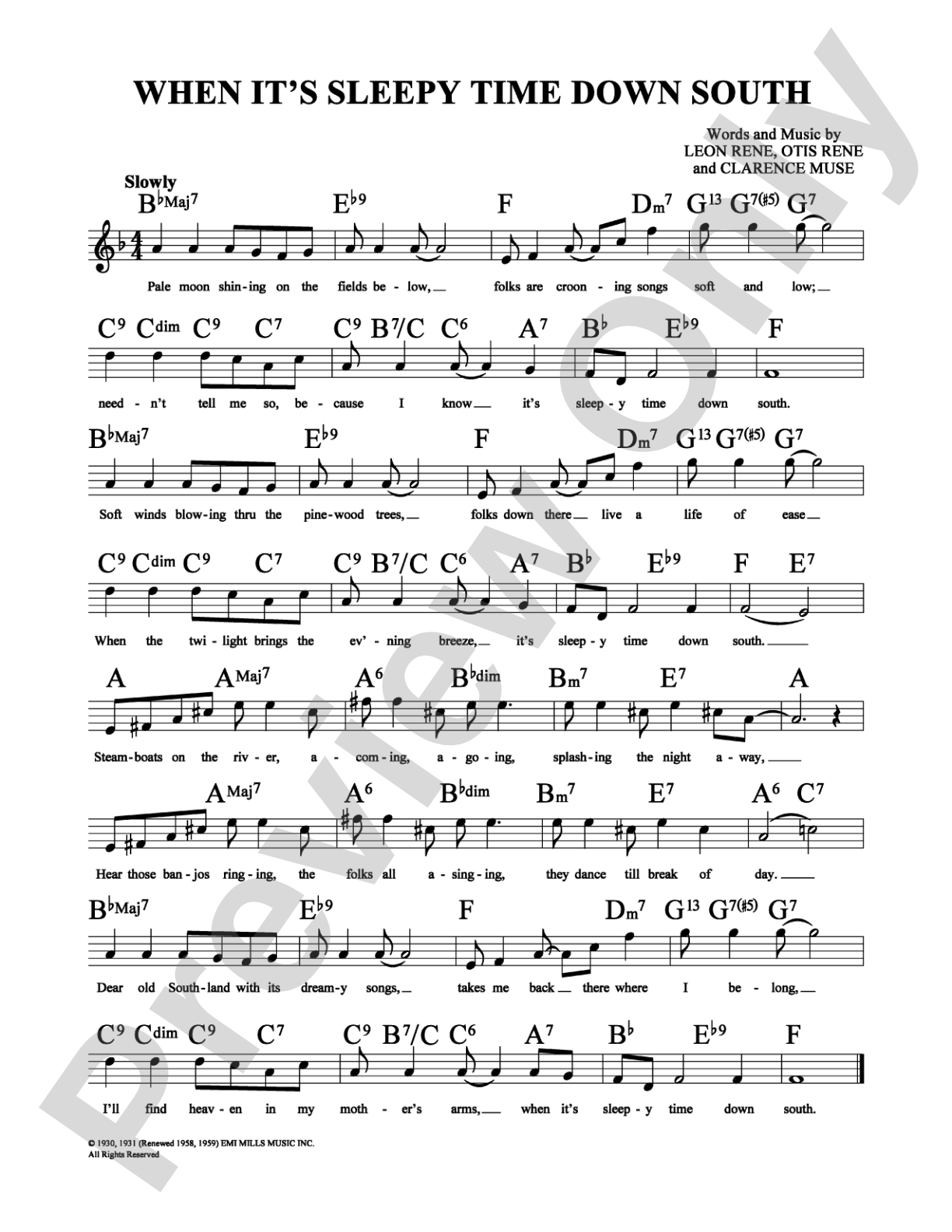
When It's Sleepy Time Down South: Lead Sheet Digital Sheet Music

When It's Sleepy Time Down South: Lead Sheet Digital Sheet Music

Louis Armstrong, Leon Rene, Otis Rene, Clarence Muse

Item: 00-PS-0002536

Digital Download
$1.99
Description

When It's Sleepy Time Down South: Lead Sheet Digital Sheet Music isn't in MakeMusic Cloud just yet...but it could be. Let us know you'd like to see it, and you'll help shape what comes next. In the meantime, start a free trial and dive into thousands of interactive titles your students can play along with today.

Sample Audio
No sample audio found.
Sample Video
Additional Details
SKU: 00-PS-0002536

More about this title

About the Artist: Louis Armstrong

Louis Armstrong (1901-1971) transformed jazz from a regional American music into a global language. His innovations on trumpet and his distinctive, warm voice established him as one of the most influential musicians of the twentieth century. Armstrong's approach to improvisation, phrasing, and rhythmic flexibility became the foundation for how musicians across all genres understand swing and feel.

Beyond his virtuosity, Armstrong was a master communicator. His interpretations of standards demonstrated how deeply a soloist could reshape a familiar melody while remaining true to its emotional core. For educators, Armstrong's recordings offer masterclasses in articulation, rhythmic placement, and the art of accompaniment.

Why we love this

This lead sheet captures one of jazz's most enduring melodies in a format that invites exploration and interpretation. The standard's straightforward harmonic structure makes it accessible for students learning to navigate jazz changes, while its cultural significance and melodic charm ensure that learners connect immediately with the material. Armstrong's own reading of this tune demonstrates how a deceptively simple melody can become profound through thoughtful phrasing and expression.

What to expect

Gentle and contemplative, with a nostalgic warmth that makes you think of a quiet evening settling into night. The melody unfolds with natural grace, inviting the performer to lean into its inherent softness and allow space for tenderness in every phrase. Despite its modest surface, the tune carries genuine emotion and the particular beauty of American songwriting from the early twentieth century.

Who it's for

Jazz ensemble musicians learning to read and interpret lead sheets, vocalists and instrumentalists exploring jazz standards, and educators seeking repertoire that connects students to foundational American music. The simplicity of the notation paired with the depth of the composition makes it suitable for intermediate students who are ready to move beyond head arrangements and engage with jazz interpreting traditions.

How to get the most out of it

  • Study Armstrong's original recording to hear how he phrases the melody. Notice where he anticipates beats, holds notes past their written values, and shapes phrases with dynamic shaping rather than playing mechanically.
  • Treat the lead sheet as a starting point, not a definitive statement. Sketch out your own melodic embellishments and interpret the rhythm with swing feel rather than straight subdivision.
  • Pay attention to the harmonic rhythm and the relationship between the melody and the underlying changes. Use the lead sheet to understand where the composition breathes and where tension and resolution occur.
  • Experiment with different instrumental voicings and tempos. The piece works equally well as a slower, introspective ballad or a moderately swung medium tempo piece.

How to use it

Feature this in a jazz showcase or standards concert as a vehicle for soloists to demonstrate their interpretation skills. Pairing it with other Armstrong recordings or related standards from the same era creates a coherent programming thread that helps audiences understand the development of jazz idiom. It also works beautifully as a teaching moment in ensemble rehearsals, where you can explore as a group how the same lead sheet generates different performances.

Skills your students will build

  • Reading and interpreting jazz lead sheets with chord symbols
  • Understanding swing feel and rhythmic flexibility in melody
  • Phrasing decisions and dynamic shaping in melodic performance
  • Harmonic awareness and the relationship between melody and changes
  • Style-appropriate articulation and expression in jazz contexts

You May Also Like