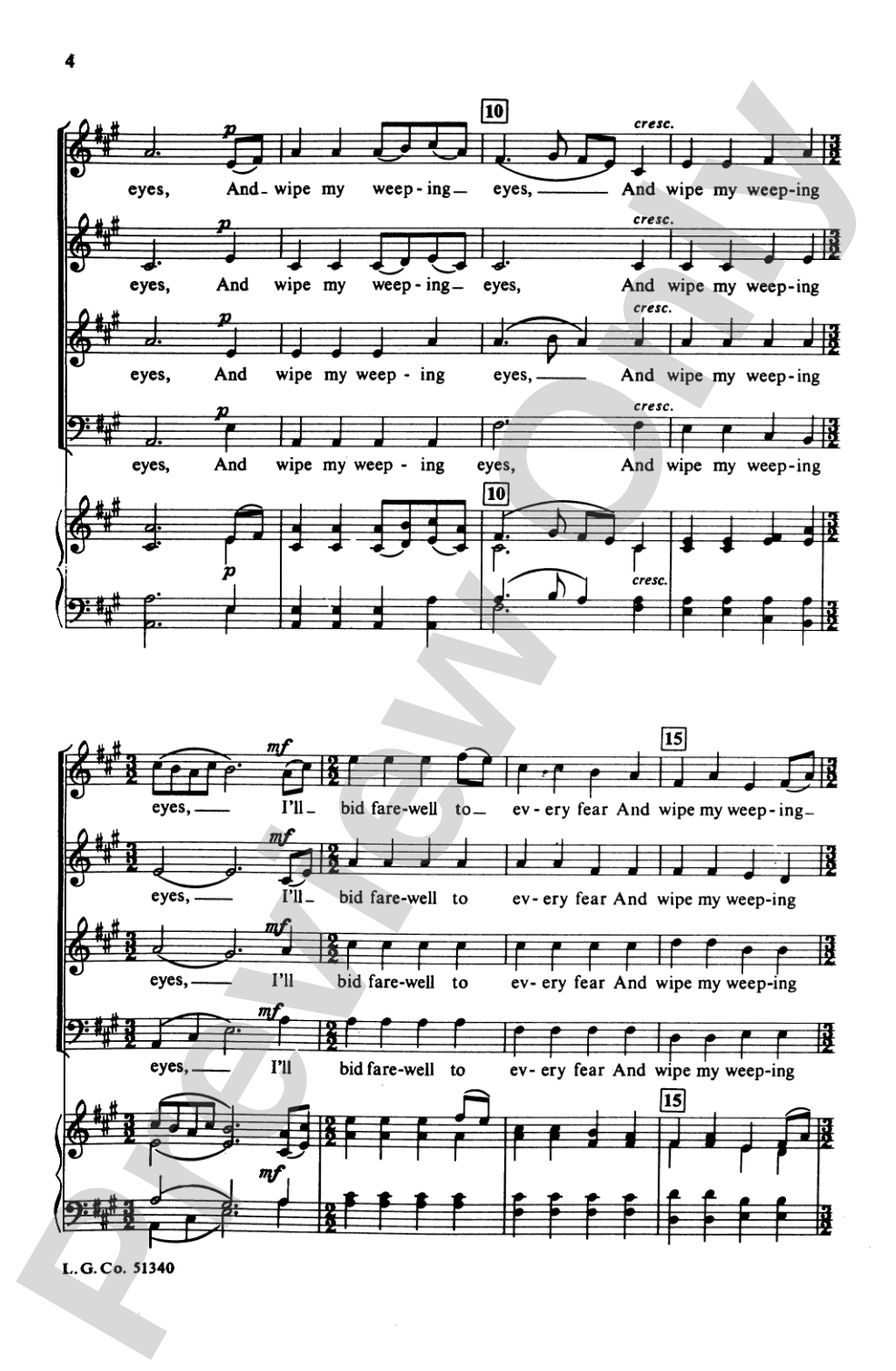
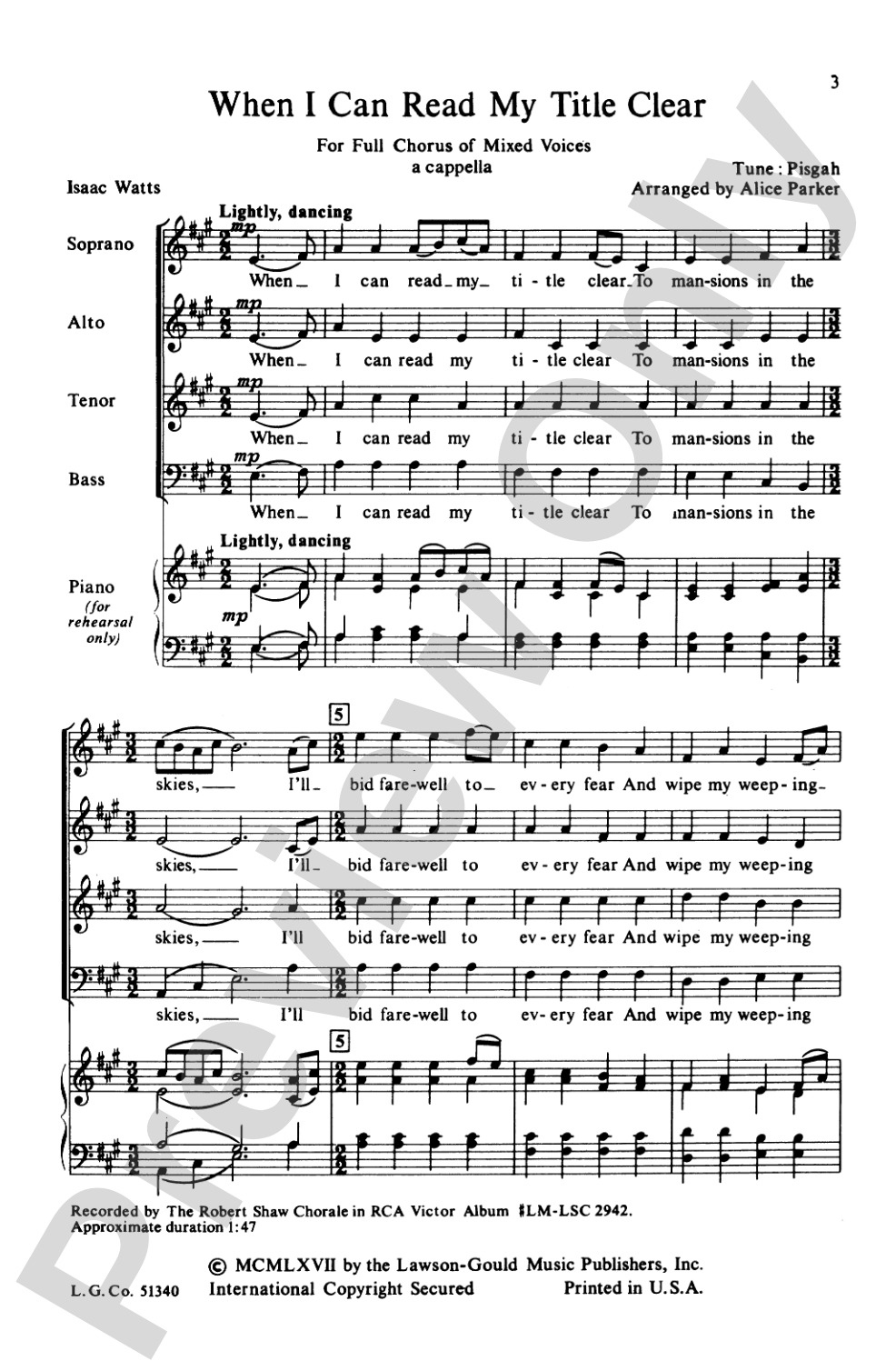
When I Can Read My Title Clear Sheet Music Preview

When I Can Read My Title Clear: SATB Choral Octavo

Arr. Alice Parker

Item: 00-PO-0002658

Digital Download
$2.25

Minimum order quantity: 20 copies

Description

When I Can Read My Title Clear: SATB Choral Octavo isn't in MakeMusic Cloud just yet...but it could be. Let us know you'd like to see it, and you'll help shape what comes next. In the meantime, start a free trial and dive into thousands of interactive titles your students can play along with today.

Sample Audio
No sample audio found.
Sample Video
Additional Details
Series: Alfred Archive Edition: Lawson-Gould Music Publishers
Publisher: Alfred Music
Page Count: 12
SKU: 00-PO-0002658

More about this title

About the Arranger: Alice Parker

Alice Parker

Alice Parker brought decades of experience in choral arranging, composition, and conducting to her work with American folksongs, hymns, and spirituals. Her partnership with Robert Shaw produced settings that have become standard repertoire for choirs worldwide, and her output spans more than five hundred published works across operas, cantatas, song cycles, and individual anthems. In 1985, Parker founded Melodious Accord, Inc., centering her scholarship and teaching on the relationship between melody and vocal music. She authored influential texts on melodic styles, choral improvisation, and church music practices, including the widely consulted "Melodious Accord: Good Singing in Church."

Parker's contributions to American choral music earned her recognition as Distinguished Composer of the Year by the American Guild of Organists, the Robert Shaw Award from the American Choral Directors Association, and fellowships from the Hymn Society and numerous major funding organizations. She received six honorary doctorates and served as the first Director Laureate of Chorus America, cementing her legacy as a leading voice in choral pedagogy and musical scholarship.

Why we love this

Parker's setting of this spiritual carries the integrity and singability that defined her life's work with American choral music. The SATB voicing balances accessibility with genuine harmonic substance, making it equally effective in community choruses and advanced ensembles. This is the kind of arrangement that sounds fresh each time you rehearse it because the melody always remains the musical center.

What to expect

This arrangement radiates quiet certainty, the kind of spiritual that settles into a listener's heart through honest melody and unadorned harmony. There is dignity here without sentimentality, and hope expressed through clear, direct musical language that invites congregational participation or concert-hall reflection.

Who it's for

This octavo works for any SATB choir seeking spirituals arranged with both musical substance and rehearsal-friendly clarity. Intermediate to advanced ensembles will find the harmonic language rewarding to shape, while developing choirs appreciate the straightforward notation and singable voice leading that Parker champions.

How to get the most out of it

  • Emphasize the natural phrasing of the text and melody rather than counting beats; Parker's harmonic movement often clarifies where breaths belong organically.
  • Shape each phrase from a point of arrival rather than working toward it; this lifts the spiritual's inherent hope and avoids a plodding approach to the harmonic progressions.
  • Let the homophonic sections breathe with clear articulation so the voice parts remain independent and distinct even when moving together.
  • Attend to any unison or octave doublings in the outer voices as moments to crystallize the melodic line before the harmony thickens again.

How to use it

Pair this with other spirituals or folk hymns for a focused programming thread, or use it as a standalone moment of peace within a larger concert. It works equally well in church services, festival performances, and community choral events where the spiritual tradition carries cultural and musical weight.

Skills your students will build

  • Singing sustained lines with consistent tone quality across phrase boundaries
  • Balancing independent voice parts in close harmonies
  • Understanding the spiritual tradition and its place in American choral repertoire
  • Interpreting text with restraint and authenticity

You May Also Like