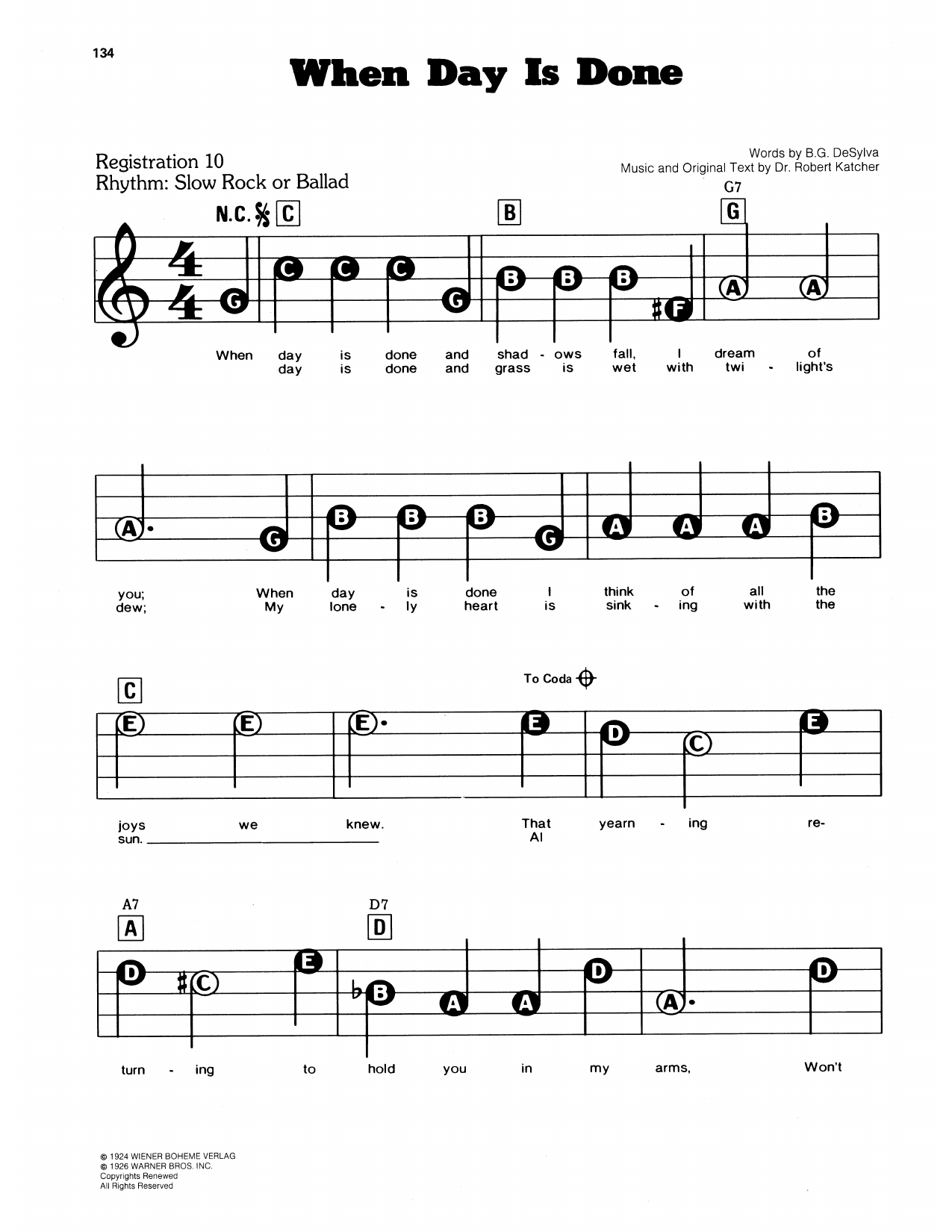
When Day Is Done Sheet Music Preview

When Day Is Done: E-Z Play Today

As performed by B.G. DeSylva

Item: 35-DS01873964

Digital Download
$4.99
Description

When Day Is Done: E-Z Play Today isn't in MakeMusic Cloud just yet...but it could be. Let us know you'd like to see it, and you'll help shape what comes next. In the meantime, start a free trial and dive into thousands of interactive titles your students can play along with today.

Sample Audio
No sample audio found.
Sample Video
Additional Details
Publisher: Hal Leonard
Page Count: 2
SKU: 35-DS01873964

More about this title

About the Artist: B.G. DeSylva

B.G. DeSylva was a prolific songwriter and lyricist who shaped American popular song during the 1920s and 1930s. His gift for crafting memorable melodies paired with clever, singable lyrics made him one of the most recorded composers of the era. Working across theater, film, and popular music, DeSylva created standards that remain staples of the jazz and popular music repertoire.

DeSylva's compositions bridge the worlds of Tin Pan Alley and early jazz, offering educators accessible material that teaches students about the harmonic language and melodic sensibility of the American songbook. His work remains relevant because it balances sophistication with approachability, making it ideal for intermediate pianists learning jazz phrasing and swing style.

Why we love this

This piece gives pianists a genuine taste of 1920s1930s jazz without requiring years of experience. The E-Z Play Today format strips away unnecessary complication while preserving the charm and harmonic interest that made DeSylva's songs endure, making it an efficient way to build jazz vocabulary and style awareness.

What to expect

Nostalgic warmth meets understated sophistication. The harmonic progressions evoke smoky jazz clubs and early radio broadcasts, with a melody that sits comfortably in the voice and invites interpretation. There is elegance here without pretension.

Who it's for

Intermediate pianists exploring jazz standards and popular songbook material. This arrangement works well for students who understand chord symbols and basic jazz phrasing, or as an introduction to swing style for classically trained players ready to branch out.

How to get the most out of it

  • Listen to vocal recordings of this standard to absorb the phrasing and rhythm feel before diving into the written arrangement. The vocal line often suggests how to shape the melody on piano.
  • Pay attention to swing eighth notes. Even when written straight, the jazz idiom calls for that characteristic lilt. Recordings will clarify the feel better than notation alone.
  • Keep the accompaniment light and conversational rather than heavy-handed. Jazz ballads breathe, so give yourself space to bend the tempo slightly and respond to the harmonic movement.
  • Experiment with voicing the chords closer to the melody. Jazz piano often thickens or reimagines the harmony, so this piece is an opportunity to learn how to comp underneath your own melody.

How to use it

Slot this into a casual jazz or popular music recital where you want to represent the American songbook without overwhelming your program with heavy arrangements. It also serves beautifully as a companion piece to other standards from the same era, creating a thematic concert set.

Skills your students will build

  • Reading chord symbols and realizing jazz harmony on keyboard
  • Swing eighth note rhythm and jazz phrasing
  • Accompanying a melody while maintaining groove
  • Navigating 32-bar song form common to American standards

You May Also Like