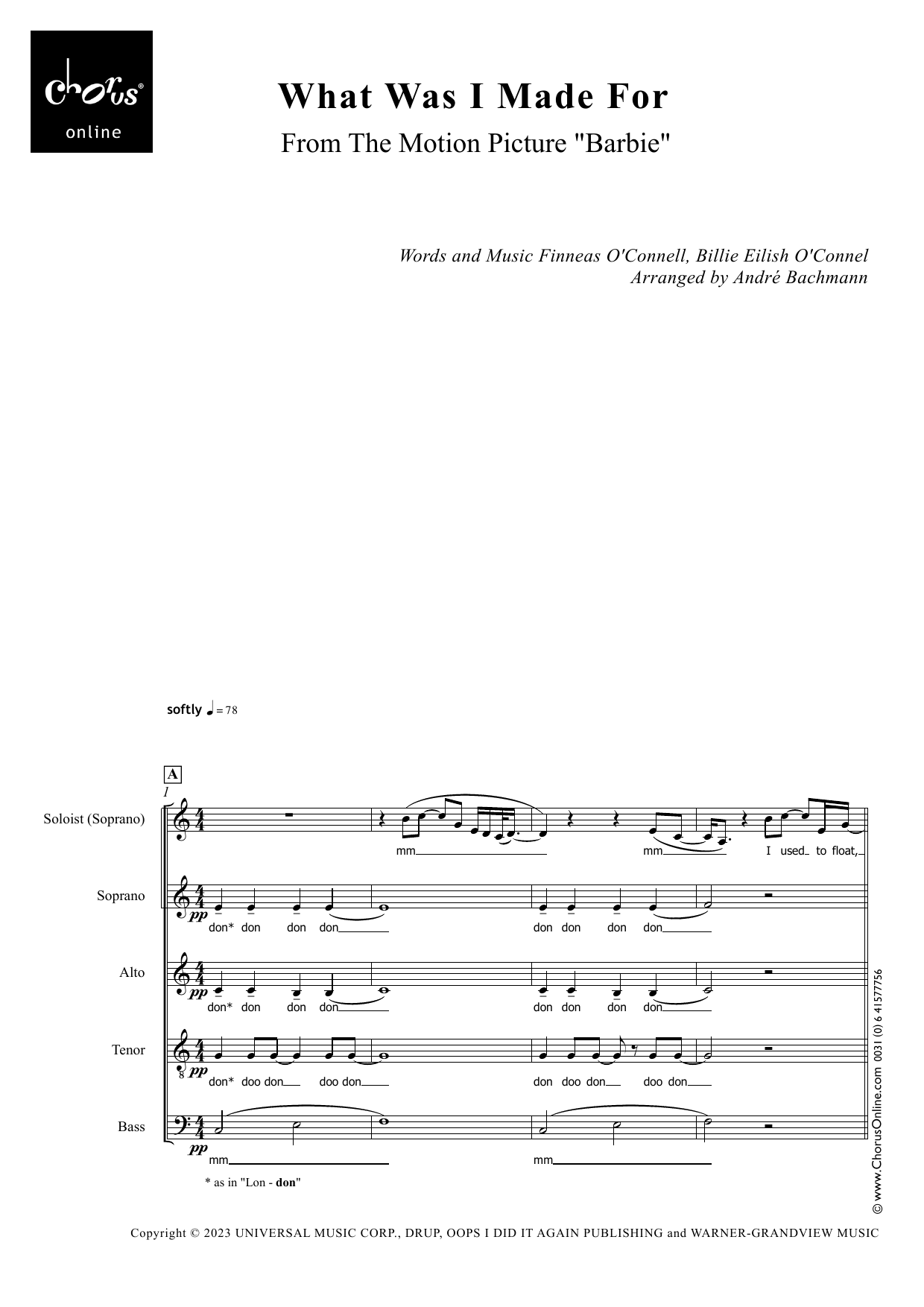
What Was I Made For? (arr. Andre Bachmann) Sheet Music Preview

What Was I Made For? (arr. Andre Bachmann): SATB Choral Octavo

As performed by Billie Eilish / Arranged by Andre Bachmann

Item: 35-DS01353346

Digital Download
$2.99
Description

What Was I Made For? (arr. Andre Bachmann): SATB Choral Octavo isn't in MakeMusic Cloud just yet...but it could be. Let us know you'd like to see it, and you'll help shape what comes next. In the meantime, start a free trial and dive into thousands of interactive titles your students can play along with today.

Sample Audio
No sample audio found.
Sample Video
Additional Details
Publisher: Hal Leonard
Page Count: 6
SKU: 35-DS01353346

More about this title

About the Artist: Billie Eilish

Billie Eilish emerged as one of the defining voices of her generation, known for her distinctive vocal timbre and introspective songwriting that blends intimate production with profound emotional depth. Her work has resonated across generations, proving that contemporary pop songwriting can carry genuine artistic substance and lyrical sophistication.

For music educators, Eilish's catalog offers an accessible entry point into arranging modern song material for choirs. Her melodies sit naturally for voices, and her lyrical themes invite meaningful interpretation from student performers.

Why we love this

Andre Bachmann's arrangement captures the vulnerability at the heart of this song while crafting it for genuine four-part writing. Your singers will connect immediately with material that speaks to their generation, and the SATB voicing distributes the melody across voice parts in ways that build musicianship rather than simply doubling the tune.

What to expect

The arrangement unfolds with quiet introspection, creating space for each voice part to be heard while honoring the reflective quality of the original. There's an intimacy here that demands focus and presence from every singer; the harmonies feel exposed and vulnerable in the most effective way.

Who it's for

Choirs seeking contemporary repertoire that doesn't compromise musicality will find this arrangement rewarding. It works equally well in secular concert settings, mixed ensembles at the intermediate level, and programs built around modern songwriting.

How to get the most out of it

  • Pay attention to dynamic control in the lower voices; this arrangement lives in the space between the parts, and tenors and basses need authority without overshadowing the soprano line.
  • Shape the phrasing across the entire phrase unit rather than measure to measure. The emotional arc of the lyric demands sustained, purposeful breath placement.
  • Balance blend over blend uniformity. This piece benefits from singers who listen across the ensemble for harmonic resonance, not singers who match vibrato or tone color.

How to use it

Consider this piece as a contemporary anchor for a concert exploring questions of identity and purpose. Pair it with classical or folk selections that share similar introspective territory, or use it to bookend a set that moves between traditional and modern voices. It also serves as a strong closer for concerts aimed at younger audiences or family settings.

Skills your students will build

  • Maintaining independence in four-part writing without doubling
  • Shaping longer melodic lines with intentional phrasing
  • Balancing harmonic blend across multiple voice parts
  • Performing contemporary music with artistic intention
  • Listening for vertical resonance rather than unison matching

You May Also Like