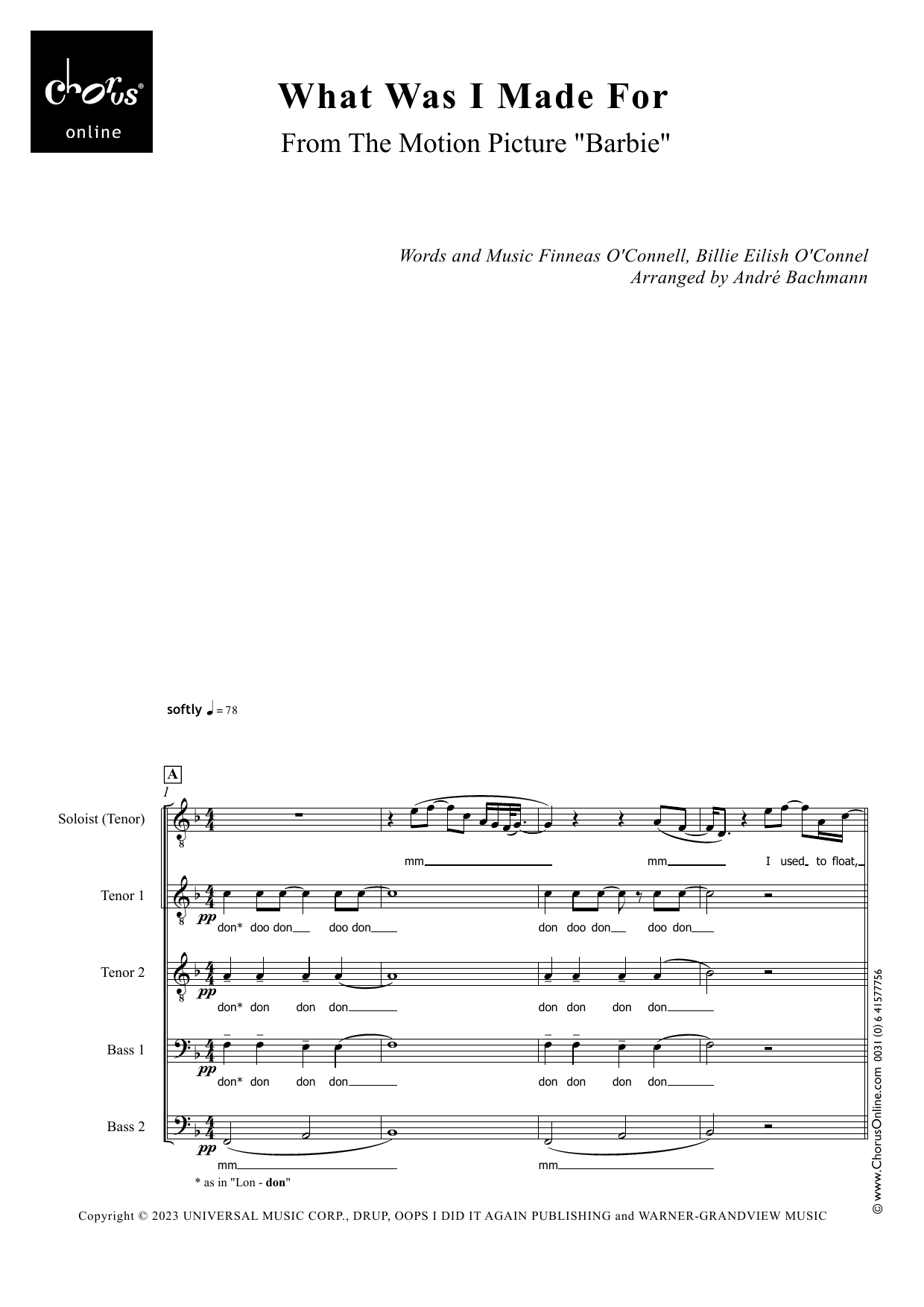
What Was I Made For? (arr. Andre Bachmann) Sheet Music Preview

What Was I Made For? (arr. Andre Bachmann): TTBB Choral Octavo

As performed by Billie Eilish / Arranged by Andre Bachmann

Item: 35-DS01353343

Digital Download
$2.99
Description

What Was I Made For? (arr. Andre Bachmann): TTBB Choral Octavo isn't in MakeMusic Cloud just yet...but it could be. Let us know you'd like to see it, and you'll help shape what comes next. In the meantime, start a free trial and dive into thousands of interactive titles your students can play along with today.

Sample Audio
No sample audio found.
Sample Video
Additional Details
Publisher: Hal Leonard
Page Count: 6
SKU: 35-DS01353343

More about this title

About the Artist: Billie Eilish

Billie Eilish emerged as a defining voice of her generation, known for her introspective lyrics and minimalist production aesthetic. Her work explores vulnerability and emotional depth, often delivered with a distinctive vocal intimacy that has resonated across demographics and influenced contemporary songwriting.

Why we love this

Bachmann's arrangement captures the contemplative essence of this song while creating genuine four-part writing that sits naturally in men's voices. The piece maintains the song's emotional weight without requiring impossible key placements, making it accessible for TTBB ensembles seeking modern repertoire with real substance.

What to expect

The piece settles into quiet introspection, with harmonies that shift subtly to reflect the song's emotional terrain. There's a conversational quality to the voicing that rewards close listening, drawing audiences into a moment of genuine reflection rather than spectacle.

Who it's for

TTBB choirs looking to program contemporary music that doesn't compromise on arranging quality. Ensembles will find this particularly valuable when reaching audiences younger than typical classical programming while maintaining artistic integrity.

How to get the most out of it

  • Balance the inner voices carefully during sustained harmonic sections; the arrangement's strength lies in its blend rather than showiness, so resist the urge to push any single part.
  • Pay attention to text clarity on repeated phrases, since contemporary songs often rely on rhythmic momentum to carry meaning. Slight rubato can actually enhance intimacy here rather than undermine it.
  • Record the part assignments separately during rehearsals so singers can solidify their lines while hearing the full harmonic context.

How to use it

This works exceptionally well as a closing number for concerts emphasizing emotional narrative or as part of a set exploring contemporary songwriting. It also pairs naturally with other modern pieces, helping bridge audiences who might not typically attend choral performances.

Skills your students will build

  • Sustaining long melodic lines without vibrato
  • Balancing four-part harmony in close voicing
  • Maintaining rhythmic precision while executing musical phrasing
  • Approaching contemporary music with vocal technique grounded in choral fundamentals

You May Also Like