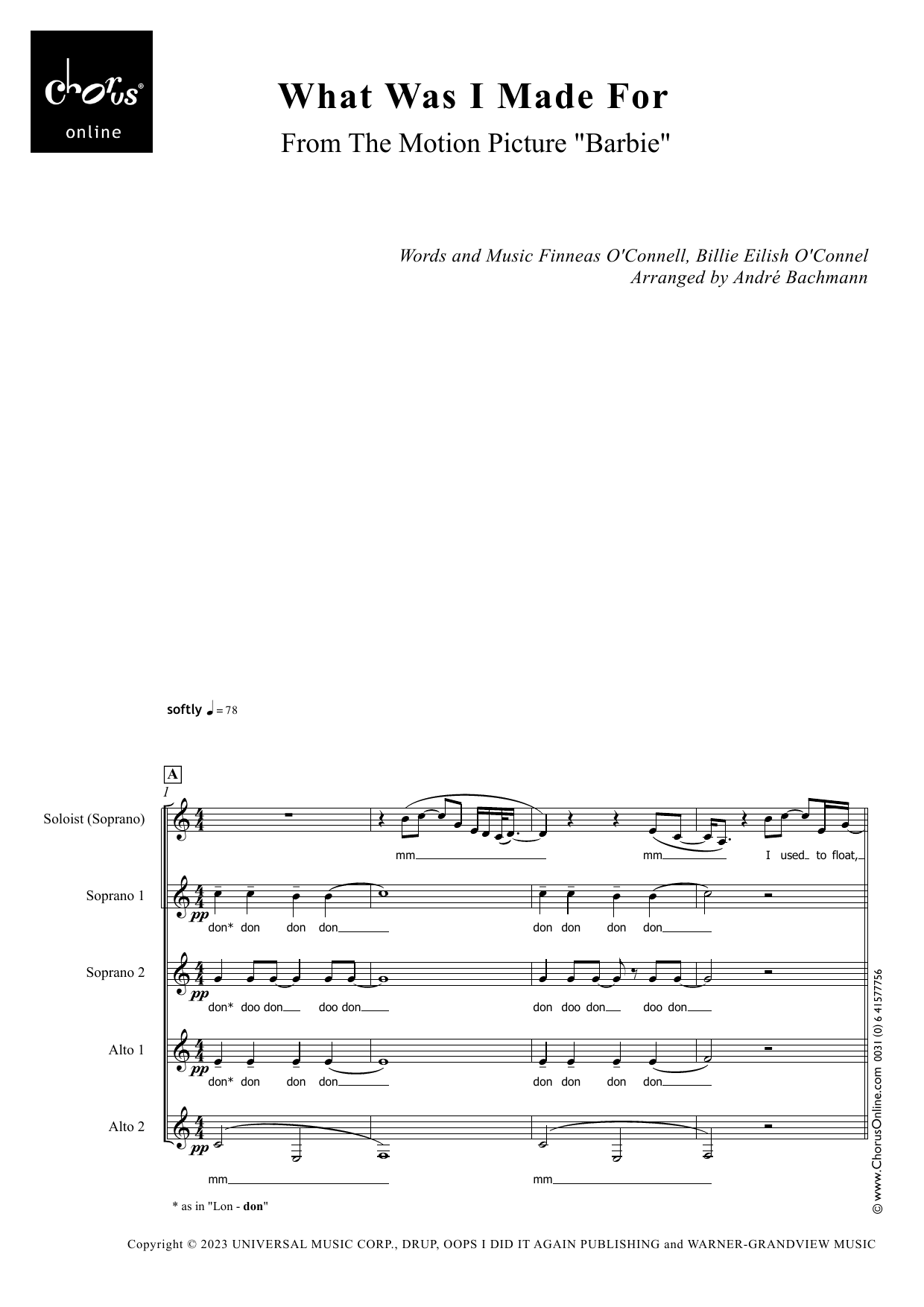
What Was I Made For? (arr. Andre Bachmann) Sheet Music Preview

What Was I Made For? (arr. Andre Bachmann): SSAA Choral Octavo

As performed by Billie Eilish / Arranged by Andre Bachmann

Item: 35-DS01353342

Digital Download
$2.99
Description

What Was I Made For? (arr. Andre Bachmann): SSAA Choral Octavo isn't in MakeMusic Cloud just yet...but it could be. Let us know you'd like to see it, and you'll help shape what comes next. In the meantime, start a free trial and dive into thousands of interactive titles your students can play along with today.

Sample Audio
No sample audio found.
Sample Video
Additional Details
Publisher: Hal Leonard
Page Count: 6
SKU: 35-DS01353342

More about this title

About the Artist: Billie Eilish

Billie Eilish emerged as a defining voice of her generation by writing and recording music that prioritizes emotional authenticity over production spectacle. Her minimalist approach to songwriting and her distinctive vocal delivery have resonated across age groups and musical backgrounds, making her catalog increasingly relevant for choral programs seeking contemporary repertoire that speaks to young singers.

Why we love this

Bachmann's arrangement respects the song's introspective vulnerability while giving it space to breathe in four-part harmony. The pop idiom paired with a cappella voicing creates a modern sound that feels accessible to singers without sacrificing musical depth, and the piece offers directors a way to program current music that their students actually care about singing.

What to expect

The song carries a quiet questioning, full of uncertainty and searching. Even in an a cappella setting, the harmonic movement supports the introspective mood, creating an intimate moment that draws the audience inward rather than commanding their attention through volume or spectacle.

Who it's for

This arrangement works well for intermediate to advanced high school and college choirs looking to expand their contemporary repertoire. It's ideal for programs that want to bridge the gap between traditional choral literature and music that resonates with younger singers.

How to get the most out of it

  • Lean into the restraint. The power of this song lives in what's not there. Avoid over-singing; clarity and simplicity serve the lyrical content better than lush harmonies.
  • Establish unison passages with intention. When voices align, let that moment feel deliberate rather than accidental, which emphasizes the moments where harmony enters.
  • Balance the melodic line carefully across the four parts. Since there's no instrumental accompaniment, the ear will travel to wherever there's movement, so coordinate with your section leaders about who carries the phrase.

How to use it

Consider this for a spring concert that mixes styles or as part of a set exploring contemporary songwriting. Its conversational tone and moderate length make it strong as a standalone piece or as a bridge between heavier classical works and lighter pop arrangements.

Skills your students will build

  • Sustaining tone with minimal vibrato for contemporary pop aesthetic
  • Blend and balance in four-part harmony without instrumental support
  • Lyrical interpretation in a minimalist musical context
  • Intonation in close harmonic intervals typical of a cappella writing

You May Also Like