
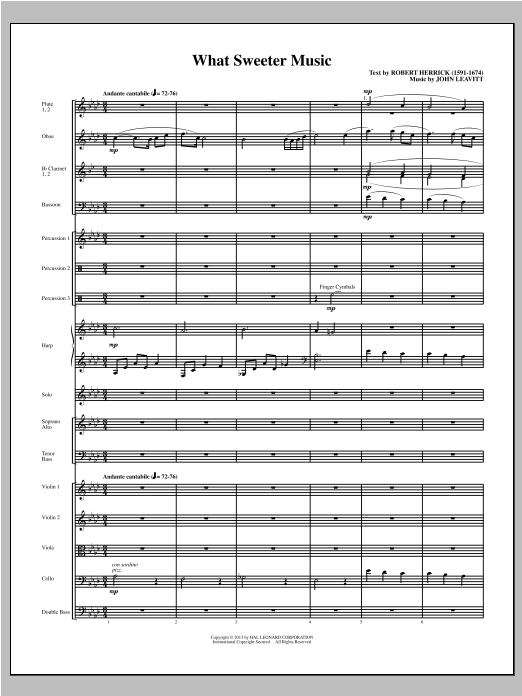

What Sweeter Music: Choral Instrumental Pak
Arranged by John Leavitt
Item: 35-PK00263839
$60.00
Pickup currently not available
Buy Extra Parts (Digital PDF Download)
Parts Added to Cart!
Description
The 17th century poem by Robert Herrick forms the basis for this lovely setting. The solo opening is taken up by the choir in a gently imitative way, followed by a contrasting middle section that reflects the imagery portrayed in the text. Finally, the music modulates and the rich choral textures bring the work to a fulfilling conclusion. Duration: ca. 3:45.


What Sweeter Music: Choral Instrumental Pak isn't in MakeMusic Cloud just yet...but it could be. Let us know you'd like to see it, and you'll help shape what comes next. In the meantime, start a free trial and dive into thousands of interactive titles your students can play along with today.
Request This Title
Tell us you want it.
Start Your Free Trial
Explore everything that's ready to play right now.
Sample Audio
No sample audio found.
Sample Video
No sample videos found.
Additional Details
Publisher:
Hal Leonard
SKU:
35-PK00263839
More about this title
About the Arranger: John Leavitt
John Leavitt has built a reputation as a composer and arranger who understands the voices he writes for. His work across choral, instrumental, and vocal jazz idioms demonstrates consistent skill at crafting singable lines with genuine musical substance. In the educational choral world, his arrangements are known for balancing accessibility with artistic integrity, making him a trusted name among directors seeking quality repertoire.
Why we love this
Leavitt's treatment of Herrick's text unfolds with architectural clarity: a solo premise, imitative choir response, and purposeful harmonic shift toward the ending create a sense of discovery rather than predictability. The chamber voicing keeps the work intimate while the modulation and textural richness at the close deliver genuine emotional weight, giving performers something substantial to shape despite the modest duration.
What to expect
This is meditative music that never settles into blandness. The opening solo carries introspection, the imitative choir writing builds gentle momentum, and the contrasting middle section opens outward before the final modulation brings warmth and completion. The overall effect is contemplative yet affirming, with a sense of unfolding rather than urgency.
Who it's for
Chamber choirs and select a cappella or semi-staged concert settings will find this work ideal. Directors with ensembles of 8 to 20 singers can program it without compromise, and the relatively brief duration makes it a natural choice for recital programming or as part of a thematic concert exploring 17th century poetry.
How to get the most out of it
- Establish the solo opening with a vocalist who can sing with clarity and restraint. The choir's imitative entrance should mirror that same focused tone before the texture expands.
- Pay close attention to the text underlay during the imitative section. Slight staggering of entries will emerge naturally if singers attend to vowel sounds and consonant placement rather than mechanical precision.
- Shape the contrasting middle section by responding directly to Herrick's imagery. Ask singers what the text is describing, then let that visualization inform their dynamic and tonal choices.
- Prepare the modulation deliberately. Mark the key change in rehearsal and hear it arriving as a brightening or deepening of color rather than a sudden shift.
How to use it
Pair this with other early poetry settings or period repertoire for a focused concert theme. Its moderate length and chamber scoring make it an excellent closer to a first half, or a transition piece between larger works. Consider it for a secular sacred music program or a spring concert focused on English choral traditions.
Skills your students will build
- Reading imitative choral writing and maintaining independence while responding to other voices
- Responding to text imagery to shape phrasing and dynamics
- Singing through key modulations with secure intonation and tonal continuity
- Balancing solo and ensemble sonorities within a single work