What's Up at the Symphony? (Bugs Bunny's Greatest Hits): Cello Sheet Music Preview

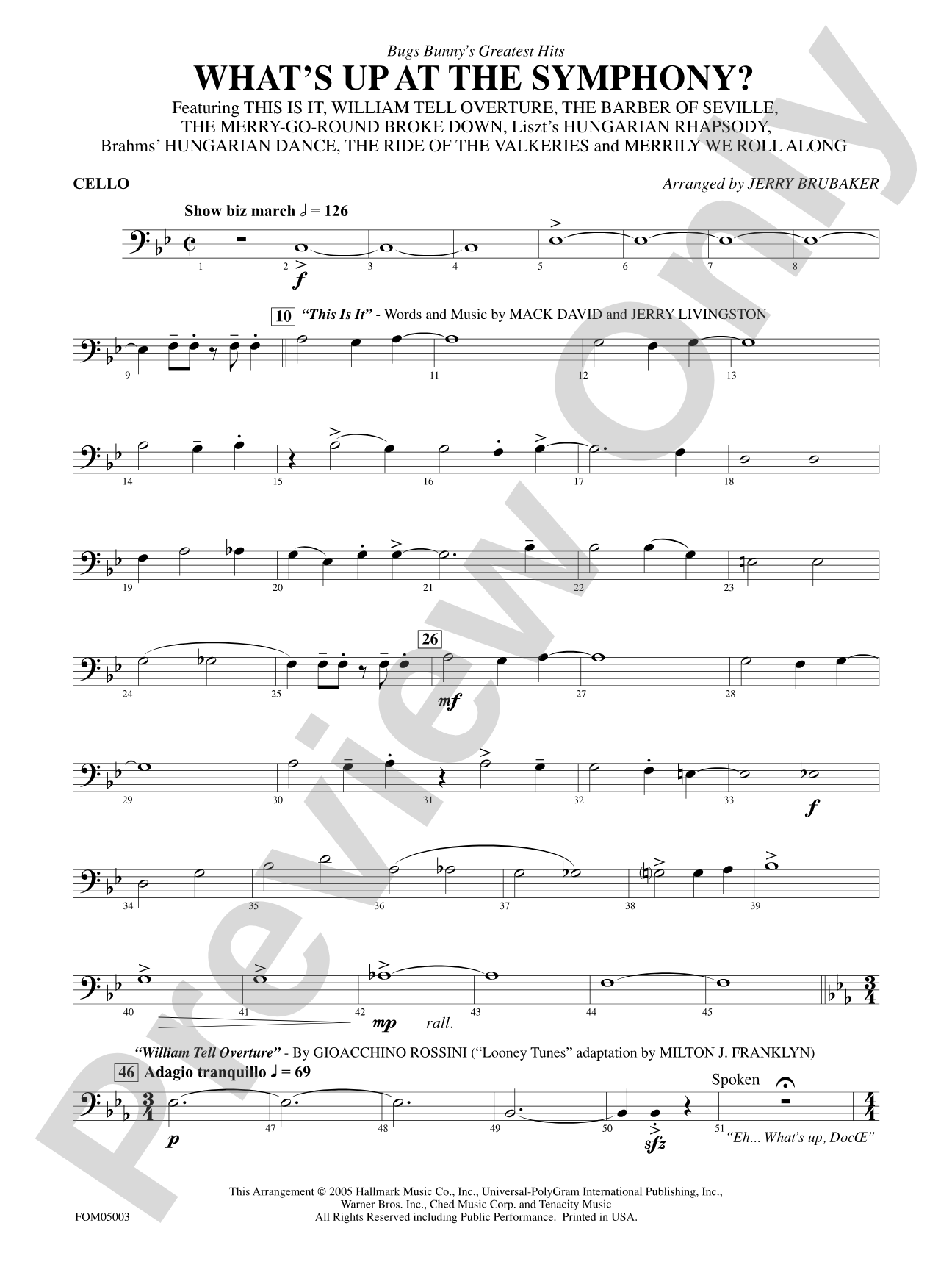
What's Up at the Symphony? (Bugs Bunny's Greatest Hits): Cello

Featuring: This Is It / William Tell Overture / The Barber of Seville / The Merry-Go-Round Broke Down / Liszt's "Hungarian Rhapsody" / and more

Arr. Jerry Brubaker

Grade: 3

Item: 00-PC-0016111_VC1

Digital Download
$3.00
Description
Bugs and Porky invite you to take part in this classical cartoon medley. All the greats are here: "This Is It," "William Tell," "Barber of Seville," "The Merry-Go-Round Broke Down," Liszt's "Hungarian Rhapsody," Brahms' "Hungarian Dance," and "Ride of the Valkeries." What's Up at the Symphony? includes every cartoon mood and effect you could expect. You've got to get up pretty early on Saturday morning to hear a medley better than this! (4:31)

Don't just read it, hear it, play along with it, and watch your students grow with it. In MakeMusic Cloud, What's Up at the Symphony? (Bugs Bunny's Greatest Hits): Cello comes alive with professional accompaniment, adjustable tempo, and built-in practice tools that turn solo practice into real progress.

Sample Audio
0:00
0:00
Sample Video
Additional Details
Series: Pop Concert Full Orchestra
Publisher: Alfred Music
Page Count: 296
SKU: 00-PC-0016111_VC1

More about this title

About the Arranger: Jerry Brubaker

Jerry Brubaker

Jerry Brubaker is an accomplished arranger and composer whose work focuses on creating accessible, engaging orchestral arrangements for educational and community ensembles. His arrangements are known for honoring the spirit of original works while reshaping them for practical performance at various ability levels.

Why we love this

This medley captures everything that made those Warner Bros. cartoons irresistible: precise comic timing, wildly contrasting moods, and orchestral color that lands every gag. Brubaker's arrangement respects both the source material and the realities of school orchestra, giving you genuine musical substance without sacrificing the fun that drew students to orchestra in the first place.

What to expect

Pure Saturday morning nostalgia wrapped in orchestral brilliance. You're stepping into a world where classical masterworks collide with cartoon hijinks, where a single pizzicato note or a sudden fortissimo cymbal crash becomes the punchline. The music tumbles from high energy to witty understatement and back again, keeping everyone (stage and audience) on their toes.

Who it's for

This works for middle and high school orchestras seeking a full-length concert closer that genuinely engages players and audiences alike. It's ideal when you want sophisticated orchestral writing without the heavy technical demands, and when the ensemble needs a project that generates real enthusiasm.

How to get the most out of it

  • Shape each section's entrance with clarity so the audience immediately recognizes the shift from one famous theme to the next; the transitions are part of the comedy.
  • Balance the theatrical character work across sections rather than letting any one group dominate; these cartoons succeeded because every instrument had a moment to shine.
  • Lean into the quirky percussion moments and sound effects cues as chances to build ensemble cohesion around shared musical storytelling.
  • Use tempo flexibility judiciously within each theme to honor the original cartoon's pacing, but lock the ensemble together before moving to the next section.

How to use it

Reserve this for the final third of a concert where it can land as a showstopper and send the audience out smiling. It pairs well with a more serious first half, offering a complete tonal and energy shift. At 4:31, it's substantial enough to earn its own program weight without overwhelming the rest of your set.

Skills your students will build

  • Coordinating rapid section transitions and cue recognition across a full orchestra
  • Balancing rhythmic clarity with theatrical expression in medley arrangements
  • Playing character and mood shifts within a single extended work
  • Responding to guest conductor cues and tempo flexibility while maintaining ensemble integrity

You May Also Like