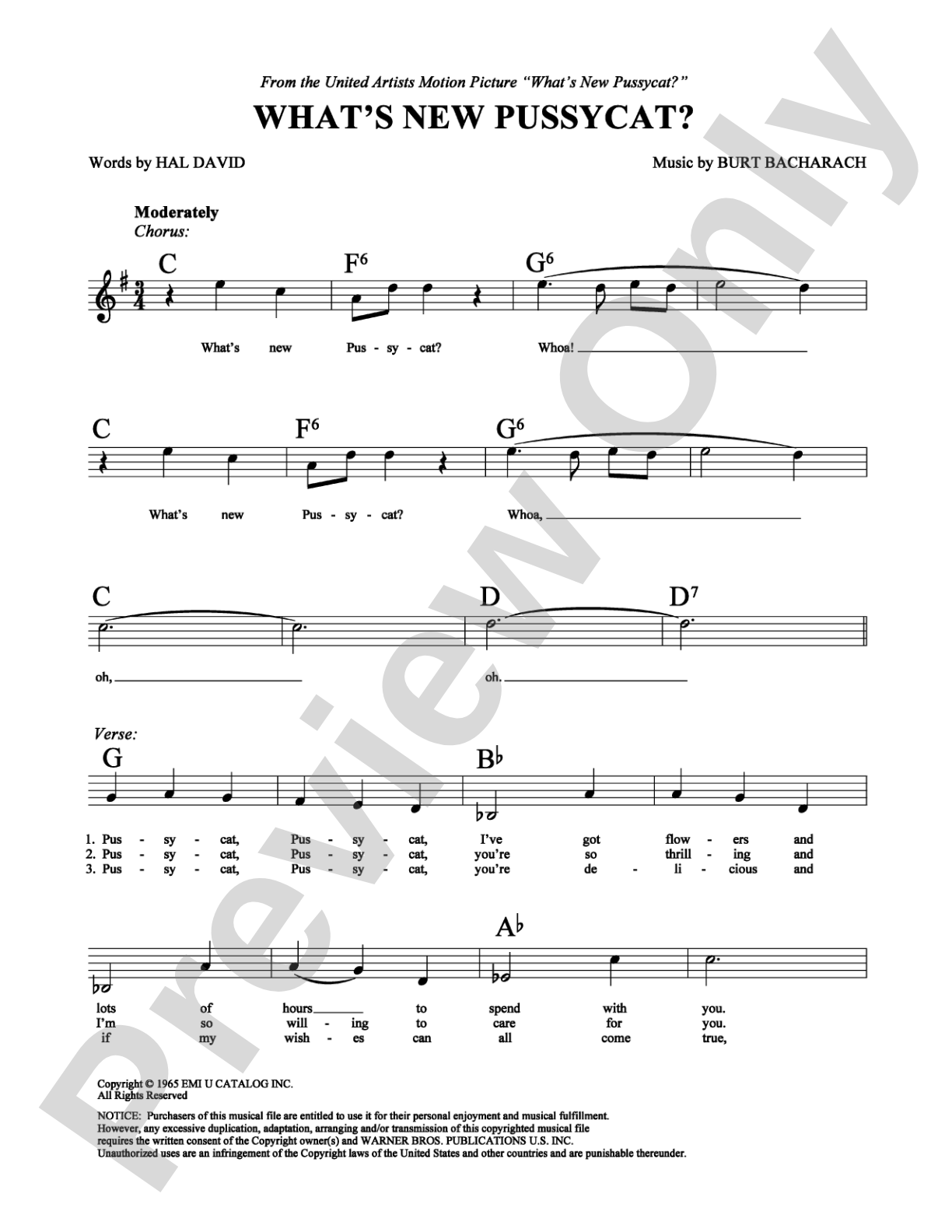
What's New Pussycat?: Lead Sheet Digital Sheet Music

What's New Pussycat?: Lead Sheet Digital Sheet Music

Burt Bacharach, Tom Jones Woodward

Item: 00-PS-0002763

Digital Download
$1.99
Description

What's New Pussycat?: Lead Sheet Digital Sheet Music isn't in MakeMusic Cloud just yet...but it could be. Let us know you'd like to see it, and you'll help shape what comes next. In the meantime, start a free trial and dive into thousands of interactive titles your students can play along with today.

Sample Audio
No sample audio found.
Sample Video
Additional Details
SKU: 00-PS-0002763

More about this title

About the Artist: Tom Jones Woodward

Tom Jones Woodward (born 1940) is a Welsh singer and actor who became an international pop icon in the 1960s with his distinctive baritone and charismatic stage presence. His recordings of standards and contemporary pop songs made him a fixture on both radio and television, earning him a devoted following across multiple generations and musical genres.

Why we love this

This lead sheet captures one of the era's most recognizable pop melodies in a format that invites reharmonization and reinterpretation. The straightforward melody and standard song form make it accessible for any musician or vocalist wanting to explore jazz voicings, swing treatments, or contemporary arrangements without getting bogged down in complex changes.

What to expect

Playful and assured, with an almost cocky ease that invites you to have fun with the tune rather than treat it reverently. The melody bounces with the kind of pop sensibility that feels instantly singable yet leaves room for genuine musical interpretation.

Who it's for

Jazz musicians and vocalists looking for accessible standards to arrange and perform. Band directors seeking pop repertoire that fits ensemble settings without heavy orchestration. Music students exploring melody and harmony in popular song.

How to get the most out of it

  • Establish the groove early. This tune thrives on rhythmic swagger, so lock in a clear sense of pulse before you add comping or melody flourishes.
  • Experiment with the melody's articulation. The original recording emphasizes particular note attacks; your lead sheet gives you freedom to phrase it differently while keeping the song's character intact.
  • Consider the harmonic possibilities. Lead sheets are maps, not destinations. Try adding extensions (9ths, 13ths) to basic chord changes to see what sounds fresh for your context.
  • Balance simplicity with personality. The melody is deceptively lean, which means every note choice and breath you make becomes audible. Make them intentional.

How to use it

Program this as part of a jazz or pop standards set where you can highlight different instrumental textures across pieces. It works equally well as a novelty opener or as an intermission moment that keeps audiences engaged without demanding their full attention.

Skills your students will build

  • Interpreting lead sheet notation and making harmonic choices
  • Phrasing melody with swing or contemporary feel
  • Balancing fidelity to a known tune with personal arrangement choices
  • Understanding song form and standard chord progressions in popular music

You May Also Like