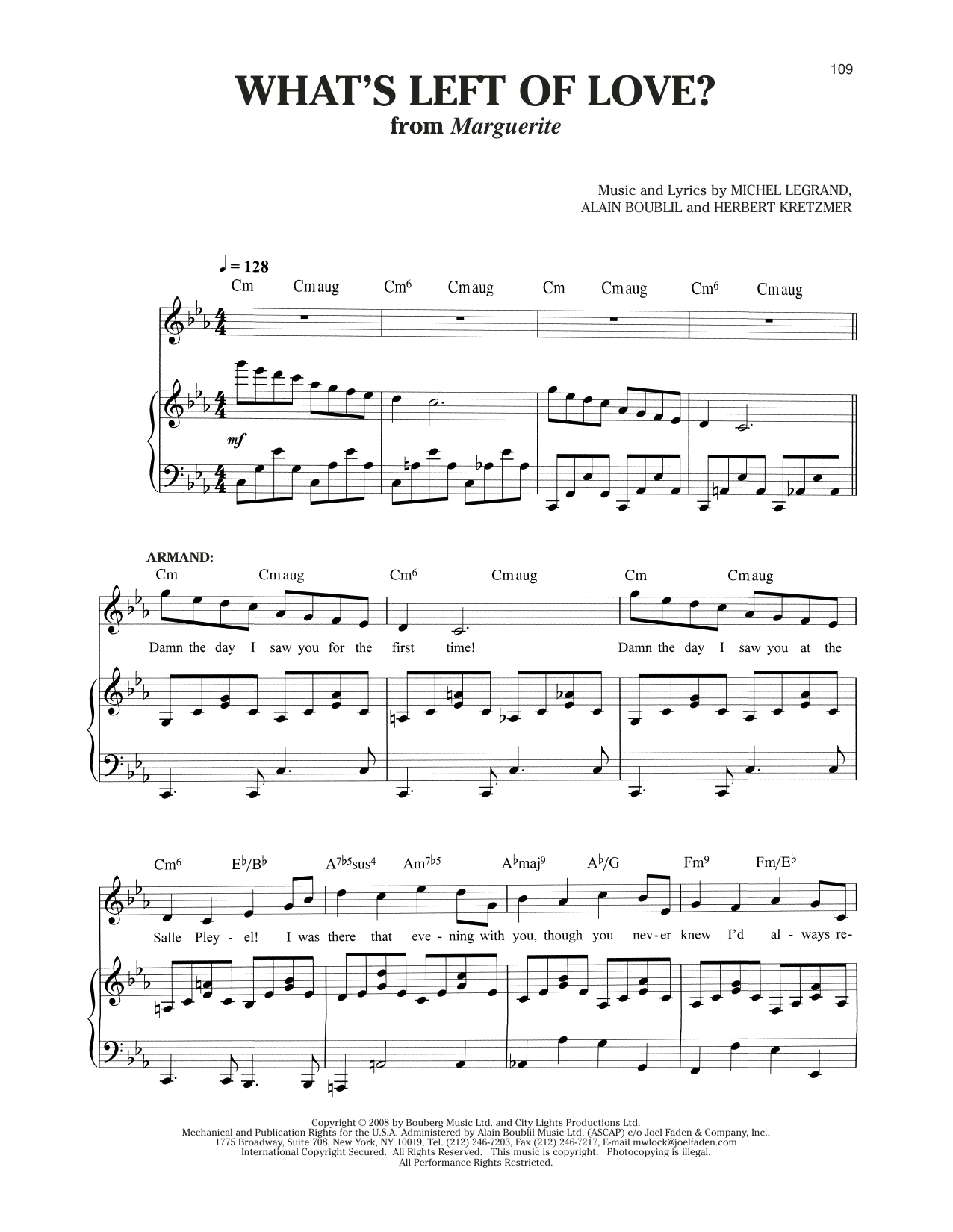
What's Left Of Love? (from Marguerite) Sheet Music Preview

What's Left Of Love? (from Marguerite): Piano Vocal

By Claude-Michel Schönberg / As performed by Michel LeGrand

Item: 35-DS01735385

Digital Download
$5.99
Description

What's Left Of Love? (from Marguerite): Piano Vocal isn't in MakeMusic Cloud just yet...but it could be. Let us know you'd like to see it, and you'll help shape what comes next. In the meantime, start a free trial and dive into thousands of interactive titles your students can play along with today.

Sample Audio
No sample audio found.
Sample Video
Additional Details
Publisher: Hal Leonard
Page Count: 5
SKU: 35-DS01735385

More about this title

About the Composer: Claude-Michel Schönberg

Claude-Michel Schönberg is a French composer whose work has shaped musical theatre for decades. He is best known as the composer of Les Misérables and Miss Saigon, two of the most performed musicals worldwide, and his gift for writing emotionally direct melodies has made his scores accessible to singers across skill levels while remaining dramatically sophisticated.

Schönberg's approach to songwriting emphasizes storytelling through melody. His compositions often sit comfortably for vocalists while maintaining the harmonic and structural depth that keeps musicians engaged. For educators, his music offers students the opportunity to work with genuine Broadway material that rewards both careful interpretation and honest emotional connection.

Why we love this

This is Schönberg in his element: a character-driven ballad that gives singers room to inhabit a moment rather than simply execute technique. The five-page length makes it accessible for voice students and audition preparation without oversizing rehearsal demands, and the emotional transparency of the writing means even younger singers can find something genuine to express.

What to expect

Introspective and tender without sentimentality. The song sits in a moment of reflection, with a vocal line that breathes naturally and piano writing that suggests rather than overwhelms. This is the sound of someone alone with their thoughts, music that trusts quiet intensity.

Who it's for

Voice students preparing audition material, singers in musical theatre ensembles, and any vocalist building a contemporary ballad repertoire. This works equally well for classical voice students seeking Broadway crossover material.

How to get the most out of it

  • Pay attention to the relationship between vocal line and piano part. The accompaniment often mirrors or anticipates the voice; letting these conversations shape your phrasing will deepen the musical storytelling.
  • Resist the urge to rush. This ballad lives in space and silence. The most powerful moments often come from what you don't fill.
  • Treat the lyrical content as a guide for vocal color and weight. The emotional arc of the text should inform how you shape vowels and manage breath rather than drive artificial dynamics.

How to use it

Pair this with other contemporary musical theatre songs in a concert focused on character-driven material, or use it as an audition selection for voice students exploring theatrical repertoire. It also works as a teaching tool for understanding how melody and accompaniment can create dramatic narrative.

Skills your students will build

  • Balancing emotional storytelling with technical vocal control
  • Interpreting dialogue-like exchanges between voice and accompaniment
  • Sustaining musical interest in a slow-tempo setting
  • Navigating contemporary Broadway diction and phrasing

You May Also Like