What Is Truth? Sheet Music Preview

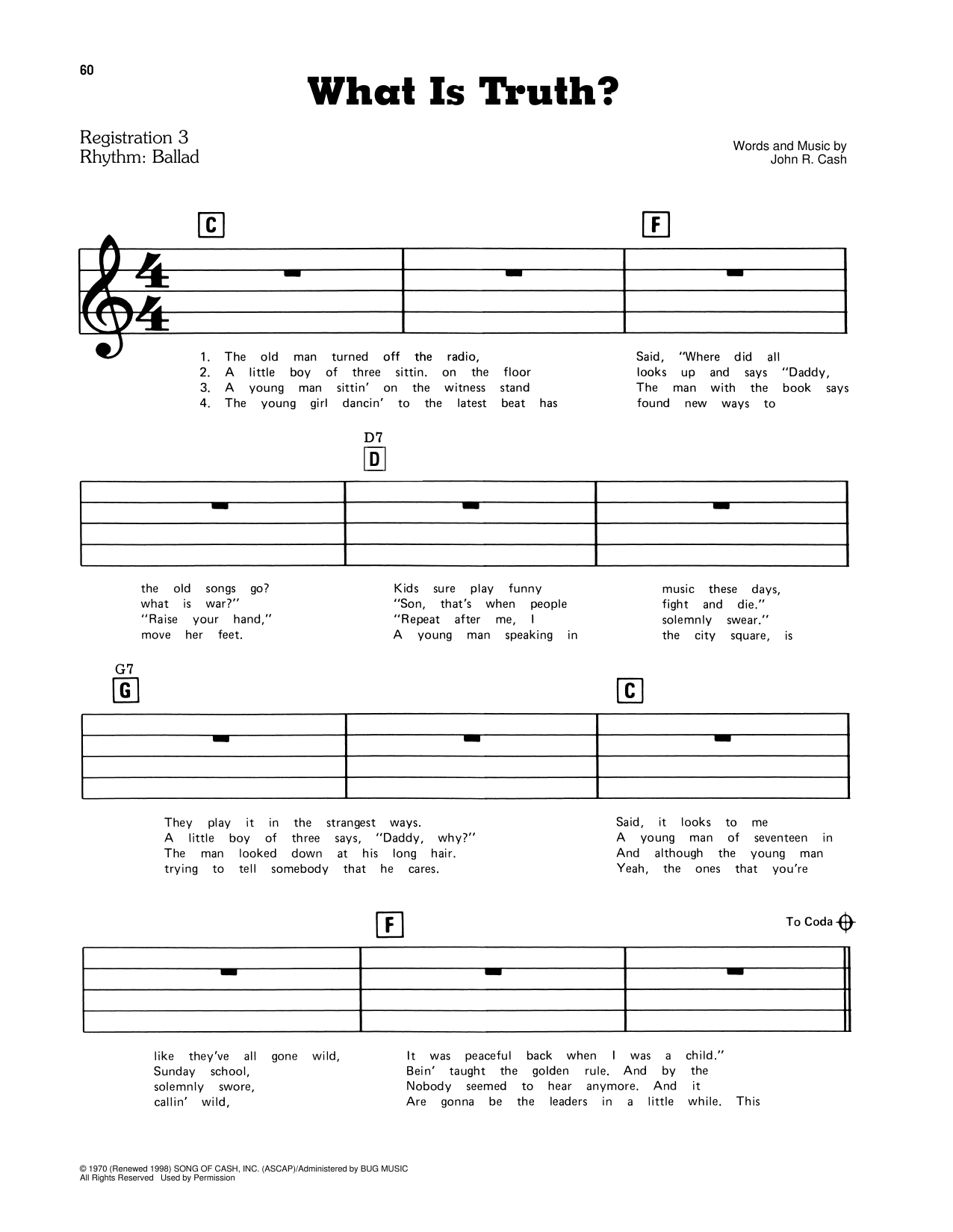
What Is Truth?: E-Z Play Today

As performed by Johnny Cash

Item: 35-DS00459819

Digital Download
$4.99
Description

What Is Truth?: E-Z Play Today isn't in MakeMusic Cloud just yet...but it could be. Let us know you'd like to see it, and you'll help shape what comes next. In the meantime, start a free trial and dive into thousands of interactive titles your students can play along with today.

Sample Audio
No sample audio found.
Sample Video
Additional Details
Publisher: Hal Leonard
Page Count: 3
SKU: 35-DS00459819

More about this title

About the Artist: Johnny Cash

Johnny Cash remains one of the most influential figures in American music history, known for his distinctive deep voice and unflinching songwriting that addressed social issues, personal struggle, and redemption. His career spanned six decades, and his crossover appeal made him a bridge between country, rock, and folk audiences. Cash's integrity as a songwriter and performer established a model for artists who refuse to compromise their artistic vision or values.

Why we love this

This arrangement brings Cash's straightforward, powerful songwriting into an accessible piano format without losing the song's spiritual weight. The three-page length keeps it manageable for intermediate pianists while preserving the message that made the original so memorable. Students get to experience how strong melodic writing and honest lyrics can carry a song across genres.

What to expect

Sturdy and grounded, with the kind of unadorned sincerity that Cash brought to everything he performed. The harmonic language is accessible but carries real weight, inviting performers to find depth in simplicity rather than complexity.

Who it's for

Piano students and teachers looking to explore country repertoire beyond traditional classical forms. This works well for students interested in songwriting, American music history, or who respond to music with direct lyrical content.

How to get the most out of it

  • Respect the straightforward melody by keeping embellishments minimal; Cash's strength was always clarity of expression
  • Pay attention to any dynamic markings that guide where the emotion swells and where it pulls back
  • Consider how the accompaniment pattern supports rather than decorates the vocal line

How to use it

Include this in a concert exploring American songwriters or pairing it with other country and folk arrangements to show students how diverse piano repertoire can be. It also serves as a great teaching tool for understanding how effective vocal melodies translate to instrumental arrangements.

Skills your students will build

  • Translating vocal melody to idiomatic piano writing
  • Balancing accompaniment with melodic prominence
  • Finding emotional authenticity in straightforward harmonic progressions
  • Interpreting country music styles on classical instruments

You May Also Like