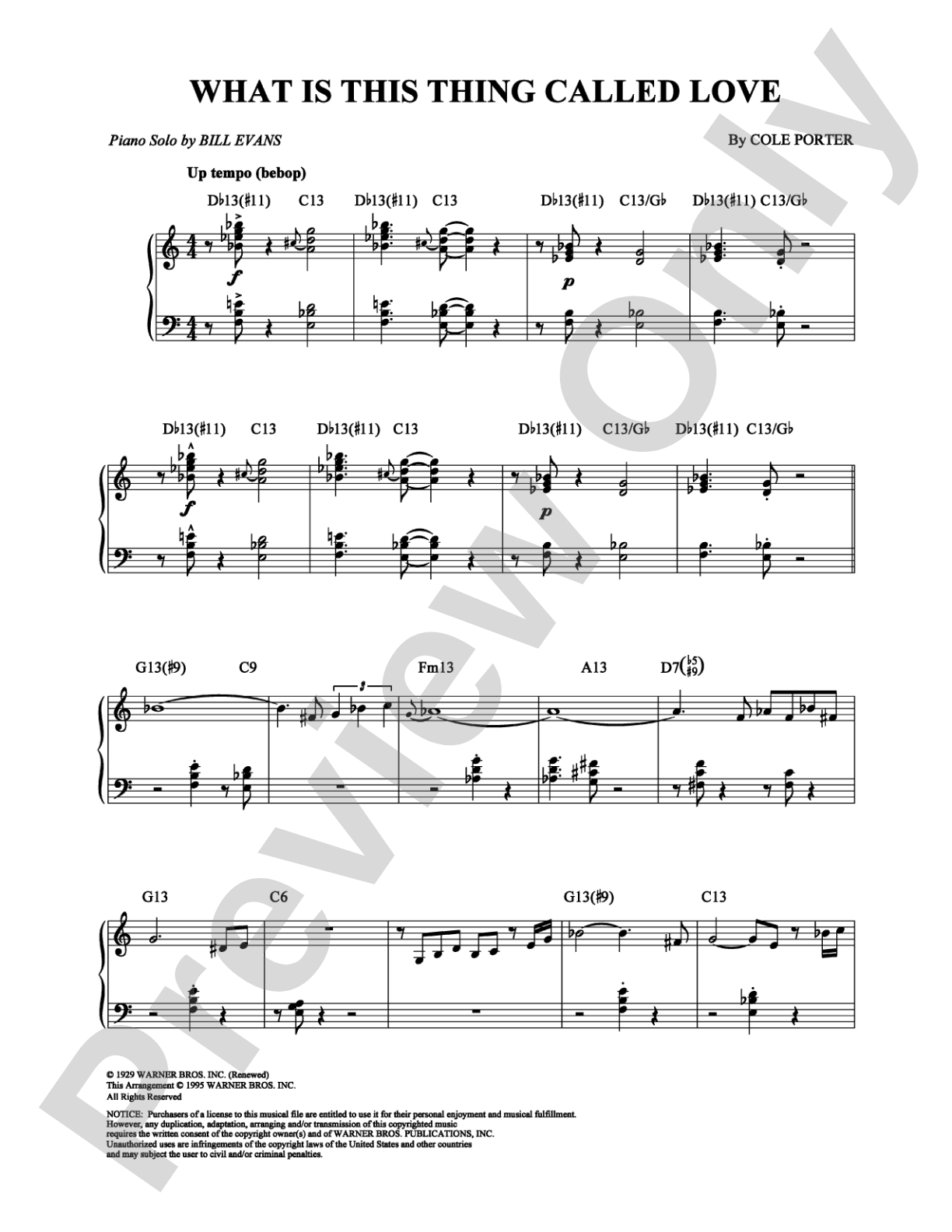
What Is This Thing Called Love: Piano Digital Sheet Music

What Is This Thing Called Love: Piano Digital Sheet Music

Cole Porter, Bill Evans

Item: 00-PS-0001942

Digital Download
$3.99
Description

What Is This Thing Called Love: Piano Digital Sheet Music isn't in MakeMusic Cloud just yet...but it could be. Let us know you'd like to see it, and you'll help shape what comes next. In the meantime, start a free trial and dive into thousands of interactive titles your students can play along with today.

Sample Audio
No sample audio found.
Sample Video
Additional Details
SKU: 00-PS-0001942

More about this title

About the Artist: Bill Evans

Bill Evans (1929-1980) was a pianist whose harmonic sophistication and lyrical touch fundamentally shaped modern jazz piano. His interpretations of jazz standards became touchstones for understanding how a classically trained musician could deepen the harmonic language of American song, moving far beyond comping to create conversation between soloist and accompaniment.

Why we love this

Evans's treatment of this Cole Porter standard reveals exactly why serious pianists study his work: the voicings are sophisticated without becoming precious, the phrasing breathes naturally through chromatic movement, and the harmonic reharmonization opens doors for your own improvisation without dictating a single path. This is a master class in how to honor a melody while transforming it entirely.

What to expect

Introspective and gently restless, Evans's version transforms this romantic standard into something more philosophical, dwelling in suspended chords and unexpected resolutions that feel both inevitable and surprising. The piano becomes a voice having a private conversation with itself, thoughtful and searching.

Who it's for

Jazz pianists expanding their harmonic vocabulary and serious students of jazz standards will find Evans's approach invaluable. Pianists preparing for jazz combo settings or looking to develop a more sophisticated improvisational language should spend time with his recordings and interpretations.

How to get the most out of it

  • Shape the melody with restraint; Evans rarely pounds a tune, so let silence and space carry as much weight as the notes themselves.
  • Study how Evans handles the chord extensions and altered dominants; they're not decoration but structural choices that shift the emotional weight of each phrase.
  • Listen closely to his touch and dynamic control in your own playing. A floating, almost introspective approach to the keyboard will unlock the intricate voicings he uses.

How to use it

Position this as a jazz recital or ensemble feature that showcases pianistic depth rather than flashiness. It pairs naturally with other Evans interpretations or as an elegant counterpoint to bebop-era or modal pieces in a jazz concert.

Skills your students will build

  • Harmonic reharmonization and extended jazz voicings
  • Phrasing and articulation in a lyrical jazz context
  • Listening and analysis of chord substitutions and voice leading
  • Developing touch sensitivity for subtle dynamic shaping

You May Also Like