
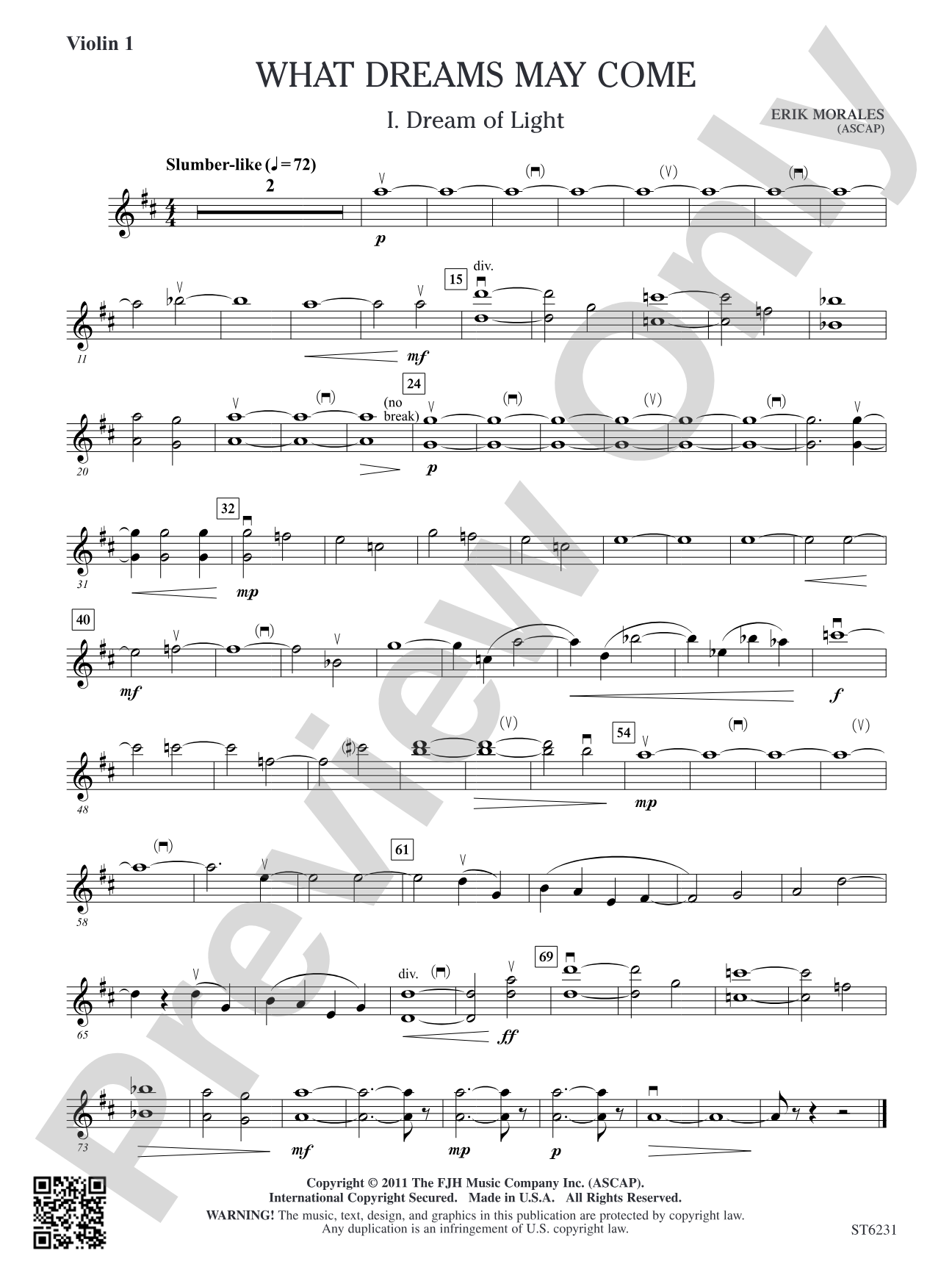

What Dreams May Come: Violin 1
By Erik Morales
Grade: 3
Item: 98-PC-DST6231_VN1
$7.00
Pickup currently not available
Description
Inspired by the famous Shakespeare soliloquy from the third act of Hamlet, this compelling two-movement work portrays a vast array of emotions. The first movement, Dream of Life, uses long phrases, slow harmonic movement, and lingering suspensions to portray a peaceful sleep. The second movement, Dream of Death, is aggressive and highly rhythmic. Beginning softly, the movement develops rhythmically and harmonically until the powerful final chord. Intense!


Don't just read it, hear it, play along with it, and watch your students grow with it. In MakeMusic Cloud, What Dreams May Come: Violin 1 comes alive with professional accompaniment, adjustable tempo, and built-in practice tools that turn solo practice into real progress.
Open in the Player
Jump straight in and assign it today.
Start Your Free Trial
Open this title and explore the full library in minutes.
Sample Audio
1
Audio File
--:--
0:00
0:00
Sample Video
No sample videos found.
Additional Details
Series:
FJH String Orchestra
Publisher:
The FJH Music Company, Inc.
SKU:
98-PC-DST6231_VN1
More about this title
About the Composer: Erik Morales

Erik Morales was born in New York City in 1966 and has become a prolific composer across classical, jazz, and commercial genres. His catalog exceeds 150 published works spanning wind ensembles, orchestras, jazz groups, and chamber settings, many of which have received performances internationally. He studied composition at Florida International University and earned his bachelor's degree from the University of Louisiana, Lafayette in 1989, beginning his professional composing career shortly after high school when a former band director commissioned him to arrange marching band music.
Morales has cultivated a distinctive approach to music education, consistently seeking balance between artistic merit and pedagogical value. His trumpet works have earned recognition at major competitions including first place finishes at the 2006 and 2008 National Trumpet Competitions, and his Concerto for Trumpet in C and Piano premiered at the 2009 International Trumpet Guild conference. In 2016, he was inducted into the Louisiana Association for Jazz Education's Hall of Fame. Schools and organizations across the country regularly commission new works from him, reflecting his reputation for creating music that resonates with both students and audiences.
Why we love this
Morales shapes two contrasting movements that grow organically from a single emotional premise, allowing your orchestra to explore both lyrical restraint and dramatic intensity within one cohesive program. The first movement's suspended harmonies and unhurried phrasing develop ensemble control and blend naturally, while the second movement's rhythmic drive and textural building demand ensemble precision and stamina. Few Grade 3 works offer this kind of emotional range without sacrificing playability.
What to expect
The first movement unfolds like drifting through a quiet dream, with suspended chords creating a gentle haze of sound that never quite settles. The second movement jolts awake with aggressive rhythmic energy, building from an intimate beginning into a forceful climax that lands with unmistakable power.
Who it's for
String orchestras at the intermediate level seeking a substantial two-movement work that explores emotional depth and compositional craft. This piece works well for groups ready to handle contrasting textures, sustained phrasing, and rhythmic complexity without excessive technical demands on individual players.
How to get the most out of it
- Let the first movement breathe. The long phrases and slow harmonic motion depend on sustained tone quality and deliberate phrasing choices from all sections. Resist the urge to rush the lingering suspensions.
- Shape the second movement's rhythmic development carefully. Mark the incremental dynamic and textural shifts in rehearsal so players understand where the music is building toward that final powerful chord.
- Balance transparency with weight in the opening of Dream of Death. It begins softly, which means precision intonation and rhythmic clarity matter even more than volume.
- Use the conductor score to identify thematic material in both movements, then rehearse those lines prominently in sectionals so the arc of each movement becomes clear to the orchestra.
How to use it
Program this as a concert centerpiece that demonstrates your orchestra's range from lyrical subtlety to dramatic impact. The two-movement structure and Shakespearean inspiration also make it suitable for chamber music festivals or concerts exploring philosophical themes in classical literature.
Skills your students will build
- Sustaining long phrases with consistent tone and intonation
- Navigating suspended harmonic movement and delayed resolutions
- Building rhythmic intensity and ensemble synchronization across a developing climax
- Controlling dynamics across a wide range, from soft passages requiring precision to powerful full-orchestra moments
- Balancing individual part responsibility with sectional blend in texturally complex writing