
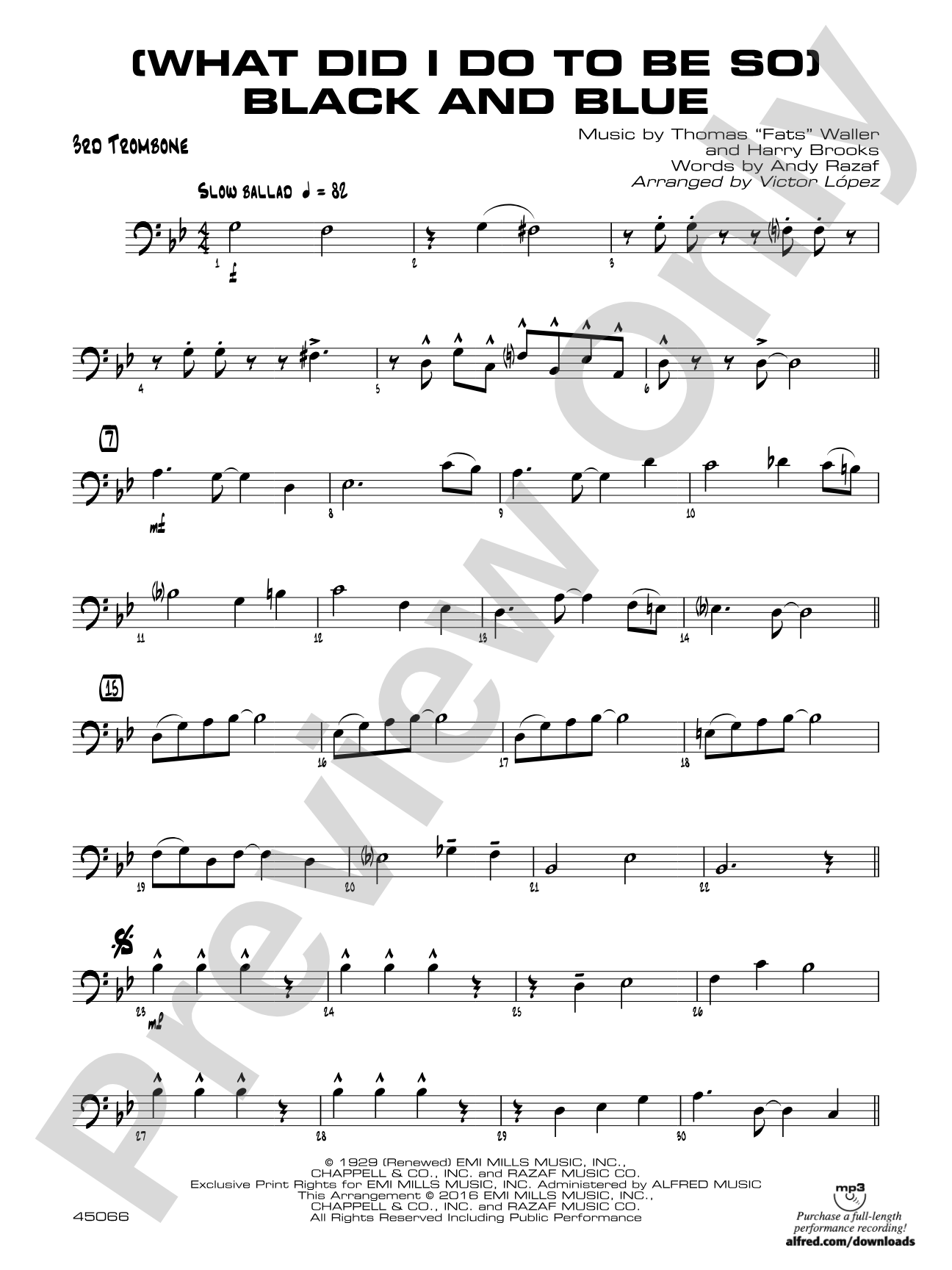

(What Did I Do to Be So) Black and Blue: 3rd Trombone
Music by Thomas "Fats" Waller and Harry Brooks / arr. Victor López
Grade: 1 (Easy)
Item: 00-PC-0017475_TN3
$3.00
Pickup currently not available
Description
"(What Did I Do to Be So) Black and Blue" arranged by Victor López is a beautiful ballad, and very playable by a young jazz group. The tempo is around 82 BPM with a straight-eighth ballad feel, smooth and lyrical melodic lines, modest brass range, no individual solos, and all the usual optional parts plus flute, clarinet, and vibes. (3:41)


Don't just read it, hear it, play along with it, and watch your students grow with it. In MakeMusic Cloud, (What Did I Do to Be So) Black and Blue: 3rd Trombone comes alive with professional accompaniment, adjustable tempo, and built-in practice tools that turn solo practice into real progress.
Open in the Player
Jump straight in and assign it today.
Start Your Free Trial
Open this title and explore the full library in minutes.
Sample Audio
1
Audio File
--:--
0:00
0:00
Sample Video
Additional Details
Series:
First Year Charts for Jazz Ensemble
Publisher:
Alfred Music
Page Count:
86
SKU:
00-PC-0017475_TN3
More about this title
About the Composer: Thomas "Fats" Waller
Thomas "Fats" Waller (1904-1943) was a virtuoso pianist, organist, and composer who became one of jazz's most influential figures during the swing era. His prolific output shaped the sound of 1920s and 1930s jazz, blending stride piano technique with sophisticated harmonies and an infectious sense of swing. Beyond his instrumental mastery, Waller composed hundreds of songs that became jazz standards, many written in collaboration with lyricist Harry Brooks and other partners.
Waller's compositions remain central to the jazz repertoire because they combine technical interest with emotional directness and accessibility. His melodies are singable and memorable, his harmonies reward close listening, and his rhythmic sensibility translates across ensembles and skill levels. Even decades after his death, his work continues to engage students and professional musicians alike, making him an essential voice in teaching jazz history and style.
Why we love this
Victor López's arrangement captures what makes this standard enduring: a lyrical, unhurried melody that sits comfortably in young players' ranges, supported by warm harmonic movement that gives the ensemble real musical substance without overwhelming them technically. The ballad feel at a modest tempo allows players to focus on tone quality and phrasing rather than speed, and the absence of featured solos means everyone contributes equally to the collective sound. This is the kind of piece that teaches musicianship through simplicity.
What to expect
A gentle, introspective ballad that asks the ensemble to listen to itself and play with restraint. The straight-eighth feel and moderate tempo create an intimate space where each section hears the others clearly, and the simple harmonic movement underneath gives the melody room to sing. There's dignity in the quietness here.
Who it's for
First-year jazz ensemble students and directors seeking a Grade 1 ballad that builds solid musicianship fundamentals without steep technical demands. Players with modest range, limited solo experience, or those new to jazz style find this especially rewarding because it prioritizes ensemble blend and lyrical playing over virtuosity.
How to get the most out of it
- Shape the melodic line with consistent vibrato and lean slightly into phrase endings rather than pushing the tempo. A straight-eighth ballad should breathe, not rush.
- Balance the vibes and rhythm section carefully; they anchor the groove but should never overshadow the melody. Rehearse them separately first to establish a cohesive pocket.
- Tune the opening chord voicings in the harmony parts with care. Even at this level, intonation on half notes and whole notes defines the ballad's warmth.
- Use the sectional ranges provided to encourage singers or players unfamiliar with jazz literature to hear how the standard melody sits across different voices.
How to use it
Program this as a concert opener to set a reflective tone, or place it alongside other standards from the First Year Charts series to build a cohesive set that showcases early jazz composition. It also works well as a palette-cleansing ballad between faster, more energetic pieces, and its contest-eligible status makes it a sound choice for early-season festival programming.
Skills your students will build
- Straight-eighth ballad feel and swing sensibility
- Tone production and sustain on longer note values
- Jazz harmonic listening and chord voicing balance
- Phrase shaping and collective ensemble musicianship
- Reading chord symbols and understanding jazz lead sheet conventions