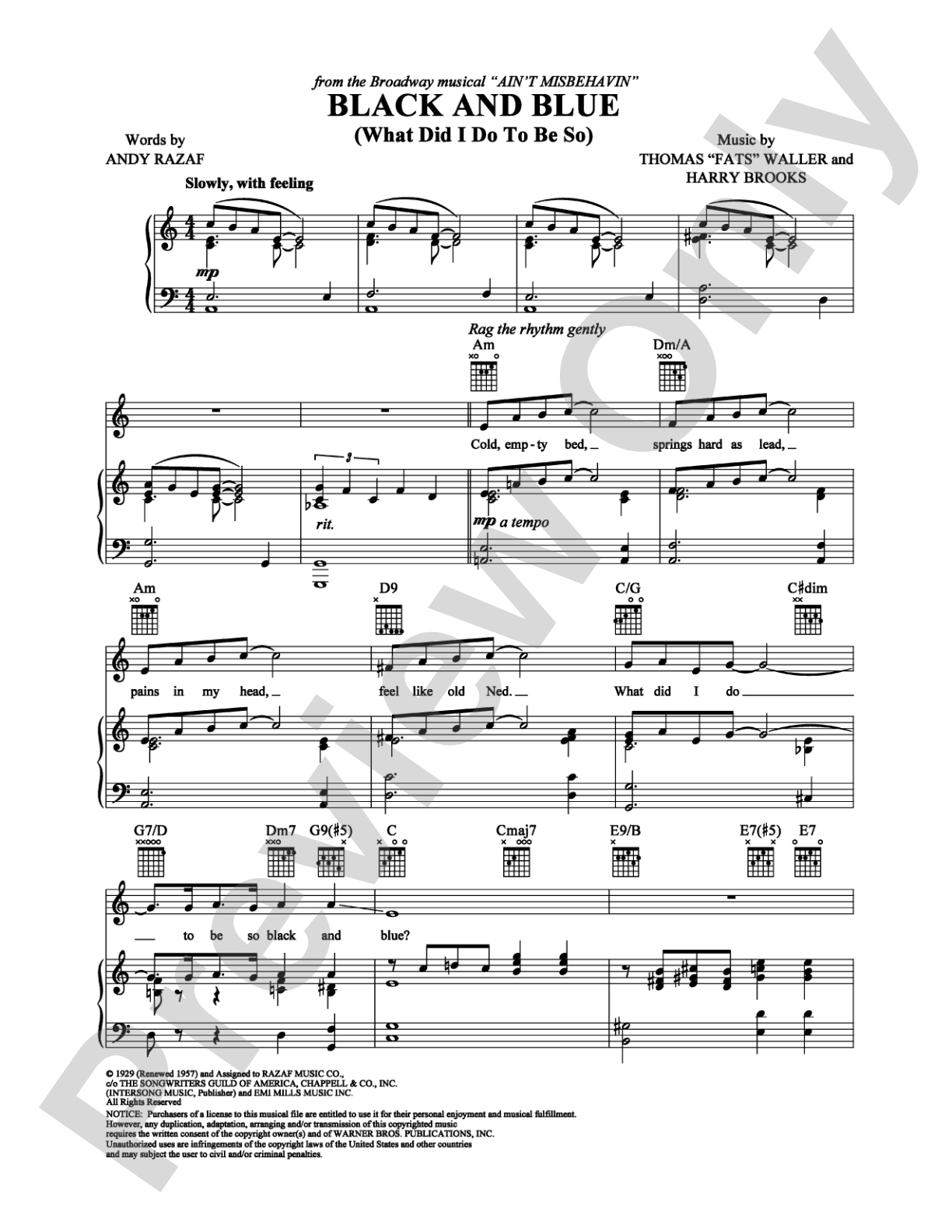
(What Did I Do To Be So) Black and Blue: Piano/Vocal/Chords Digital Sheet Music

(What Did I Do To Be So) Black and Blue: Piano/Vocal/Chords Digital Sheet Music

Harry Brooks, Fats Waller

Item: 00-PS-0007781

Digital Download
$3.99
Description

(What Did I Do To Be So) Black and Blue: Piano/Vocal/Chords Digital Sheet Music isn't in MakeMusic Cloud just yet...but it could be. Let us know you'd like to see it, and you'll help shape what comes next. In the meantime, start a free trial and dive into thousands of interactive titles your students can play along with today.

Sample Audio
No sample audio found.
Sample Video
Additional Details
SKU: 00-PS-0007781

More about this title

About the Creator

Written in 1929 by Fats Waller and Harry Brooks with lyrics by Andy Razaf, "(What Did I Do To Be So) Black and Blue" emerged from the Harlem Renaissance as one of the era's most powerful artistic statements. The song began as a lament about colorism within the Black community, later evolving into a universal anthem of suffering and resilience that has been recorded by jazz legends from Billie Holiday to Louis Armstrong.

Why we love this

This standard bridges jazz history and vocal repertoire in a format that lets singers and pianists collaborate immediately without ensemble arrangements getting in the way. The piano/vocal/chords layout gives accompanists real harmonic freedom while keeping the focus squarely on the singer's interpretation and the song's emotional core.

What to expect

A contemplative, introspective piece that lets vulnerability shine through. The harmonic language leans into blues sensibility and introspection, inviting singers to inhabit the emotional landscape rather than rush through the lyrics.

Who it's for

Singers performing jazz standards in recital, cabaret, or formal concert settings, paired with pianists who read chord charts fluently. This works equally well for music theater singers building a solo repertoire or jazz vocalists exploring classic American songbook material.

How to get the most out of it

  • Let the chords guide your harmonic choices rather than locking into a single voicing; the piano part should breathe and respond to the vocalist's phrasing.
  • Work out the vocal line separately first, then layer in the piano. The melody carries the narrative weight in this standard.
  • Treat the chord symbols as a conversation between hands. Left hand can anchor changes while the right hand colors the harmony based on the singer's dynamic choices.

How to use it

Pair this with other jazz standards from the same era for a focused recital set, or use it as a solo selection within a mixed program that needs a moment of intimate honesty. The piano/vocal format makes it an excellent choice for formal auditions or competition performances where you want accompaniment that stays transparent.

Skills your students will build

  • Reading and interpreting jazz chord charts
  • Accompanying singers while maintaining harmonic flexibility
  • Balancing melodic support with interpretive freedom
  • Connecting lyrical content to harmonic color and phrasing

You May Also Like