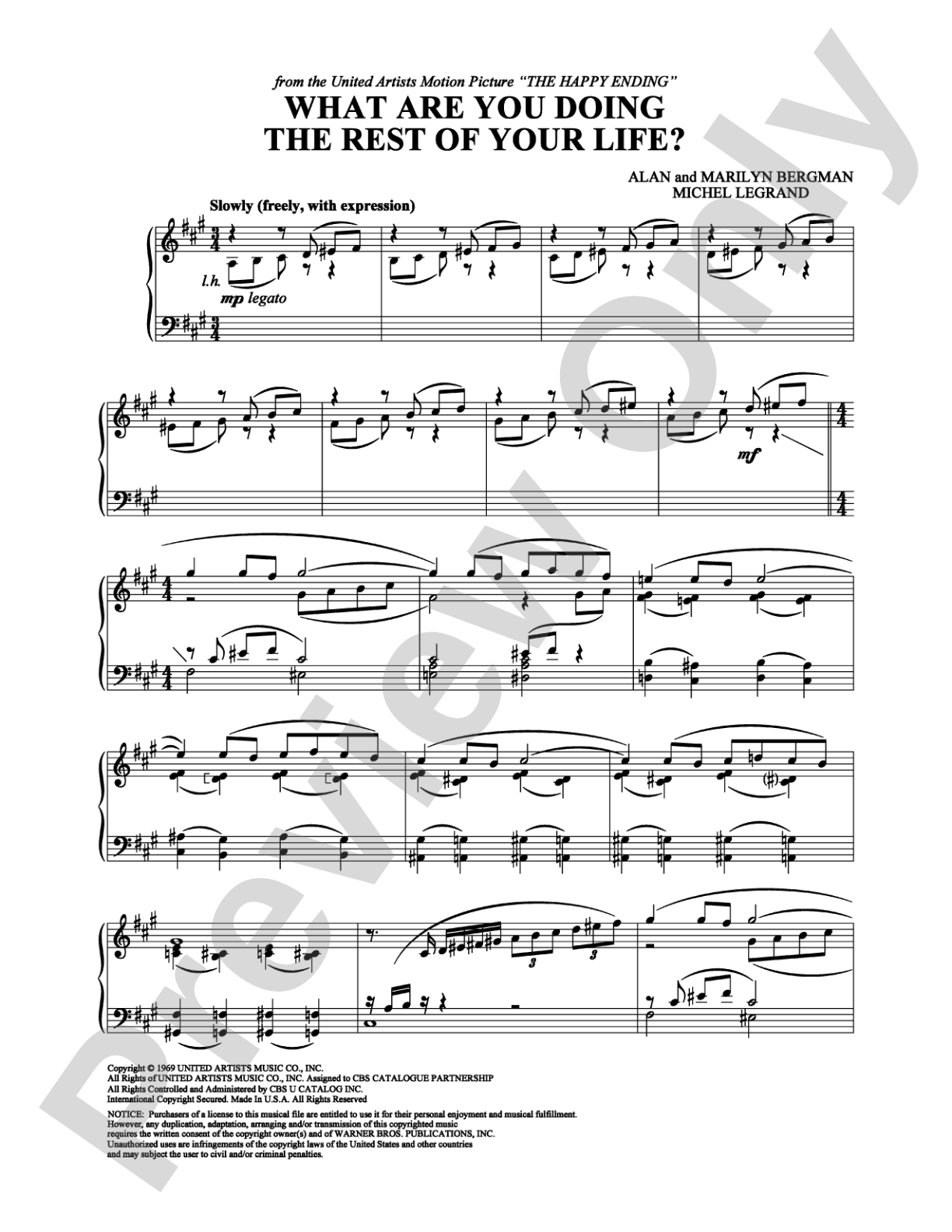
What Are You Doing The Rest Of Your Life: Piano Digital Sheet Music

What Are You Doing The Rest Of Your Life: Piano Digital Sheet Music

George Shearing, Michel Legrand

Item: 00-PS-0002910

Digital Download
$3.99
Description

What Are You Doing The Rest Of Your Life: Piano Digital Sheet Music isn't in MakeMusic Cloud just yet...but it could be. Let us know you'd like to see it, and you'll help shape what comes next. In the meantime, start a free trial and dive into thousands of interactive titles your students can play along with today.

Sample Audio
No sample audio found.
Sample Video
Additional Details
SKU: 00-PS-0002910

More about this title

About the Artist: George Shearing

George Shearing (1919-2011) was a British jazz pianist and composer whose sophisticated harmonic sensibility and elegant touch defined the sound of 1950s cool jazz. Blind from birth, he developed an extraordinary ear that allowed him to transcribe and arrange music with remarkable precision. His piano trio and later his quintet became models of understated swinging, influencing generations of jazz pianists who valued clarity and taste over flashiness.

Why we love this

Shearing's interpretation of this standard demonstrates how a master pianist shapes melody through harmony and dynamics rather than technical display. The voicings and touch offer students a masterclass in jazz comping and solo improvisation within the constraints of a beautiful song form, making it an invaluable reference recording for anyone serious about jazz piano.

What to expect

Warm and introspective, with a gentle swing that never rushes. Shearing's playing feels conversational; he lets the melody breathe while his left hand provides sophisticated harmonic support that colors every phrase without overwhelming it. There's a timeless elegance here that reveals something new with each listen.

Who it's for

Jazz piano students who want to hear how a foundational standard can be approached with sophistication and restraint, and pianists preparing to solo over this tune who benefit from studying a master's harmonic and rhythmic choices. Music educators can use this as a listening model when teaching jazz comping and melodic paraphrase.

How to get the most out of it

  • Study how Shearing voices the chords; his quartal and tertial stacks create movement and color without overcomplication. Experiment with substituting one or two of these voicings into your own solo.
  • Listen closely to his touch and dynamics across the entire phrase. Jazz piano requires singing through the instrument, not just hitting notes.
  • Notice where Shearing plays behind the beat and where he sits in front of it. These micro-rhythmic choices drive the swing and should inform your own time feel.
  • Use this as a harmonic reference. Work out the changes Shearing implies through his comping, then practice stating them clearly on your own instrument before you decorate them.

How to use it

Use this as a study score and reference recording for jazz ensemble rehearsals when working on standards and ballads. It works especially well in a unit on jazz arranging and comping, where students can transcribe and analyze his voicings. For jazz recitals, students can perform their own arrangement of the tune after studying Shearing's interpretation.

Skills your students will build

  • Jazz chord voicing and substitution
  • Playing behind and ahead of the beat in a swing context
  • Listening to and transcribing a master pianist's harmonic choices
  • Building dynamic shape and phrase contour across a ballad form
  • Understanding how comping supports and frames a melody

You May Also Like