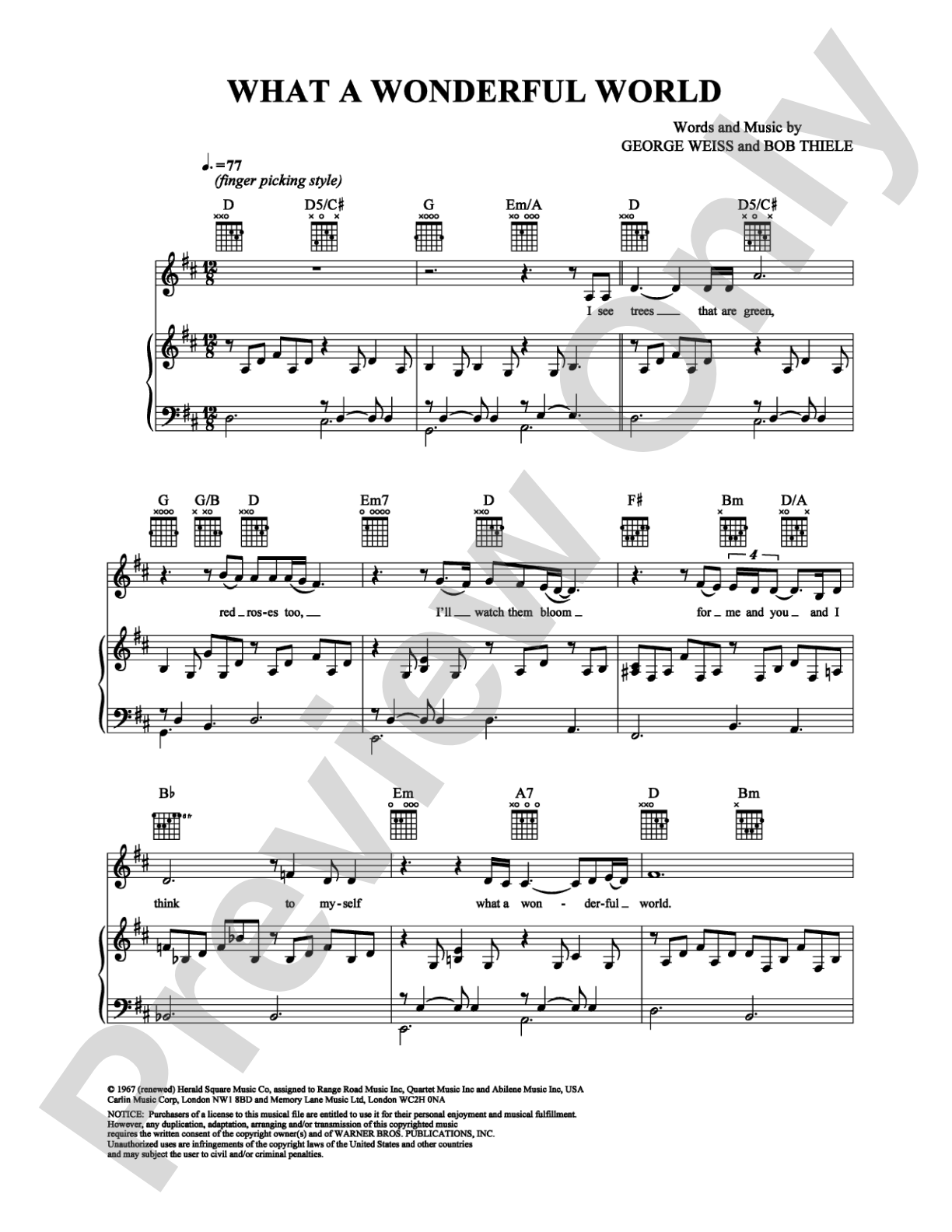
What a Wonderful World: Piano/Vocal/Chords Digital Sheet Music

What a Wonderful World: Piano/Vocal/Chords Digital Sheet Music

Bob Thiele, Eva Cassidy, George Weiss

Item: 00-PS-0005914

Digital Download
$3.99
Description

What a Wonderful World: Piano/Vocal/Chords Digital Sheet Music isn't in MakeMusic Cloud just yet...but it could be. Let us know you'd like to see it, and you'll help shape what comes next. In the meantime, start a free trial and dive into thousands of interactive titles your students can play along with today.

Sample Audio
No sample audio found.
Sample Video
Additional Details
SKU: 00-PS-0005914

More about this title

About the Artist: Eva Cassidy

Eva Cassidy (1963-1996) was a Washington D.C.-based vocalist known for her interpretive gifts and ability to inhabit songs across multiple genres with emotional authenticity. Though she recorded primarily in jazz, folk, blues, and pop contexts during her lifetime, her career gained significant posthumous recognition, particularly through her stripped-down arrangements that emphasized vocal nuance and instrumental restraint.

Why we love this

Cassidy's reading of this standard balances simplicity with emotional depth, making it accessible for singers building interpretive confidence while offering enough sophistication to reward mature performance. The arrangement respects the song's inherent warmth without overcomplexity, giving pianists and vocalists room to shape phrasing and dynamics rather than navigate technical obstacles.

What to expect

Intimate and unhurried, with the quality of a private performance rather than a polished stage recital. The arrangement has a gentle, conversational tone that invites the listener inward, reflecting Cassidy's gift for making familiar songs feel newly discovered.

Who it's for

Singers with developing interpretive skills who benefit from working with a trusted, emotionally direct arrangement, and pianists seeking accessible accompaniment that allows focus on supporting a vocalist's phrasing. This works equally well for studio vocalists, recital performers, and ensemble programs exploring contemporary interpretations of familiar standards.

How to get the most out of it

  • Resist the urge to hurry; Cassidy's interpretation thrives on space and breath. Let rests do their work, and allow the vocalist time to shape longer phrases without rushing toward the next section.
  • Balance the piano part as accompaniment rather than showcase. The focus should remain on the vocal line, with chordal comping that supports rather than competes with the singer's interpretation.
  • Explore the tension between the song's optimistic text and the intimate, sometimes wistful quality Cassidy brings to it. This restraint creates emotional resonance that sentimentality would undermine.
  • Pay attention to vowel resonance in sustained notes. Cassidy's tone is characterized by clarity and warmth; mirror that quality through consistent breath support and placement.

How to use it

Pair this with other contemporary vocal interpretations of standards to create a program that explores how modern artists reclaim classic material. It works particularly well in recitals focused on American songwriting or as a reflective moment in concerts that mix genres and eras.

Skills your students will build

  • Phrasing and text expression in a sparse harmonic context
  • Accompaniment balance and responsiveness to vocal interpretation
  • Reading chord symbols and realizing lead sheet notation
  • Sustaining emotional connection across a simple melodic arc
  • Collaboration between vocalist and pianist in real time

You May Also Like