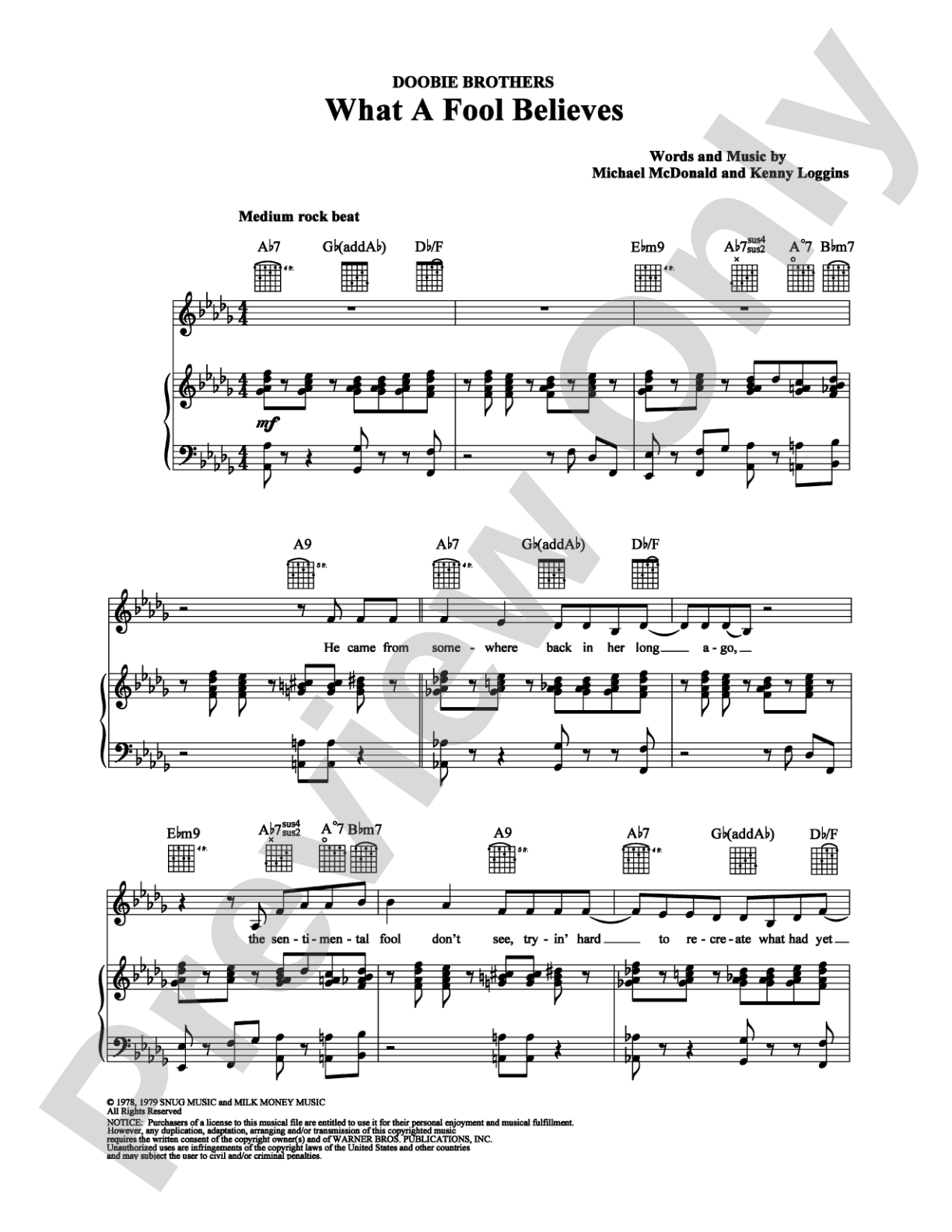
What A Fool Believes: Piano/Vocal/Chords Digital Sheet Music

What A Fool Believes: Piano/Vocal/Chords Digital Sheet Music

Kenny Loggins, Doobie Brothers, Michael Mcdonald

Item: 00-PS-0005531

Digital Download
$3.99
Description

What A Fool Believes: Piano/Vocal/Chords Digital Sheet Music isn't in MakeMusic Cloud just yet...but it could be. Let us know you'd like to see it, and you'll help shape what comes next. In the meantime, start a free trial and dive into thousands of interactive titles your students can play along with today.

Sample Audio
No sample audio found.
Sample Video
Additional Details
SKU: 00-PS-0005531

More about this title

About the Artist: Doobie Brothers

The Doobie Brothers emerged from San Jose in the early 1970s as one of rock music's most skilled and versatile bands. Their catalogue spans tight harmonies, sophisticated arrangements, and memorable melodic hooks that bridge pop sensibility with genuine musicianship. The band's willingness to evolve their sound across country rock, funk, and adult contemporary idioms made them enduring favorites on both radio and in live performance.

Their songwriting consistently rewards close listening and skilled execution. Works like "What A Fool Believes" showcase the band's gift for crafting songs that sound effortless on the surface but demand precision and taste in performance.

Why we love this

This track sits in that valuable space between sophisticated pop arrangement and genuinely singable melodic content. The piano part carries real harmonic substance without overwhelming a vocalist, and the chord progression rewards players who understand voice leading and jazz-inflected alterations. It's a song that sounds deceptively simple until you're actually playing it, which makes it ideal for students ready to move beyond basic accompaniment.

What to expect

Smooth, knowing, slightly wry. The song carries warmth and accessibility on top of sophisticated harmonic thinking. There's a reflective quality to it, grounded in mid-1970s production sensibilities that valued clarity and musicianship over bombast.

Who it's for

Intermediate to advanced pianists and vocalists who can handle songs with jazz-influenced harmonies and want material that works equally well for study or performance. This is excellent for singers working on contemporary popular music with substance, and for pianists strengthening their skill at accompanying vocalists with taste and restraint.

How to get the most out of it

  • Lock the harmonic rhythm between your left hand and vocal line; the chords need precision timing to sit behind the melody rather than push ahead of it.
  • Pay attention to any seventh and ninth chord extensions in the changes; they color the arrangement and shouldn't be flattened into basic triads.
  • Maintain rhythmic independence between melody and accompaniment, especially if the piano part includes syncopation that doesn't align with the vocal phrasing.
  • Balance dynamic support: your job is to float the vocal line, not compete with it.

How to use it

Program this in a student recital showcasing contemporary American songwriting, paired with other pop or adult contemporary standards that demand real musical maturity. It works particularly well for demonstrating how skilled accompaniment and vocal performance can carry material without production tricks. It's also valuable in a studio lesson sequence on learning to support vocalists with appropriate harmonic texture.

Skills your students will build

  • Accompanying vocalists with dynamic control and harmonic accuracy
  • Reading and performing jazz-influenced chord extensions and alterations
  • Rhythmic independence between piano accompaniment and melody line
  • Interpreting chord charts to shape harmonic color and support vocal phrasing

You May Also Like