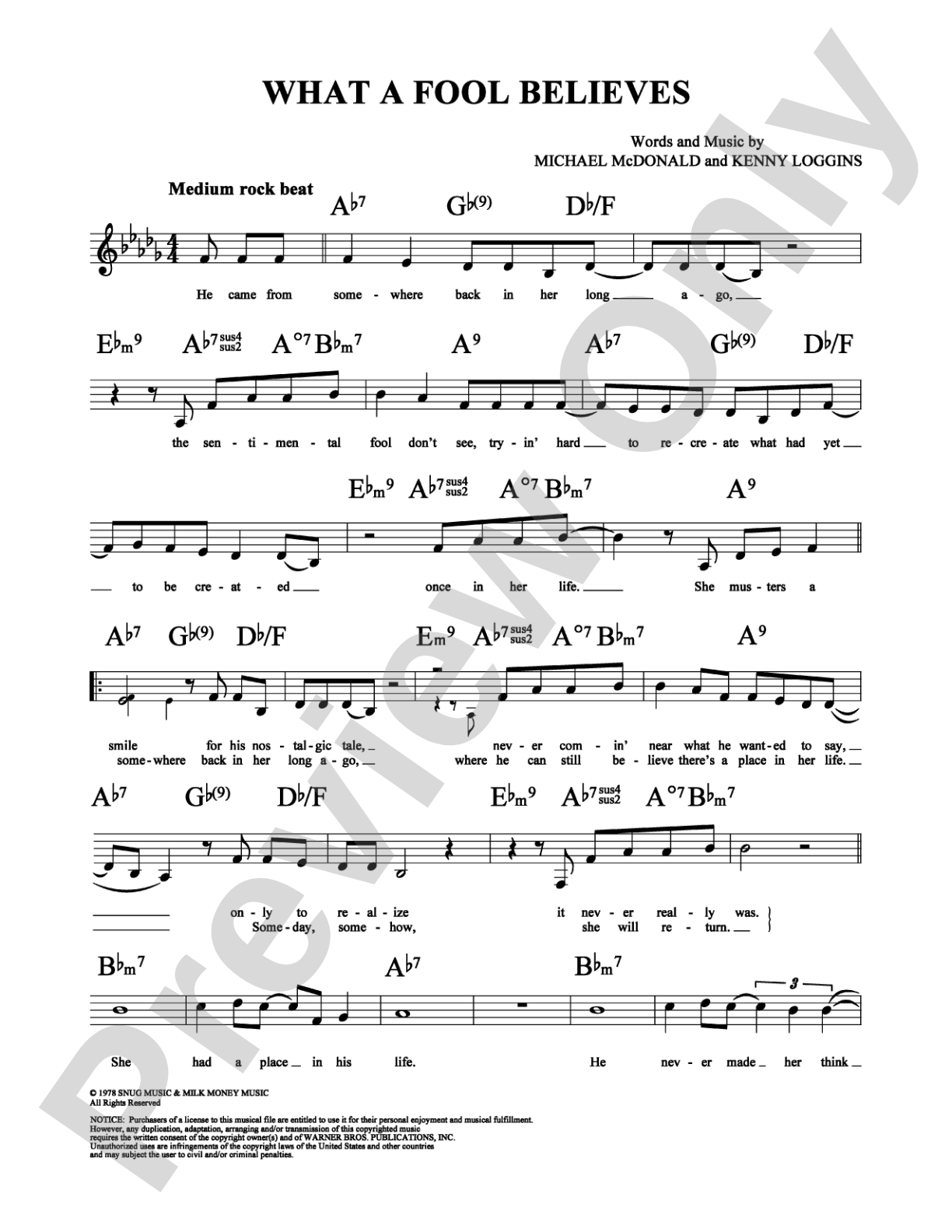
What A Fool Believes: Lead Sheet Digital Sheet Music

What A Fool Believes: Lead Sheet Digital Sheet Music

Kenny Loggins, Doobie Brothers, Michael Mcdonald

Item: 00-PS-0002355

Digital Download
$1.99
Description

What A Fool Believes: Lead Sheet Digital Sheet Music isn't in MakeMusic Cloud just yet...but it could be. Let us know you'd like to see it, and you'll help shape what comes next. In the meantime, start a free trial and dive into thousands of interactive titles your students can play along with today.

Sample Audio
No sample audio found.
Sample Video
Additional Details
SKU: 00-PS-0002355

More about this title

About the Artist: Doobie Brothers

The Doobie Brothers emerged from the San Jose rock scene in the early 1970s, blending rock, soul, and R&B into a distinctly groove-oriented sound. Their catalog includes some of the era's most enduring hits, characterized by tight harmonies, infectious rhythms, and songwriting that balanced commercial appeal with genuine musicianship.

Why we love this

This lead sheet captures one of pop rock's most sophisticated chord progressions and melodic hooks, making it ideal for teaching jazz voicings and reharmonization in a contemporary context. Students immediately recognize the tune, which creates instant engagement while they work through the harmonic language beneath a beloved recording.

What to expect

Smooth and introspective with an undercurrent of groove. The melody drifts thoughtfully over changes that hint at jazz sensibility without veering into true bebop territory, creating a sound that feels both accessible and musically substantial.

Who it's for

Pianists, guitarists, and jazz/contemporary music students looking to explore sophisticated pop songwriting. This lead sheet works for anyone studying functional harmony in a non-classical context, from high school musicians to adult jazz learners.

How to get the most out of it

  • Study the original recording to internalize the groove and phrasing of the melody; the subtle rhythmic placement of notes shapes the character as much as the harmony does.
  • Experiment with comping patterns that balance rootless voicings with fuller chords, allowing space for the melody to breathe without cluttering the texture.
  • Pay attention to the song's dynamic arc; this arrangement benefits from subtle dynamic shaping rather than uniform accompaniment throughout.
  • Consider how different instrumental combinations can recolor the harmonic palette; this tune works equally well on piano, guitar, or keyboard trio.

How to use it

Include this in a pop standards or jazz standards recital to bridge classical training with contemporary repertoire. It also works well in ensemble settings where improvisation is encouraged, allowing soloists to explore the changes over a familiar foundation.

Skills your students will build

  • Reading and interpreting lead sheet notation with chord symbols
  • Understanding jazz voicing and chord extensions in popular music context
  • Phrasing melody over syncopated harmonic accompaniment
  • Improvisation over changes in a contemporary song form
  • Listening to and replicating subtle rhythmic and dynamic nuance from the original recording

You May Also Like