
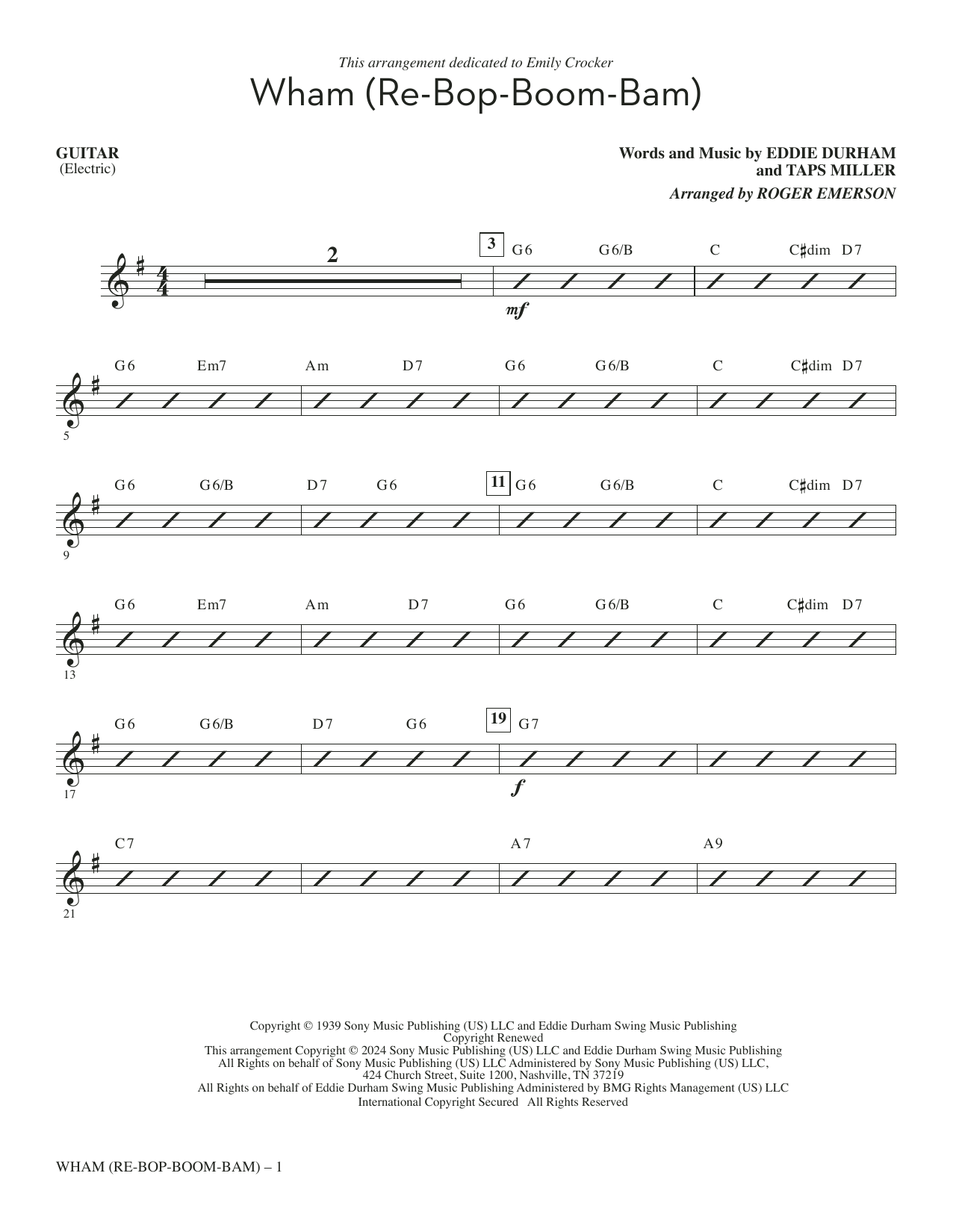

Wham (Re Bop Boom Bam) (arr. Roger Emerson): Choral Instrumental Pak
As performed by Mildred Bailey / Arranged by Roger Emerson
Item: 35-PK01523710
$21.00
Pickup currently not available
Buy Extra Parts (Digital PDF Download)
Parts Added to Cart!
Description
There's nothing like the refined, ageless cool of a swing classic. "Wham (Re-Bop-Boom-Bam)" is about as "hep" as it gets, with a catchy melody and colorful lyrics that offer a snapshot of the era's finest musical slang. Roger Emerson's arrangement is patterned after the 1939 version by Mildred Bailey (as featured in the TV series Lessons in Chemistry), reflecting its tight jazzy harmonies and snappy syncopated rhythms.


Wham (Re Bop Boom Bam) (arr. Roger Emerson): Choral Instrumental Pak isn't in MakeMusic Cloud just yet...but it could be. Let us know you'd like to see it, and you'll help shape what comes next. In the meantime, start a free trial and dive into thousands of interactive titles your students can play along with today.
Request This Title
Tell us you want it.
Start Your Free Trial
Explore everything that's ready to play right now.
Sample Audio
No sample audio found.
Sample Video
No sample videos found.
Additional Details
Publisher:
Hal Leonard
SKU:
35-PK01523710
More about this title
About the Artist: Mildred Bailey
Mildred Bailey (1907–1951) was a pioneering jazz vocalist whose crystalline voice and impeccable phrasing made her one of the most recorded artists of the 1930s and 1940s. She earned the nickname "Mrs. Swing" for her ability to navigate complex jazz harmonies with ease, collaborating with major bandleaders and becoming a model for generations of jazz singers who followed.
Bailey's legacy in music education rests on her technical precision and rhythmic sophistication. She demonstrated that swing singing required genuine musicianship—precise intonation, sensitive interpretation of lyrical intent, and command of syncopation. Her recordings remain essential listening for students learning how to approach jazz repertoire with intelligence and restraint.
Why we love this
Roger Emerson captures the era's linguistic playfulness and musical snap without oversimplifying the harmonic language. The arrangement respects Mildred Bailey's 1939 recording while remaining singable for high school and collegiate choirs, making it possible for students to inhabit authentic swing phrasing rather than simulate it. Programming this piece signals that your choir takes jazz seriously as a compositional tradition, not a novelty.
What to expect
Cool, sophisticated, and alive with period charm. The arrangement evokes a late-night jazz club where musicians trust each other enough to let the arrangement breathe; there's space between the lines, and the syncopated rhythms nudge against the beat without ever losing control. It feels urbane and knowing, the musical equivalent of a raised eyebrow and a sly smile.
Who it's for
High school and college choirs with some jazz experience or a willingness to learn swing idioms from scratch. The rhythm voicing keeps technical demands reasonable while the harmonic content rewards groups that can hear and balance tertian chords with accuracy.
How to get the most out of it
- Isolate the syncopated rhythmic figures in rehearsal separately from the melody line. Have students tap and sing the syncopation independently first, then layer it against the tune so the interaction becomes muscle memory rather than a cognitive strain.
- Anchor the swing feel through your rhythm section's interpretation of the written rhythms. If your accompanists rush or flatten the eighth notes, the whole arrangement loses its buoyancy; record a click or live run-through to calibrate everyone's internal subdivision.
- Let the lyrics breathe. The period slang ("hep," "re-bop," "boom bam") should feel conversational, not cartoonish. Emphasize clear diction without forcing exaggerated articulation that undermines the relaxed, cool quality of the original.
- Shape phrases using dynamics and rubato rather than tempo changes. Swing is about flexibility within a steady groove, not pushing and pulling the underlying pulse.
How to use it
Place this on a concert that celebrates American songwriting traditions or pairs it alongside other standards and jazz classics. It works particularly well as a palate cleanser between heavier contemporary works or as an encore that leaves audiences grinning. The piece also serves as a teaching anchor for a unit on swing era aesthetics and the intersection of jazz with popular song.
Skills your students will build
- Reading and executing syncopated rhythms in a jazz context
- Swing articulation and phrasing (anticipation, relaxation, groove awareness)
- Navigating tertian harmony by ear
- Blending with a rhythm section and responding to its energy
- Historical listening and era-specific stylistic choices