
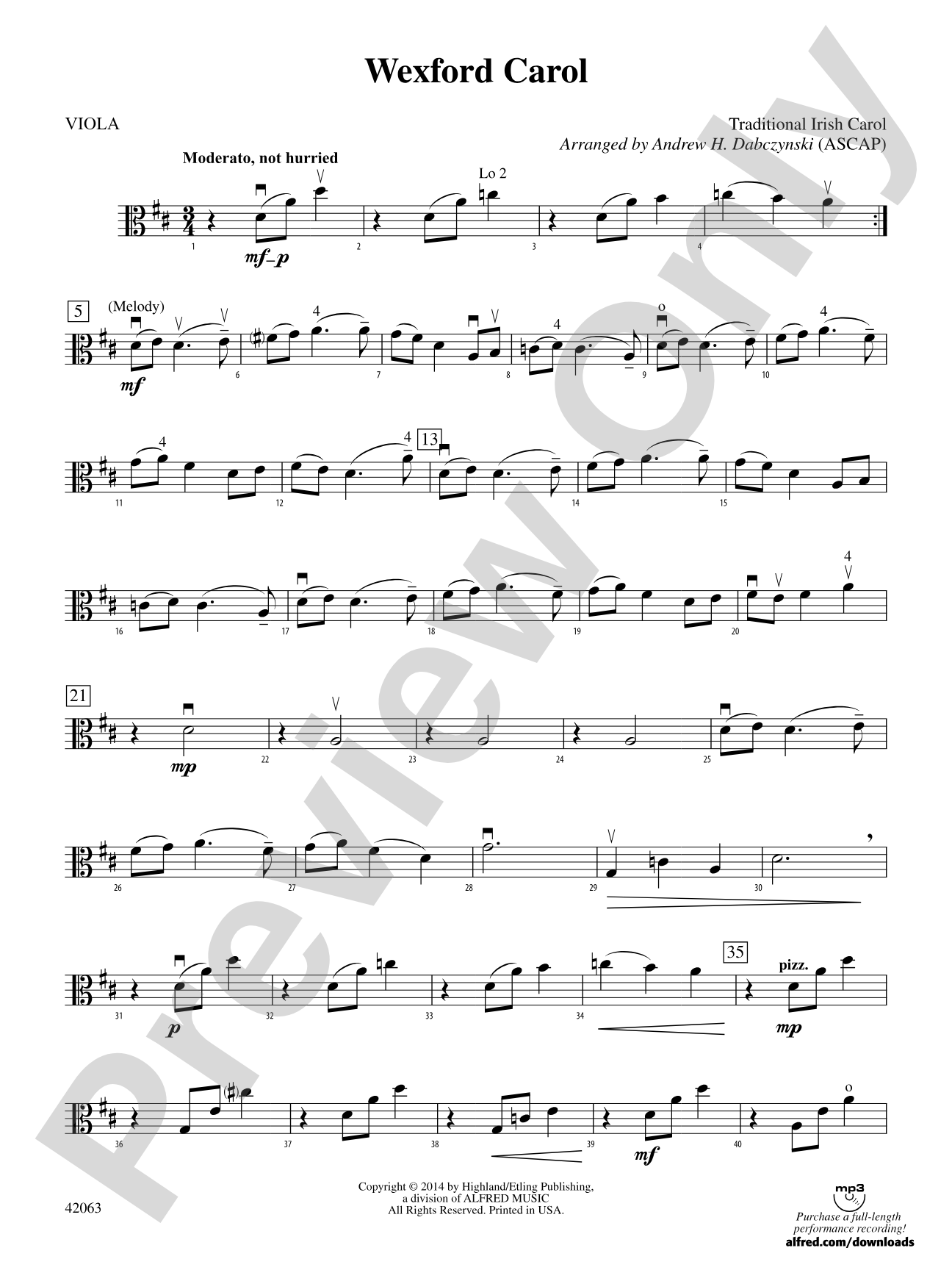

Wexford Carol: Viola
Traditional Irish Carol / arr. Andrew H. Dabczynski
Grade: 2
Item: 00-PC-0016455_VA1
$5.99
Pickup currently not available
Description
In this sensitive arrangement of one of the world's oldest Christmas carols, the haunting melody is passed throughout the orchestra. Changing textures combine with shifting modes to create a lyric and peaceful atmosphere that surely will be remembered long after the concert is over. (3:30) This title is available in MakeMusic Cloud.


Don't just read it, hear it, play along with it, and watch your students grow with it. In MakeMusic Cloud, Wexford Carol: Viola comes alive with professional accompaniment, adjustable tempo, and built-in practice tools that turn solo practice into real progress.
Open in the Player
Jump straight in and assign it today.
Start Your Free Trial
Open this title and explore the full library in minutes.
Sample Audio
1
Audio File
--:--
0:00
0:00
Sample Video
No sample videos found.
Additional Details
Series:
Highland/Etling String Orchestra
Publisher:
Alfred Music
Page Count:
124
SKU:
00-PC-0016455_VA1
More about this title
About the Arranger: Andrew H. Dabczynski

Andrew H. Dabczynski served as Emeritus Professor of Music Education at Brigham Young University, where he founded the BYU "New Horizons Orchestra," an ensemble that serves both adult beginners and as a training ground for string educators. His contributions to music education earned him BYU's Joseph E. White Fellowship for Teaching and Learning, recognition from Utah ASTA as Higher Education Teacher of the Year in 2005, and the organization's award for Outstanding Contributions to Music Education in 2014.
Dabczynski's career spans teaching positions at the Eastman School of Music and in public school districts across New York and Michigan, along with work as a violist in regional orchestras including the Rochester Philharmonic and Hartford Symphony. His deep expertise in string pedagogy shaped the development of String Explorer, a comprehensive string method series co-authored with Alfred Publishing. His scholarly interests in folk music and ethnomusicology have consistently informed his arrangements and research into traditional music transmission.
Why we love this
Dabczynski's arrangement honors the ancient melody while giving every section of the orchestra a moment to carry the tune, creating a genuine sense of collaboration rather than relegating students to supporting voices. The shifting modes and changing textures keep the piece engaging for young players while maintaining the carol's meditative quality, making it a repertoire choice that feels substantial rather than seasonally obligatory.
What to expect
The piece unfolds with a quiet dignity. The haunting melody drifts from one choir of instruments to another, supported by harmonies that shift subtly between modal colors, creating an atmosphere that feels both ancient and gently introspective. By the end, you're left with a sense of calm reflection rather than festive noise.
Who it's for
String orchestras at the Grade 2 level who want meaningful holiday repertoire beyond the obvious choices. Ensembles with developing players benefit from the straightforward writing and the chance to trade the melody back and forth, building confidence and ensemble awareness.
How to get the most out of it
- Allow the melody to sing naturally when it passes to your section; resist over-articulating in an attempt to balance with other parts. The piece asks for lyrical phrasing throughout, not precision at the expense of warmth.
- Shape each transition carefully as the textural changes occur. These shifts are intentional and should feel like a conversation unfolding, not abrupt changes in accompaniment.
- Work with your violins and violas to maintain consistent vibrato and tone quality as the melody travels. This continuity will make the "haunting" quality Dabczynski writes about feel intentional and connected.
- Observe the modes closely during rehearsal. Some passages may feel unfamiliar compared to traditional major and minor tonality, so isolate those sections and let your ear adjust to the harmonic colors.
How to use it
This works beautifully as a centerpiece in a winter concert program where you want to create a contemplative moment between more energetic selections. At Grade 2 and under four minutes, it fits comfortably into most orchestral lineups while establishing your ensemble's ability to handle lyrical, atmospheric music.
Skills your students will build
- Passing a melody smoothly between sections while maintaining tonal consistency
- Listening and balancing when the main tune is in unfamiliar voices
- Playing in modal contexts (non-major/minor tonality)
- Sustaining tone quality during exposed, lyrical passages
- Sensitivity to textural and harmonic shifts as an ensemble