
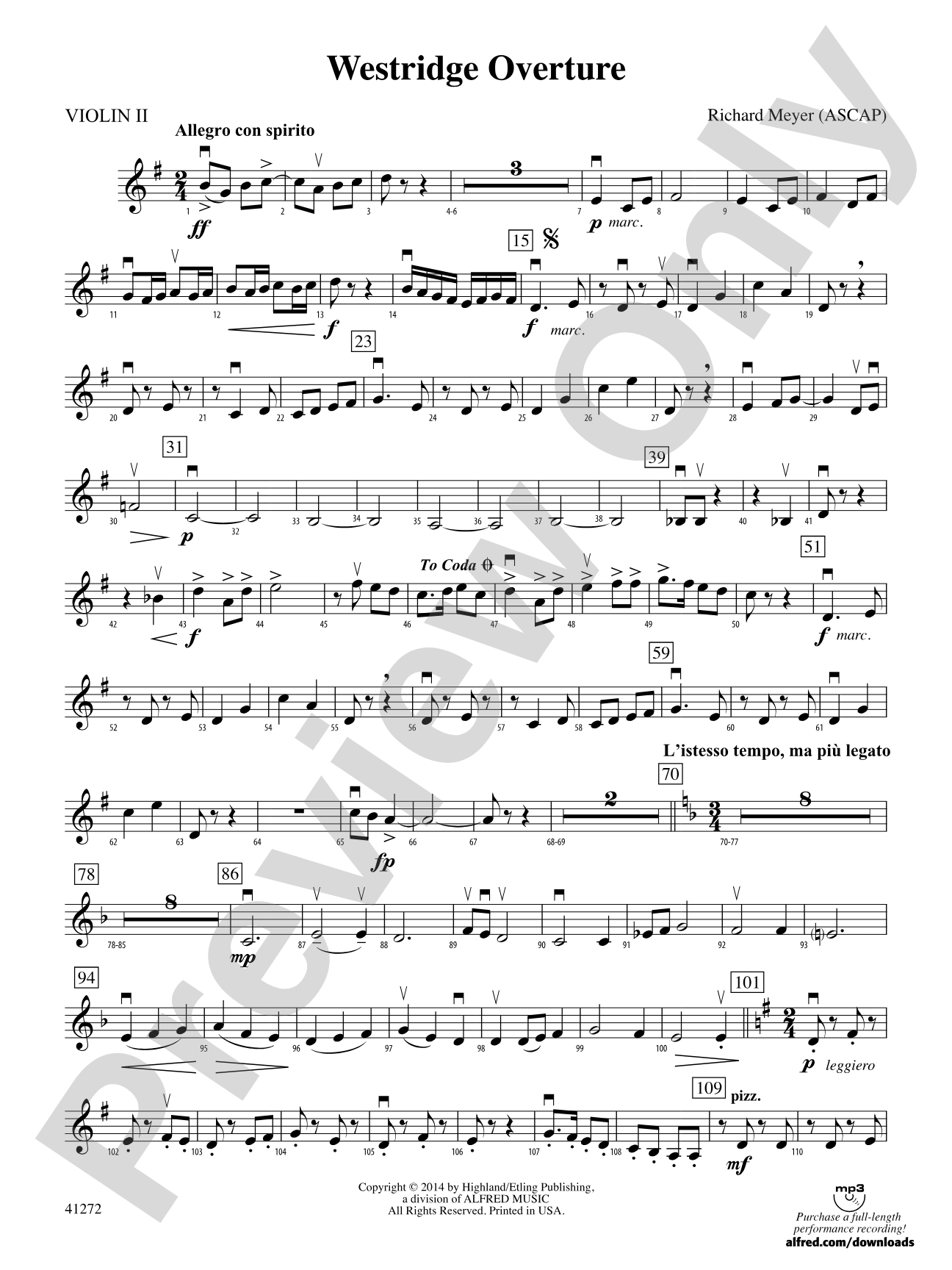

Westridge Overture: 2nd Violin
By Richard Meyer
Grade: 4
Item: 00-PC-0016389_VN2
$5.99
Pickup currently not available
Description
This festive overture is full of challenges for every section and sure to be a favorite with more mature and experienced players! An exciting opener or closer for any concert, the work is built around the school anthem, "Surgere Tentamus." (6:45) This title is available in MakeMusic Cloud.


Don't just read it, hear it, play along with it, and watch your students grow with it. In MakeMusic Cloud, Westridge Overture: 2nd Violin comes alive with professional accompaniment, adjustable tempo, and built-in practice tools that turn solo practice into real progress.
Open in the Player
Jump straight in and assign it today.
Start Your Free Trial
Open this title and explore the full library in minutes.
Sample Audio
1
Audio File
--:--
0:00
0:00
Sample Video
No sample videos found.
Additional Details
Series:
Highland/Etling String Orchestra
Publisher:
Alfred Music
Page Count:
124
SKU:
00-PC-0016389_VN2
More about this title
About the Composer: Richard Meyer

Richard Meyer spent 35 years teaching strings across elementary, middle, and high school levels in public schools. At Oak Avenue Intermediate School in Temple City, California, he directed orchestras for 22 years and expanded the program from 29 to 200 students while overseeing the district's elementary string curriculum. He also led the Pasadena Youth Symphony Orchestra for 16 years, bringing ensembles to perform in New York, Washington D.C., Vienna, Australia, and Canada.
Beyond the classroom, Meyer has shaped music education through innovation and advocacy. In 2009 he created the "Giving Bach" program, which uses interactive concerts to serve special needs and underserved students throughout Southern California and has earned national recognition. As a composer, he has published over 190 works and arrangements; he also served as string editor for Alfred Publishing Company for 16 years and co-authored the String Explorer Series and Sight-read It for Strings. Meyer remains an active guest conductor and clinician, having presented at the A.S.T.A. National Conference, Texas Orchestra Directors' Association Conference, and university workshops across the country.
Why we love this
Meyer understands what mature string players want to play: music that sounds sophisticated and challenges every stand, not just the first violins. Built on a school anthem, Westridge Overture carries real meaning for your community while giving everyone in the orchestra genuine musical work to do. The 6:45 runtime and festive character make it equally effective as a concert opener or closer, solving the perpetual programming puzzle of finding worthy pieces that fit both roles.
What to expect
Westridge Overture opens with the energy and brightness of a celebration, grounded in the familiar ground of your school's anthem. The writing sparkles with rhythmic vitality and colorful textures, moving from moments of gentle lyricism to passages that require everyone's full technical engagement and ensemble cohesion.
Who it's for
This score is written for string orchestras with solid technical skills and musical maturity—players who can handle divided parts, shifting meters, and exposed passages without losing focus. Grade 4 difficulty means your ensemble has moved beyond simple unison passages and is ready to balance independent lines and stylistic nuance.
How to get the most out of it
- Balance the anthem melody carefully as it passes between sections; mark these moments in rehearsal and remind players they're carrying the school's musical identity.
- Work the rhythm section first, locking in the foundation before layering the running passages in the upper strings.
- Highlight the contrasting textures Meyer writes into each section; violas and cellos have real melodic moments, not filler, so make sure they know when to step forward.
- Use the recorded accompaniment or click track during early rehearsals to establish tempo confidence, then gradually conduct without it as the ensemble solidifies.
How to use it
This piece earns its place as a concert centerpiece because it honors your school identity while sounding genuinely polished. Program it to frame a concert—opening with momentum and optimism, or closing on a high note of collective achievement. It also works well in festival or contest settings where the combination of technical challenge and musical substance appeals to adjudicators.
Skills your students will build
- Balancing divided parts across multiple sections
- Sustaining melodic independence within a full ensemble texture
- Executing rhythmic precision in fast, running passages
- Responding to shifting articulation and dynamic demands
- Playing exposed lines with secure intonation and confident tone