
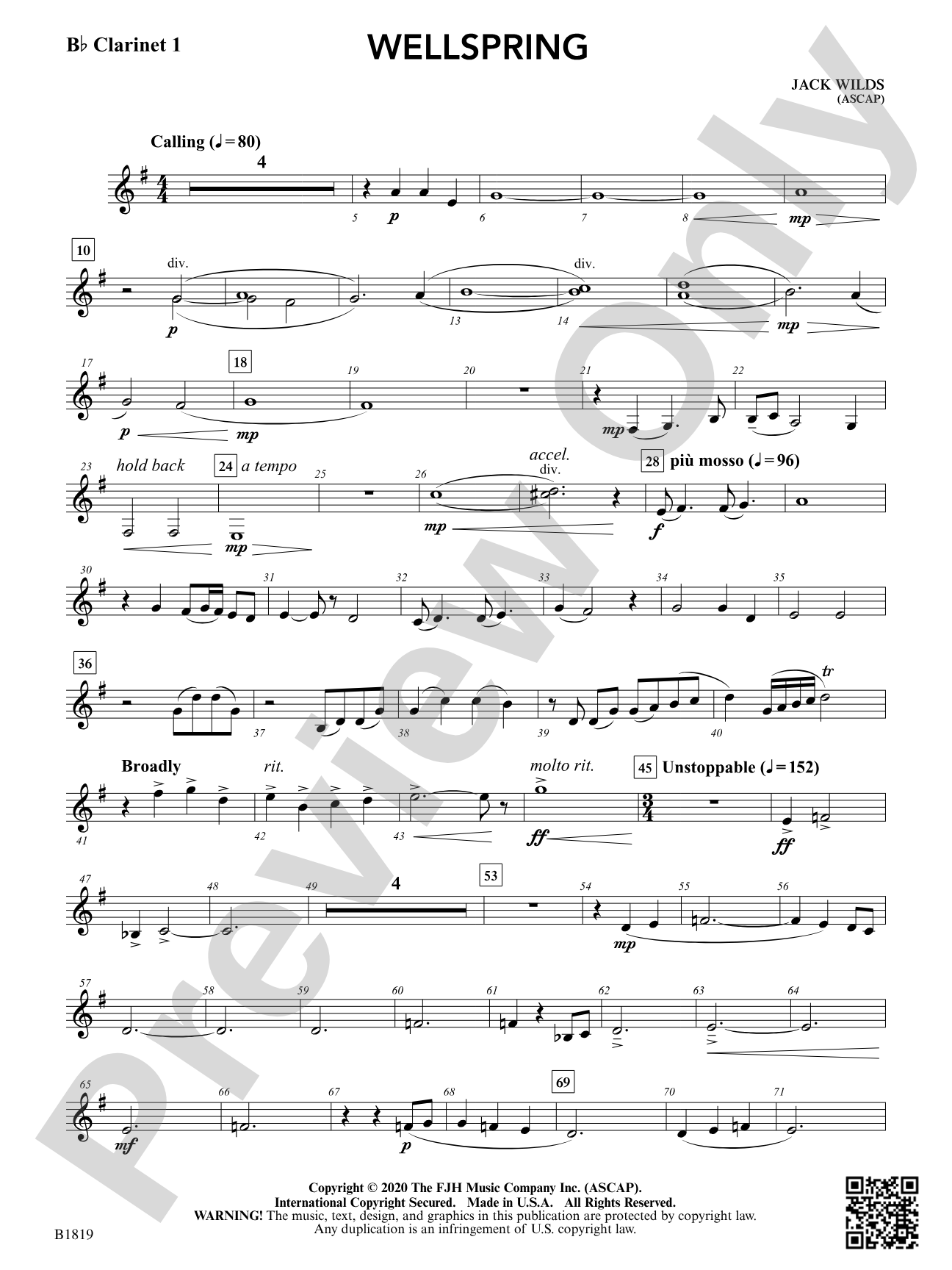

Wellspring: B-flat Clarinet 1
By Jack Wilds
Grade: 2.5
Item: 98-PC-DB1819_C1
$7.00
Pickup currently not available
Description
This outstanding work traces the emotional arc of finding renewal in the midst of exhaustion. A recurring four note motive interacts with a beautiful, lyrical melody. As the piece develops, the melody is ultimately transformed into a shout of sheer joy. A perfect opportunity for teaching your students about motivic development while offering ample opportunities for musicality and expressive playing.


Wellspring: B-flat Clarinet 1 isn't in MakeMusic Cloud just yet...but it could be. Let us know you'd like to see it, and you'll help shape what comes next. In the meantime, start a free trial and dive into thousands of interactive titles your students can play along with today.
Request This Title
Tell us you want it.
Start Your Free Trial
Explore everything that's ready to play right now.
Sample Audio
1
Audio File
--:--
0:00
0:00
Sample Video
No sample videos found.
Additional Details
Series:
FJH Young Band
Publisher:
The FJH Music Company, Inc.
SKU:
98-PC-DB1819_C1
More about this title
About the Composer: Jack Wilds

Jack Wilds has spent his career writing music that speaks directly to the performers who play it, from young ensembles to professional orchestras. His works draw inspiration from visual art, literature, and philosophical thought, resulting in compositions that challenge musicians technically while remaining deeply human and accessible. Chamber ensembles including the Attacca Quartet and members of the New York Philharmonic and Atlanta Symphony have performed his music, and his compositions appear on festival required repertoire lists across multiple continents.
Before becoming a full-time composer, Wilds directed bands in public schools, giving him firsthand knowledge of what developing musicians need. He has published over 40 works for wind ensemble and choir and regularly conducts clinics and adjudication sessions nationwide. At Texas State University, he teaches composition, theory, ear training, and music technology. His studies with Michael Ippolito, Chris Trapani, and Donald Grantham shaped an approach that balances musical ambition with pedagogical clarity.
Why we love this
Wellspring uses a deceptively simple compositional device—a four-note motive—to anchor an entire piece about emotional transformation. The journey from exhaustion to joy unfolds naturally through how Wilds develops his material, making this an ideal teaching score for conductors who want students to grasp motivic development by living it. The lyricism never overshoots what a 2.5-level band can deliver, and the expressive payoff at the end rewards musicians for their attention to detail.
What to expect
Wellspring moves from introspection to vitality, tracing an emotional path that feels both personal and universal. The recurring motive becomes a companion through the piece, familiar yet constantly recontextualized, while the central melody offers moments of genuine lyrical warmth. When that final transformation arrives, the accumulated energy breaks into something celebratory and unambiguous.
Who it's for
Grade 2.5 concert bands seeking meaningful repertoire that combines musical substance with accessible execution. Directors working with developing musicians who are ready to engage with compositional process and expressive musicianship without struggling with extreme technical demands.
How to get the most out of it
- Shape the four-note motive consistently throughout the piece so students hear it evolve rather than disappear. Even when it passes between sections, maintain its identity through articulation and phrasing.
- Resist the impulse to rush the lyrical melody early on. Let it breathe and land with warmth; the joy at the end will feel earned rather than imposed.
- Balance transparency with fullness in the middle section where motivic and melodic material interact. Encourage inner voices to support the primary line without drowning it.
- Build the final transformation gradually. The "shout of sheer joy" gains power when it emerges from previous material rather than arriving suddenly.
How to use it
Program this as the centerpiece of a concert exploring themes of resilience and growth, pairing it with lighter opening works and perhaps a contrasting finale. It works equally well as a festival or contest entry where judges appreciate both craft and emotional honesty. Consider programming it mid-season once your band has the technical foundation to focus on musicality and expressive interpretation.
Skills your students will build
- Recognizing and tracking motivic development across sections and instrumental changes
- Shaping lyrical melody with controlled phrasing and dynamic shape
- Balancing transparency when multiple musical ideas occur simultaneously
- Building climax through cumulative energy rather than sudden volume changes
- Listening for inner parts that support rather than compete with primary lines