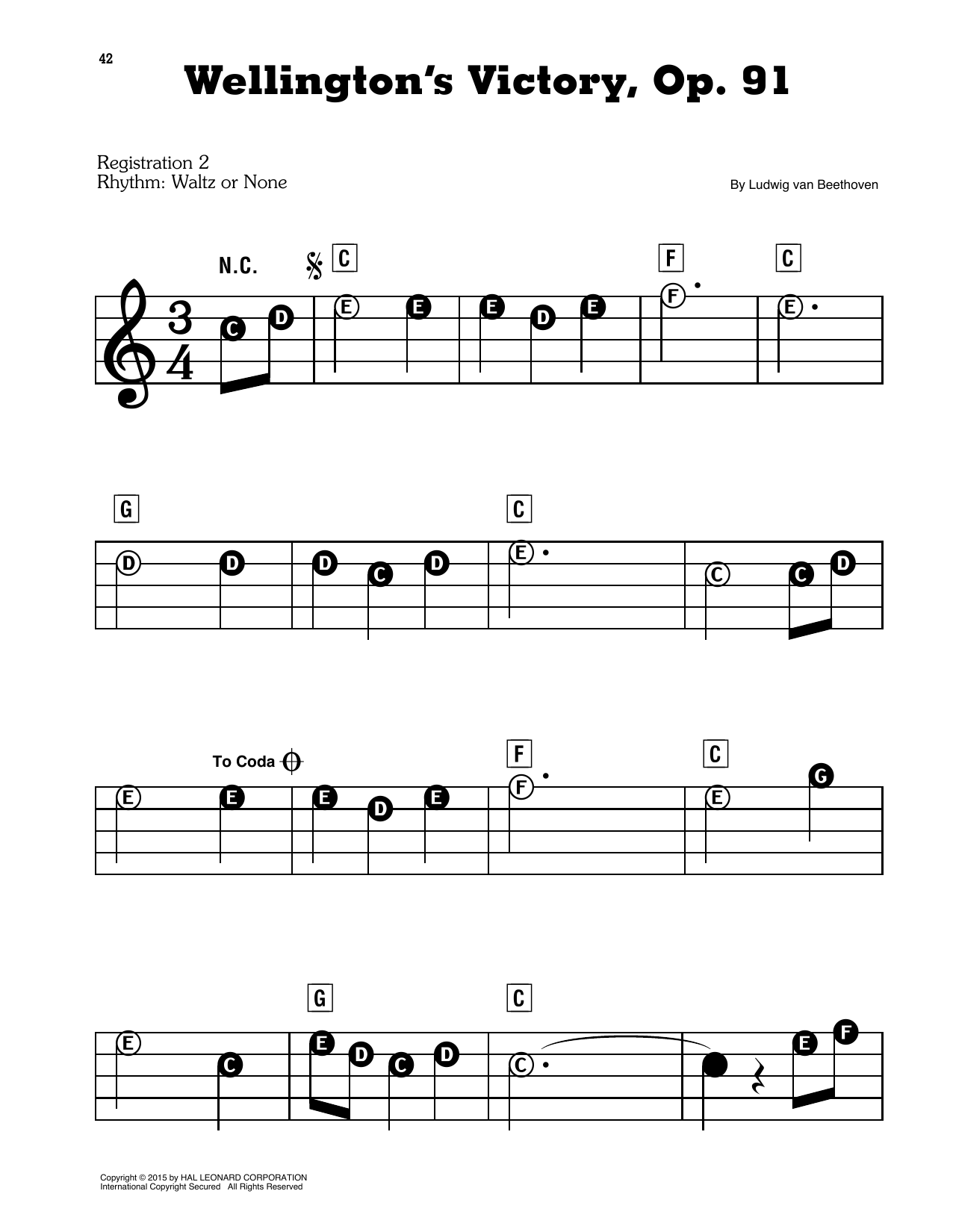
Wellington's Victory Sheet Music Preview

Wellington's Victory: E-Z Play Today

By Ludwig Van Beethoven

Item: 35-DS00603407

Digital Download
$4.99
Description

Wellington's Victory: E-Z Play Today isn't in MakeMusic Cloud just yet...but it could be. Let us know you'd like to see it, and you'll help shape what comes next. In the meantime, start a free trial and dive into thousands of interactive titles your students can play along with today.

Sample Audio
No sample audio found.
Sample Video
Additional Details
Publisher: Hal Leonard
Page Count: 3
SKU: 35-DS00603407

More about this title

About the Composer: Ludwig Van Beethoven

Beethoven composed Wellington's Victory in 1813 to commemorate the Duke of Wellington's triumph at the Battle of Vitoria during the Peninsular War. Written for Maelzel's mechanical orchestra (a precursor to programmatic orchestral writing), the work captures the composer's gift for translating historical events into visceral musical drama. His ability to blend patriotic fervor with genuine compositional craft makes this piece enduringly appealing for both performers and audiences.

Why we love this

This E-Z Play arrangement strips away orchestral complexity without sacrificing the work's infectious energy and clear structural logic. Students encounter one of history's most celebrated battle pieces in a format that emphasizes rhythm, melodic continuity, and the fun of playing something immediately recognizable and historically significant.

What to expect

Triumphant and propulsive, with the swagger of a military march underpinned by driving rhythmic patterns. Moments of heroic melody alternate with percussive energy, creating the impression of conflict resolved into celebration.

Who it's for

Piano students at the intermediate level who are ready for something beyond simplified classical fare but want an accessible entry point to Beethoven's programmatic thinking. Teachers looking to connect music history and performance in a single, engaging piece.

How to get the most out of it

  • Treat the contrasting sections as distinct armies or movements; clarity of articulation between them keeps the narrative momentum alive
  • Lock in the march rhythms early by practicing slowly with a metronome, then gradually building tempo to capture the forward thrust
  • Balance celebratory passages with crisp attacks on staccato figures so the piece doesn't flatten into a single dynamic

How to use it

Pair this with other Beethoven works at the ensemble's level during a concert exploring his range from intimate to grandiose, or feature it as a standalone novelty piece that never fails to capture an audience's attention. It works equally well as a recital showpiece for a student wanting to demonstrate both technical facility and musicality.

Skills your students will build

  • Reading repeated rhythmic patterns and maintaining steady pulse under melodic variation
  • Coordinating both hands independently through contrasting textures (march, fanfare, military signals)
  • Understanding program music and how composers use rhythm, dynamics, and melodic contrast to depict narrative
  • Articulation control (staccato vs. legato) in service of musical storytelling

You May Also Like