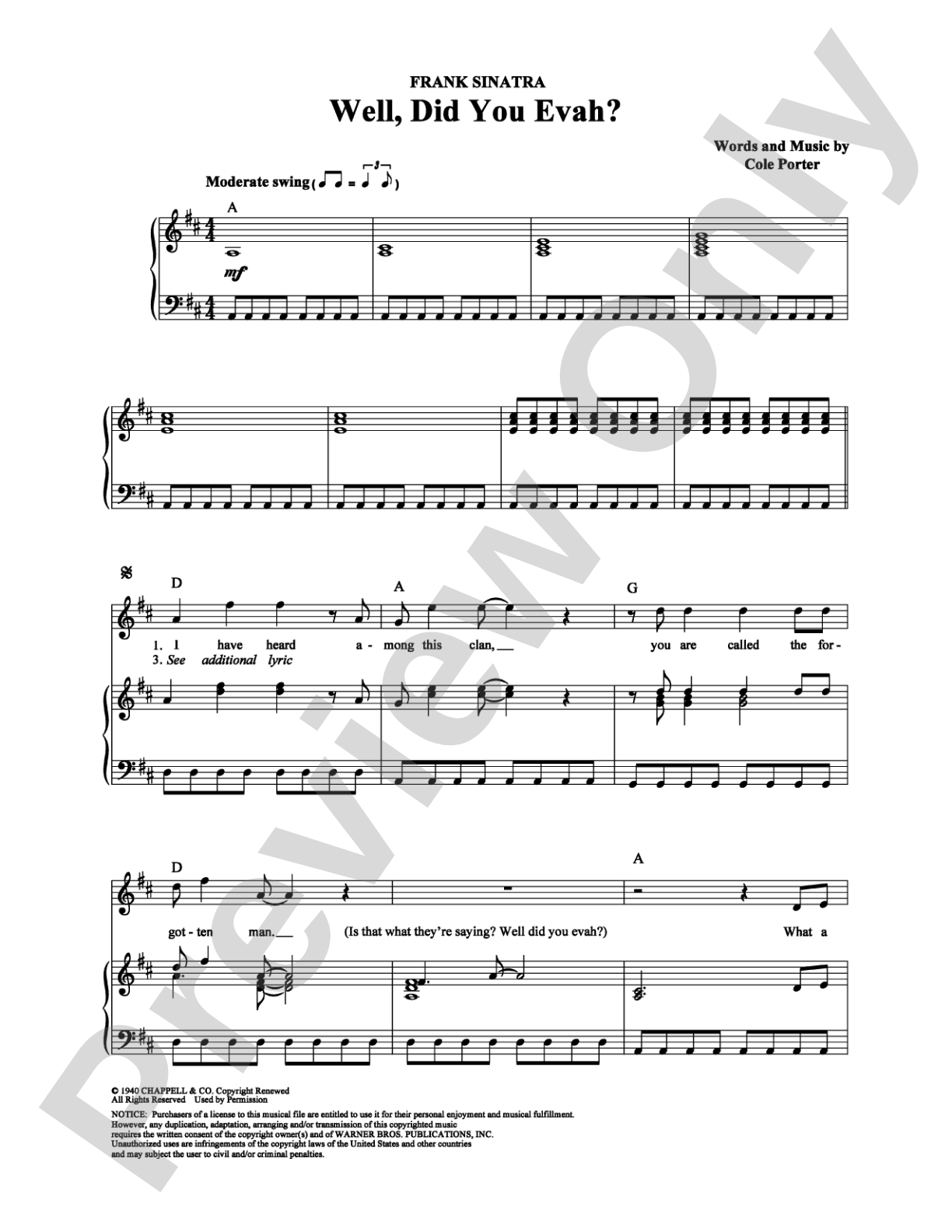
Well, Did You Evah?: Piano/Vocal/Chords Digital Sheet Music

Well, Did You Evah?: Piano/Vocal/Chords Digital Sheet Music

Cole Porter, Bing Crosby, Frank Sinatra

Item: 00-PS-0004587

Digital Download
$3.99
Description

Well, Did You Evah?: Piano/Vocal/Chords Digital Sheet Music isn't in MakeMusic Cloud just yet...but it could be. Let us know you'd like to see it, and you'll help shape what comes next. In the meantime, start a free trial and dive into thousands of interactive titles your students can play along with today.

Sample Audio
No sample audio found.
Sample Video
Additional Details
SKU: 00-PS-0004587

More about this title

About the Artist: Bing Crosby

Bing Crosby (1903-1977) was an American singer and actor whose smooth baritone voice and relaxed phrasing defined popular music through the mid-twentieth century. His influence on vocal interpretation extends far beyond his era; his approach to swing phrasing, rubato, and intimate microphone technique shaped how musicians understand jazz-inflected standards and continues to inform vocal pedagogy today.

Crosby's catalog of duets and ensemble recordings demonstrates his gift for blending voices and navigating sophisticated harmonic territory. For music educators, his recordings serve as exemplary models of how to balance technical precision with emotional accessibility, making his arrangements and interpretations valuable references for students studying American songbook repertoire.

Why we love this

This duet sits at the heart of the Great American Songbook and gives pianists and singers a chance to work with Cole Porter's wit and harmonic invention. The interplay between voices carries both comedy and sophistication, rewarding careful attention to phrasing and ensemble balance. Teaching this piece opens conversations about swing rhythms, lyrical storytelling, and how conversational delivery shapes musical meaning.

What to expect

The piece sparkles with surprise and complicity. It moves like quick-witted conversation between two people who know each other well, full of rhythmic snap and harmonic color. The melody dances across the changes with the ease of someone telling a story they've perfected over many tellings, inviting both performers and listeners into an intimate, knowing moment.

Who it's for

This arrangement serves pianists accompanying singers in studio, recital, or rehearsal settings, as well as vocalists who need readable chord changes and melodic cues. Music theater programs, jazz ensembles, and vocal studios regularly program this duet for its musical and comedic payoff. Students learning to read and interpret lead sheets gain practical experience with jazz nomenclature and accompaniment voicing.

How to get the most out of it

  • Shape the dialogue. Each phrase belongs to one vocalist or the other; use dynamics and tone color to keep the conversation clear and bouncing between the two parts.
  • Lock the rhythm section feel. The piano accompaniment drives the groove; anchor tempo and swing subdivisions so the singers can trade lines without losing pocket.
  • Lean into the humor. Porter's lyric is playful and knowing; resist over-legit singing and instead let the banter stay light and conversational in character.
  • Balance the vocal blend carefully during unison passages. Singers should match vowel shape and vibrato rate to lock harmonically without one voice disappearing.

How to use it

Use this as a centerpiece for a standards-focused concert or as an opener that signals to the audience you're not taking yourself too seriously. It pairs well with other Porter tunes or with bebop-era compositions that share similar harmonic sophistication. The duet format also makes it an ideal choice for showcasing ensemble work in a recital that might otherwise feature solo repertoire.

Skills your students will build

  • Reading and interpreting lead sheet notation
  • Negotiating swing eighths and jazz phrasing conventions
  • Vocal blend and cue exchange in duet singing
  • Harmonic analysis of jazz standards (chord substitutions, voice-leading)
  • Conversational delivery and musical storytelling
  • Accompaniment texture and groove in jazz-inflected contexts

You May Also Like