Welcome, Sweet Pleasure Sheet Music Preview

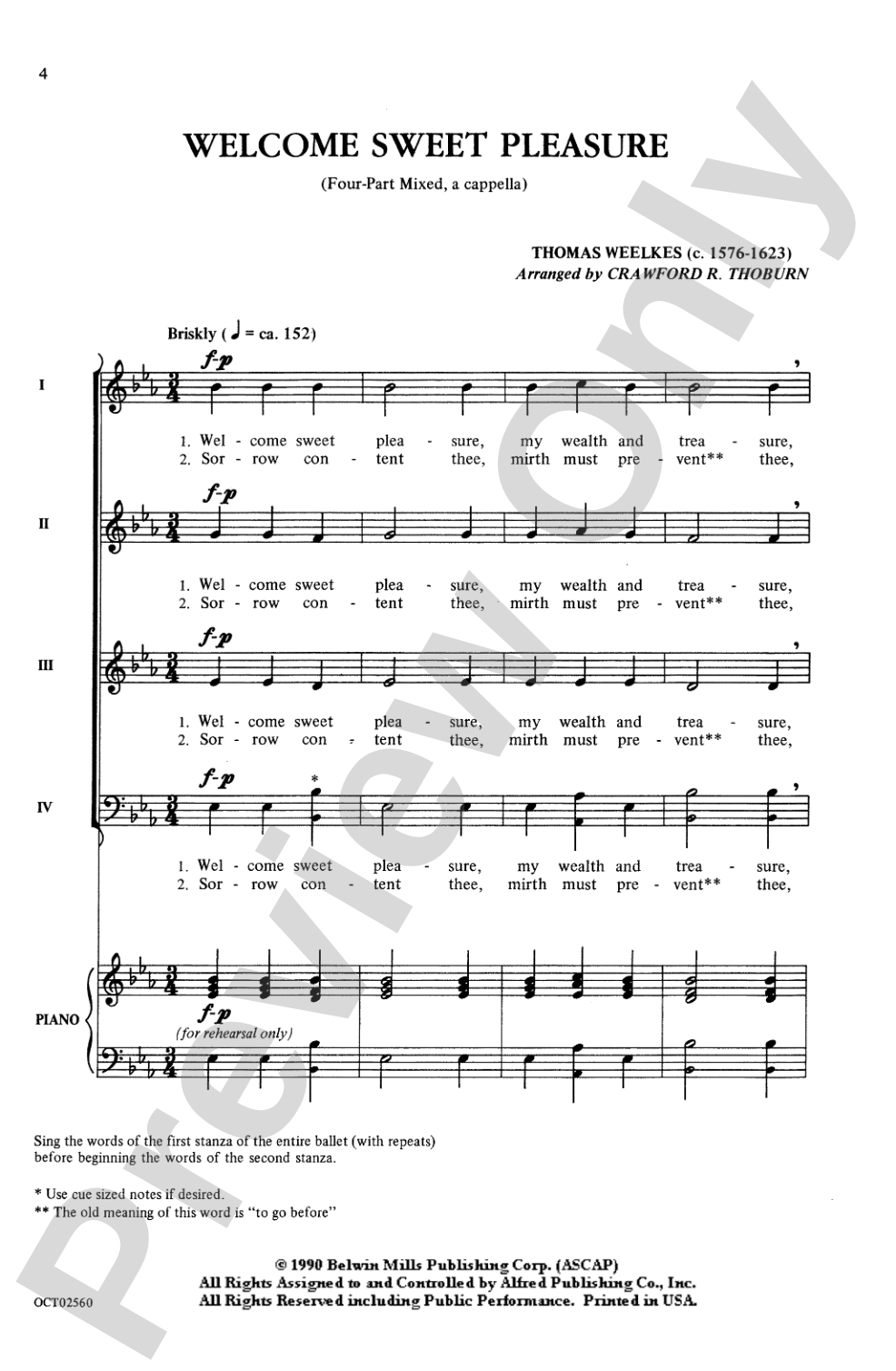
Welcome, Sweet Pleasure: 4-Part Mixed Choral Octavo

By Thomas Weelkes / arr. Crawford R. Thoburn

Level: Moderate

Item: 00-PO-0005138

Digital Download
$2.25

Minimum order quantity: 20 copies

Description

Welcome, Sweet Pleasure: 4-Part Mixed Choral Octavo isn't in MakeMusic Cloud just yet...but it could be. Let us know you'd like to see it, and you'll help shape what comes next. In the meantime, start a free trial and dive into thousands of interactive titles your students can play along with today.

Sample Audio
No sample audio found.
Sample Video
Additional Details
Series: Alfred Archive Edition: Belwin Mills Catalog
Publisher: Alfred Music
Page Count: 8
SKU: 00-PO-0005138

More about this title

About the Composer: Thomas Weelkes

Thomas Weelkes (1576-1623) was an English composer and organist whose madrigals and consort music shaped the late Renaissance choral tradition. He served as organist at Chichester Cathedral and earned recognition as one of the most inventive madrigal composers of his era, publishing five volumes of secular vocal works alongside his church music. His writing combines expressive text-painting with sophisticated harmonic language and remains central to the English Renaissance choral repertoire.

Weelkes's secular works demonstrate remarkable character and emotional depth. His ability to balance technical demands with singable lines and clear part-writing made his music accessible to amateur singers even in his own time, a quality that continues to engage student choirs today.

Why we love this

This arrangement brings a genuine Renaissance gem into reach for Grade 3 choirs without compromising the sophisticated harmonic language that makes Weelkes so rewarding to perform. Crawford R. Thoburn's adaptation preserves the original's character and contrapuntal interest while creating music that sounds elegant and historically informed rather than simplified. Programs seeking repertoire that educates singers about early music while remaining musically substantial will find this a natural choice for festivals or concert programming.

What to expect

This is charming and intimate secular music with elegant part-writing and gentle expression. The piece unfolds with the courtesy and refinement characteristic of Renaissance madrigals, inviting singers to discover the warmth in Weelkes's harmonic language and the delight of blending four distinct vocal lines into unified music.

Who it's for

Grade 3 mixed choirs with solid voice independence and basic facility with Renaissance vocal style will connect with this work. It suits student singers ready to engage with historical choral literature while still developing ensemble skills and part confidence.

How to get the most out of it

  • Shape the opening phrase to establish the character from the first note; these lines deserve the legato articulation and gentle dynamic shape typical of Renaissance secular works, even without modern dynamic markings.
  • Balance the four parts carefully during imitative passages so that each voice line remains audible; this reveals Weelkes's contrapuntal craft and engages singers in following the musical conversation.
  • Approach the text with clarity and natural phrasing rather than rhythmic precision; Renaissance madrigals gain life when singers prioritize word communication over mechanical timing.

How to use it

Program this among other Renaissance secular works or mixed with early music to create a thematically focused concert section, or feature it as a festival entry that demonstrates student understanding of historical style. It pairs well with instrumental Renaissance consort music and provides an accessible entry point for choirs exploring the English musical tradition.

Skills your students will build

  • Reading and singing in Renaissance harmonic language and voice leading
  • Part independence in four-part texture with attention to correct voice entrances
  • Historical performance practice awareness for secular madrigal style
  • Text painting and interpretive choices in early music repertoire

You May Also Like