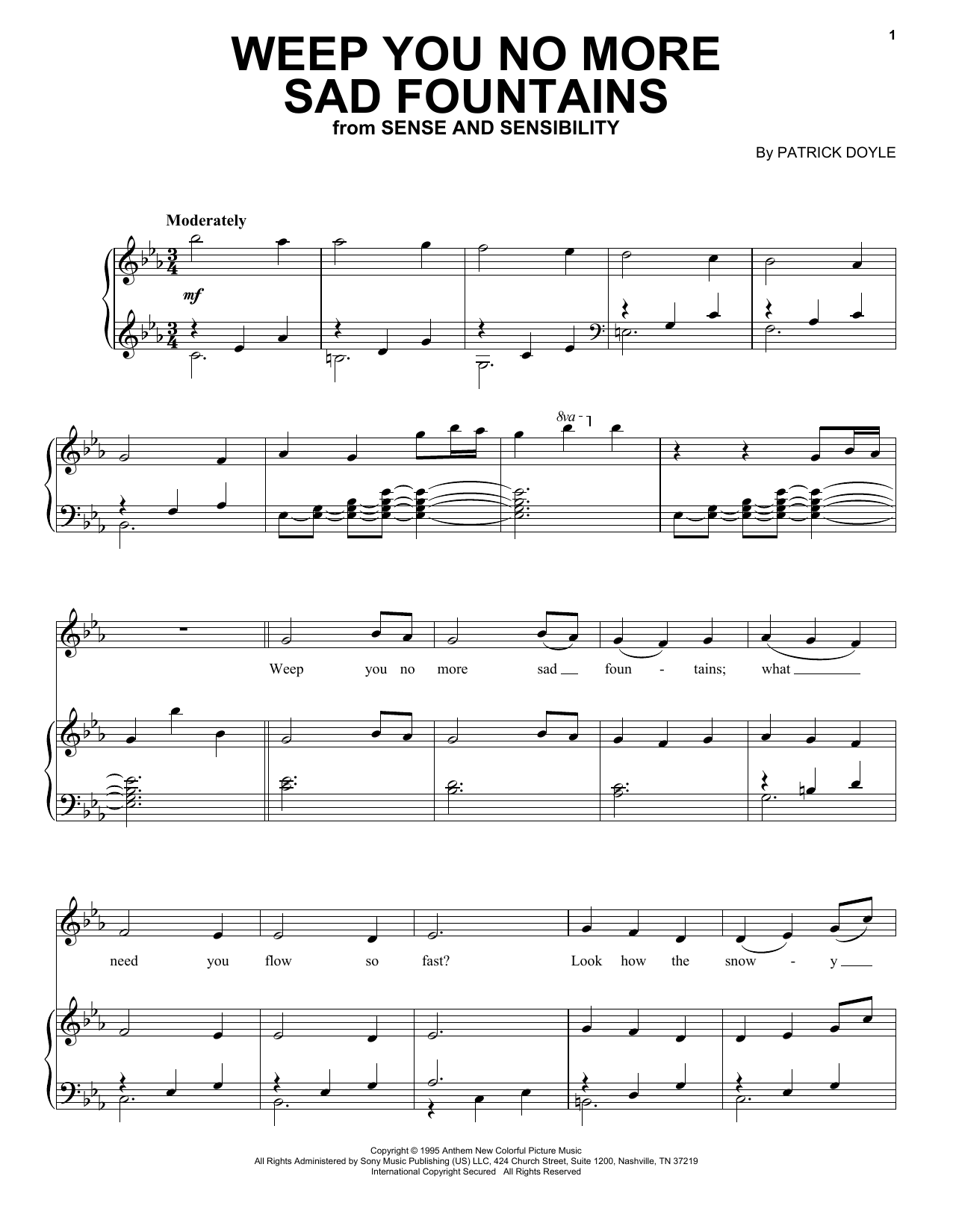
Weep You No More Sad Fountains (from Sense and Sensibility) Sheet Music Preview

Weep You No More Sad Fountains (from Sense and Sensibility): Piano Vocal

By Patrick Doyle

Item: 35-DS01570327

Digital Download
$5.99
Description

Weep You No More Sad Fountains (from Sense and Sensibility): Piano Vocal isn't in MakeMusic Cloud just yet...but it could be. Let us know you'd like to see it, and you'll help shape what comes next. In the meantime, start a free trial and dive into thousands of interactive titles your students can play along with today.

Sample Audio
No sample audio found.
Sample Video
Additional Details
Publisher: Hal Leonard
Page Count: 5
SKU: 35-DS01570327

More about this title

About the Composer: Patrick Doyle

Patrick Doyle is a Scottish composer whose work spans orchestral concert music, opera, and film scores. He has composed the music for numerous feature films, including the 2009 adaptation of Jane Austen's Sense and Sensibility, where his elegant orchestral writing brings depth to the emotional landscape of the story. His compositional voice balances classical sensibility with contemporary orchestration, making his work accessible to performers while maintaining sophisticated harmonic language.

Doyle's experience writing for both concert hall and cinema has made him skilled at crafting music that serves dramatic narrative while standing on its own musical merit. His film scores frequently find their way into music programs because they offer singers and pianists substantial material that rewards careful interpretation and ensemble collaboration.

Why we love this

This aria captures the emotional restraint and underlying passion that Austen's novel demands. Doyle's setting gives the vocalist room to express vulnerability without theatrical excess, and the piano part provides elegant support that young musicians can shape expressively without excessive technical burden. It's the kind of repertoire that teaches singers how to sing with intelligence rather than volume.

What to expect

Quiet dignity permeates this setting. The music breathes with emotional restraint, creating space for genuine feeling rather than sentimentality. There's a melancholic acceptance woven throughout, supported by Doyle's lush but controlled harmonic palette that never overwhelms the voice.

Who it's for

Mezzo sopranos and soprano singers with at least intermediate technique and text interpretation skills will find a rewarding musical context here. This works equally well for advanced high school singers, undergraduates, and developing professionals preparing art song repertoire. Pianists accompanying this piece should be comfortable with Romantic era harmonic language and responsive collaboration.

How to get the most out of it

  • Shape the vocal line with gentle, continuous breath; resist the impulse to break the melody into obvious phrases, letting the words themselves guide your phrasing architecture.
  • Balance the piano accompaniment so it complements rather than competes with the voice. The keyboard writing is delicate, and transparency matters more than fullness.
  • Explore the harmonic shifts between verses; Doyle uses subtle chromatic coloration to deepen the emotional landscape, so voice those changes with slight rubato and dynamic shaping.
  • Consider the text setting's relationship to Dowland's original poem (if familiar). Doyle's version sits in conversation with centuries of musical responses to this Renaissance text.

How to use it

Program this on a concert dedicated to film and television music alongside other screen composers, or pair it with other settings of Dowland's text to explore how different eras approach the same poetry. It also works beautifully as part of a recital program focused on adaptations of classic literature to music.

Skills your students will build

  • Sustaining lyrical legit through longer phrases without relying on breath support
  • Shaping rubato within tonal framework to enhance harmonic progression
  • Collaborative communication between vocalist and pianist for interpretive choices
  • Distinguishing between emotional expression and theatrical delivery
  • Navigating Romantic era harmonic language through performance rather than analysis alone

You May Also Like