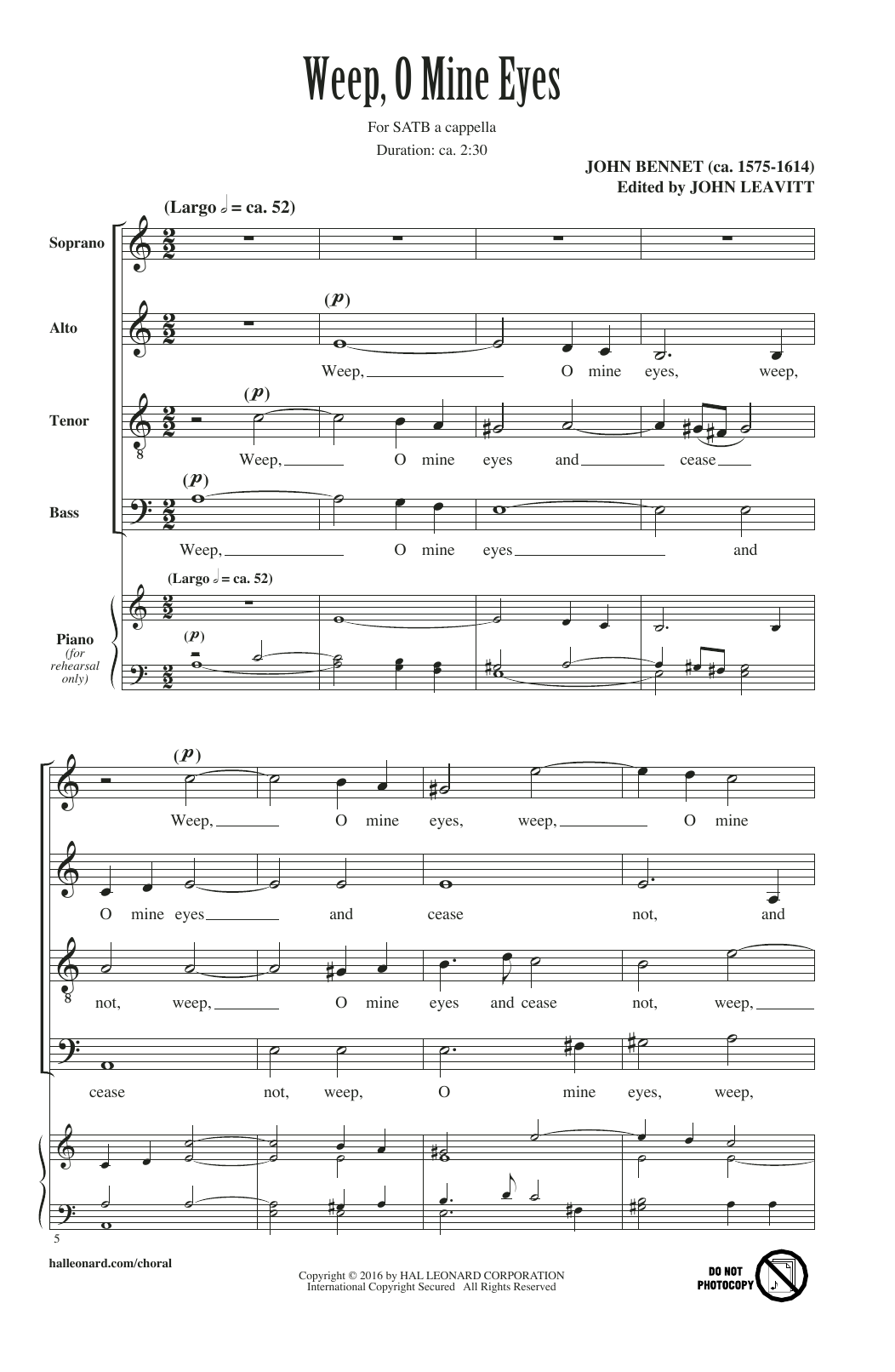
John Bennet was an English Renaissance composer whose output, though modest in size, secured him a lasting place in the choral repertoire. Active in the late 16th century, he contributed motets and secular vocal works that reveal a gift for expressive text-setting and clear harmonic logic. His music remains valued in educational settings for its blend of accessibility and genuine compositional craft.
Why we love this
Leavitt's arrangement preserves the tender affect of this Renaissance gem while calibrating the part-writing for modern choirs. The piece moves efficiently through its emotional arc without demanding extreme ranges or unrelenting textural density, making it both singable and affecting for intermediate ensembles.
What to expect
A meditation on sorrow that never tips into self-indulgence. The music unfolds with the stillness of candlelight, its harmony warm and consonant yet touched with poignancy. Singing this feels like shared prayer.
Who it's for
This octavo suits intermediate to advanced choirs seeking repertoire with genuine Renaissance roots but modern usability. It works equally well for concert settings and service music contexts where emotional depth and textual resonance matter more than showmanship.
How to get the most out of it
Shape each phrase with subtle dynamic contours rather than stark contrasts; the piece's power lies in emotional clarity, not dramatic swells.
Balance the text declamation across all four parts so that words land together without sounding mechanical or rushed.
Allow the harmonic progressions to breathe by resisting the urge to rush through cadences, particularly the final resolution.
How to use it
Pair this with other Renaissance secular works for a focused concert set, or place it as a moment of repose between more energetic pieces. Its intimate scale and emotional authenticity make it ideal for chapel services or chamber choir performances.
Skills your students will build
Awareness of text-expression relationships in Renaissance vocal writing
Blending and balance within four-part texture
Phrasing across longer melodic lines without modern vibrato habits
Reading and realizing Renaissance harmonic language
You May Also Like
Scan to Complete Your Purchase
Use your phone's camera to scan the code below
You'll log in on your phone and the order will be added to your account