Weep, O Mine Eyes Sheet Music Preview

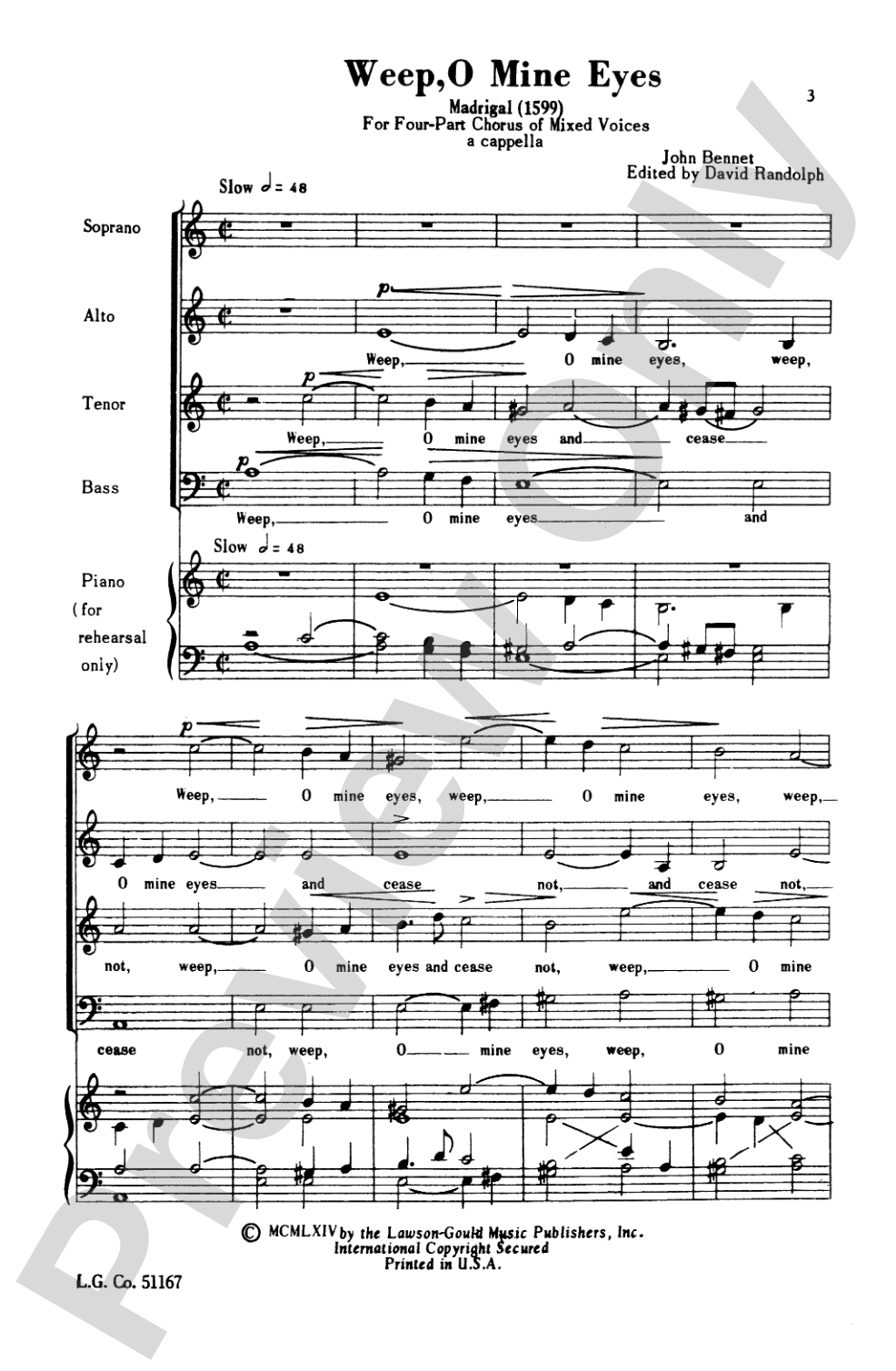
Weep, O Mine Eyes: SATB, a cappella Choral Octavo

By John Bennet / ed. David Randolph

Item: 00-PO-0002653

Digital Download
$2.25

Minimum order quantity: 20 copies

Description

Weep, O Mine Eyes: SATB, a cappella Choral Octavo isn't in MakeMusic Cloud just yet...but it could be. Let us know you'd like to see it, and you'll help shape what comes next. In the meantime, start a free trial and dive into thousands of interactive titles your students can play along with today.

Sample Audio
No sample audio found.
Sample Video
Additional Details
Series: Alfred Archive Edition: Lawson-Gould Music Publishers
Publisher: Alfred Music
Page Count: 8
SKU: 00-PO-0002653

More about this title

About the Composer: John Bennet

John Bennet (c. 1540–1599) was an English composer active during the reign of Elizabeth I, a period of extraordinary flowering in English vocal music. He contributed significantly to the development of the English madrigal, a secular vocal form that dominated late Renaissance music and attracted both court musicians and amateur singers throughout the realm.

Bennet's output, though modest in size, reflects the sophisticated compositional techniques and emotional depth characteristic of his era. His madrigals are marked by careful text-painting, fluid counterpoint, and a sensitivity to the English language that made them favorites in domestic music-making. Works like Weep, O Mine Eyes remain central to the Renaissance choral repertoire taught in universities and sung by chamber choirs worldwide.

Why we love this

Bennet's mastery of imitative counterpoint and his restraint in text-painting create an emotionally mature piece that never feels overwrought. The chromatic voice-leading and harmonic language feel surprisingly modern for the period, making it a rewarding choice for singers who have progressed beyond homophonic Renaissance works and are ready to explore the subtlety of late 16th-century English composition.

What to expect

Weep, O Mine Eyes inhabits the bittersweet emotional landscape of the English madrigal, with poignant chromaticism and carefully interwoven melodic lines that create intimacy and depth. The piece invites singers into a world of refined melancholy, where each voice's contribution to the harmonic whole carries weight and meaning.

Who it's for

This octavo suits intermediate to advanced SATB choirs with secure part-singing skills and familiarity with Renaissance idioms. It works well in concert settings, educational contexts, and smaller ensemble performances where the a cappella texture can be heard clearly.

How to get the most out of it

  • Establish clear phrase breathing at the natural textual boundaries rather than at rests in the score; this maintains the flow of the English text and allows the imitative entries to sing through without fragmentation.
  • Balance the texture by keeping inner voices transparent; in pieces like this, the soprano and bass often carry harmonic weight, so alto and tenor lines must be sung with full color but without swallowing the overall sound.
  • Approach chromatic passages with attention to harmonic function, not as ornamentation; each chromatic step serves the underlying emotional content of the text.
  • Shape individual phrases with gentle dynamic arcs rather than static dynamic levels; the emotional arc of the poetry benefits from subtle expressive shaping within a basically soft dynamic world.

How to use it

Program this alongside other English Renaissance madrigals (Byrd, Morley, Weelkes) to create a compelling portrait of secular vocal music in Elizabethan England. It also pairs thoughtfully with later partsongs and Romantic choral works that drew inspiration from Renaissance models, or stands alone as a concert opener that sets a sophisticated, introspective tone.

Skills your students will build

  • Reading and performing imitative counterpoint
  • Managing chromatic voice-leading and harmonic progression
  • Ensemble balance in multi-voice textures without accompaniment
  • Text-painting and expressive shaping in English Renaissance poetry
  • Secure ensemble intonation in a cappella contexts

You May Also Like