
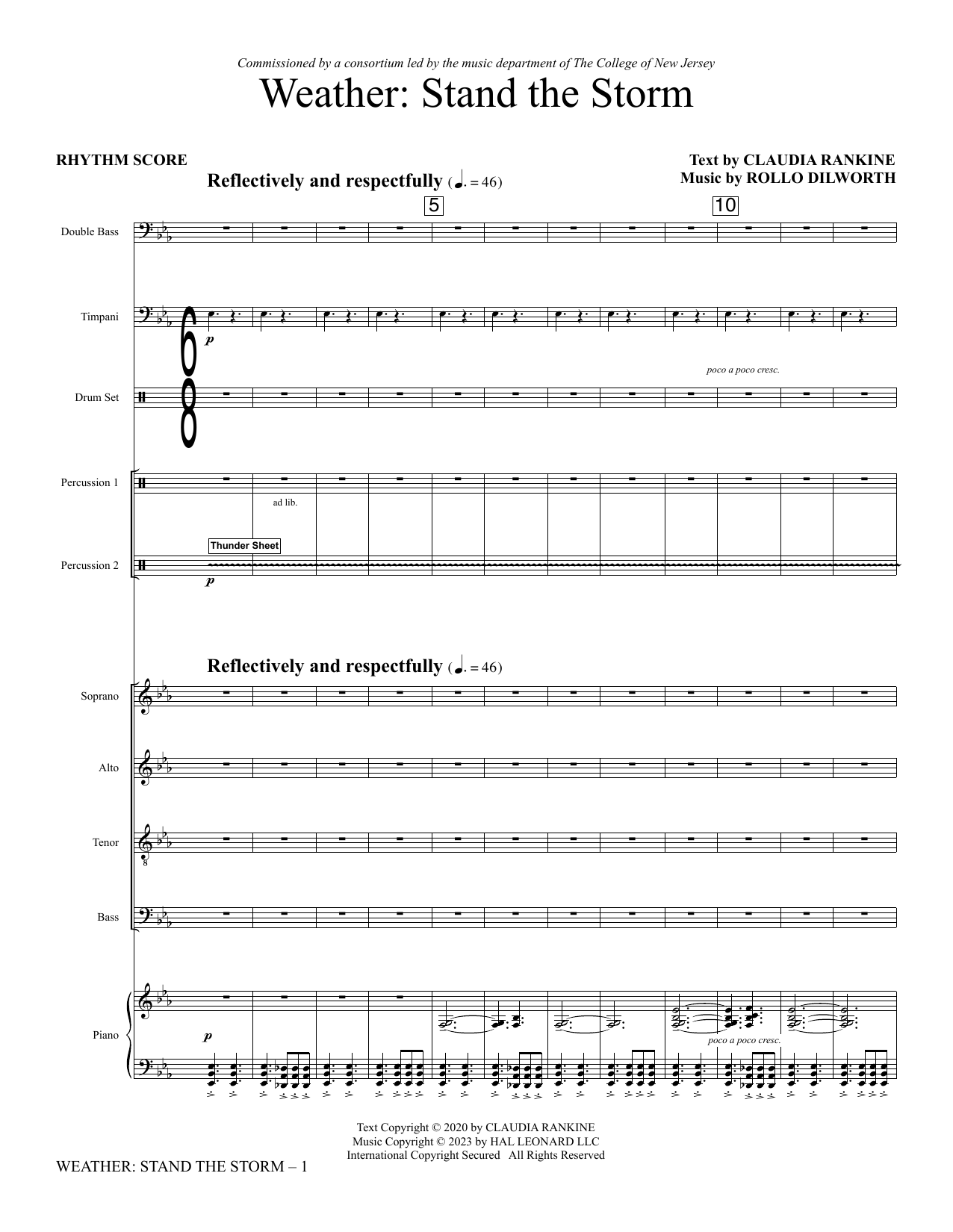

Weather: Stand The Storm (Rhythm Ensemble): Choral Instrumental Pak
By Rollo Dilworth
Item: 35-PK01416809
$75.00
Pickup currently not available
Buy Extra Parts (Digital PDF Download)
Parts Added to Cart!
Description
Historically, the arts have always fulfilled the dual roles of responding to change while at the same time creating change. "Weather" is a poem that gives voice to the voiceless, especially those who have been and continue to be marginalized because of difference. It responds to and reflects realities that are both culturally specific and humanly universal. Professor Claudia Rankine challenges all of us (no matter our background or lived experience) to know better, to do better, to take action, and to become agents of social justice and social change. This work for choir, narrator, and piano with optional Wind Symphony or Chamber ensemble, is to be a learning and growing experience for the singers, the audience, and the conductor/teacher in all ways emotional and intellectual . There is a companion resource for "Weather" intended for students, educators, conductors, and audiences to learn more about the social, political, and historical context of this work. This guide offers an opportunity for everyone to deeply engage with "Weather" and understand its critically important social and historical context. The guide, created by Dr. Colleen Sears, Professor of Music at The College of New Jersey, encourages us to honor the intent of Claudia Rankine's poetry and Rollo Dilworth's music; to become better citizens in our communities and to bridge divides through our shared humanity. Score and Parts: 8.5" x 11"


Weather: Stand The Storm (Rhythm Ensemble): Choral Instrumental Pak isn't in MakeMusic Cloud just yet...but it could be. Let us know you'd like to see it, and you'll help shape what comes next. In the meantime, start a free trial and dive into thousands of interactive titles your students can play along with today.
Request This Title
Tell us you want it.
Start Your Free Trial
Explore everything that's ready to play right now.
Sample Audio
No sample audio found.
Sample Video
No sample videos found.
Additional Details
Publisher:
Hal Leonard
SKU:
35-PK01416809
More about this title
About the Composer: Rollo Dilworth
Rollo Dilworth is a composer and arranger whose work consistently centers on expanding choral literature with pieces that speak to social consciousness and human dignity. His compositions bridge concert music with community engagement, creating works that demand both musical rigor and emotional authenticity from performers and listeners alike.
Dilworth's catalog reflects his commitment to making choral music a vehicle for meaningful dialogue about identity, justice, and shared experience. His collaborations with poets and spoken word artists have established him as a composer unafraid to position the choir at the intersection of art and activism.
Why we love this
This work refuses to be background music. Pairing Claudia Rankine's incisive poetry with instrumental accompaniment, Dilworth creates something that your singers will still be thinking about weeks after learning it. The optional Wind Symphony and Chamber ensemble configurations mean you can scale this to match your resources without diminishing its impact, and the companion educational guide transforms rehearsal into a space where students engage with text, context, and conscience simultaneously.
What to expect
Urgent and thoughtful in equal measure. The music moves between moments of stark beauty and active resistance, never settling into comfortable lyricism. There's an underlying current of determination here, a sense that bearing witness through song is itself an act of agency and change.
Who it's for
Choirs ready to engage their singers and audiences in work that matters, and programs seeking repertoire that combines artistic sophistication with social relevance. Directors comfortable with music that asks hard questions and aren't afraid to let the rehearsal process become transformative. Ensembles with access to instrumentalists (or the flexibility to build those partnerships) will unlock the full scope of what this piece offers.
How to get the most out of it
- Study the companion resource before rehearsals begin. Understanding Rankine's historical and cultural references will shape every interpretive choice your ensemble makes, from phrasing to dynamic intention.
- Balance the narrative voice with instrumental texture carefully. The narrator should never disappear into the ensemble; instead, instruments and singers create a conversation rather than mere accompaniment.
- If using the Wind Symphony or Chamber ensemble option, coordinate sectional rehearsals between instrumentalists and singers early. The rhythmic precision and interpretive alignment these pieces demand require shared rehearsal time, not just separate preparation.
- Attend to silence and stillness as active musical choices. The emotional power here often lives in the space between statements, not in constant sound.
How to use it
Feature this as a centerpiece of a concert explicitly built around themes of identity and justice, or use it as a catalyst for a community conversation that extends beyond the performance itself. The accessibility of the rhythm ensemble version makes it viable for spring festivals while the full Wind Symphony configuration suits formal concert presentations where the scale of the ensemble can match the scale of the message.
Skills your students will build
- Interpreting poetry through musical choices (phrasing, dynamics, tempo)
- Coordinating vocal lines with instrumental textures in ensemble writing
- Understanding how context (social, historical, cultural) shapes musical meaning
- Navigating mixed ensemble scorework with optional instrumental configurations
- Sustaining focus through pieces that prioritize message and emotional depth over virtuosity