
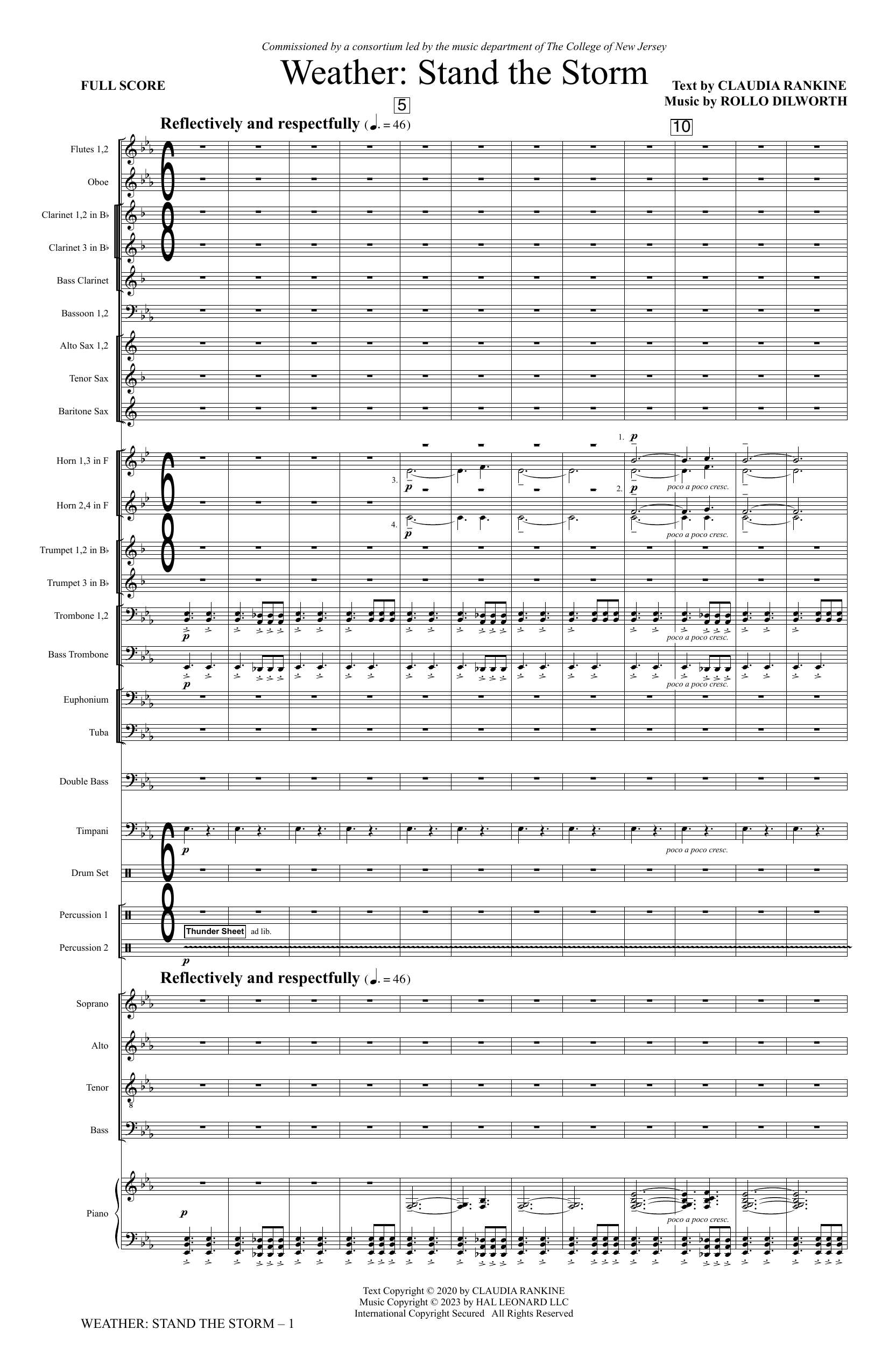

Weather: Stand The Storm (Full Orchestration): Choral Instrumental Pak
By Rollo Dilworth
Item: 35-PK01416808
$200.00
Pickup currently not available
Buy Extra Parts (Digital PDF Download)
Parts Added to Cart!
Description
Historically, the arts have always fulfilled the dual roles of responding to change while at the same time creating change. "Weather" is a poem that gives voice to the voiceless, especially those who have been and continue to be marginalized because of difference. It responds to and reflects realities that are both culturally specific and humanly universal. Professor Claudia Rankine challenges all of us (no matter our background or lived experience) to know better, to do better, to take action, and to become agents of social justice and social change. This work for choir, narrator, and piano with optional Wind Symphony or Chamber ensemble, is to be a learning and growing experience for the singers, the audience, and the conductor/teacher in all ways emotional and intellectual . There is a companion resource for "Weather" intended for students, educators, conductors, and audiences to learn more about the social, political, and historical context of this work. This guide offers an opportunity for everyone to deeply engage with "Weather" and understand its critically important social and historical context. The guide, created by Dr. Colleen Sears, Professor of Music at The College of New Jersey, encourages us to honor the intent of Claudia Rankine's poetry and Rollo Dilworth's music; to become better citizens in our communities and to bridge divides through our shared humanity. Score: 11" x 17"; Parts: 8.5" x 11"


Weather: Stand The Storm (Full Orchestration): Choral Instrumental Pak isn't in MakeMusic Cloud just yet...but it could be. Let us know you'd like to see it, and you'll help shape what comes next. In the meantime, start a free trial and dive into thousands of interactive titles your students can play along with today.
Request This Title
Tell us you want it.
Start Your Free Trial
Explore everything that's ready to play right now.
Sample Audio
No sample audio found.
Sample Video
No sample videos found.
Additional Details
Publisher:
Hal Leonard
SKU:
35-PK01416808
More about this title
About the Composer: Rollo Dilworth
Rollo Dilworth is a composer, arranger, and conductor whose work consistently centers the choral ensemble as a vehicle for social awareness and cultural expression. His compositions span concert music, jazz arrangements, and educational works that challenge singers to engage intellectually and emotionally with texts of substance. Dilworth's approach to choral writing combines sophisticated harmonic language with accessibility, making complex ideas available to student and professional ensembles alike.
Why we love this
Dilworth pairs Claudia Rankine's powerful poetry with music that refuses easy answers or sentimentality. The orchestration options (full wind symphony or chamber ensemble) give you genuine flexibility without compromising the work's artistic integrity. Programming this signals to your community that your ensemble takes on material with real stakes.
What to expect
The music moves between moments of quiet introspection and passages of collective urgency, mirroring the arc of Rankine's verse. Harmonies are modern and sometimes unsettled, creating space for the narrator's voice to land with impact. There is tenderness here, but it is never naive; strength comes through clarity and conviction rather than volume.
Who it's for
This work belongs in programs where your ensemble is ready to engage with contemporary poetry and social themes at a mature level. It serves concert settings, festivals, and community events where audiences expect intellectually demanding music. Both the singers and the listeners should leave changed, not merely entertained.
How to get the most out of it
- Build interpretive depth by engaging with the companion study guide yourself before rehearsals begin; your understanding of the historical and social context will shape every musical decision you model.
- Balance the narrator's voice as an equal partner to the choir and instruments, not as a guest soloist; this requires deliberate mixing choices and ensemble awareness of when they support versus when they yield.
- Honor the emotional weight of the text by resisting the impulse to over-conduct or impose theatrical gestures; let the poetry and music speak through clarity and ensemble focus.
- If using the wind symphony orchestration, give winds and strings equal rehearsal time; these instrumental voices carry their own commentary and must be as secure as the voices.
How to use it
Consider pairing this with a pre-concert panel or community conversation so audiences arrive prepared to listen deeply. This is the kind of work that justifies a full concert or a significant portion of one, rather than a single item on a mixed program. The chamber instrumentation option makes it accessible for schools with smaller ensembles while maintaining full artistic vision.
Skills your students will build
- Interpreting contemporary choral music with complex harmonic language
- Performing alongside a narrator and balancing ensemble presence with solo text delivery
- Engaging with poetry as a musical text, not merely lyrics
- Building cultural and historical literacy through guided study materials
- Ensemble blend and dynamic control across mixed instrumentation
- Sustained focus and emotional maturity in performance