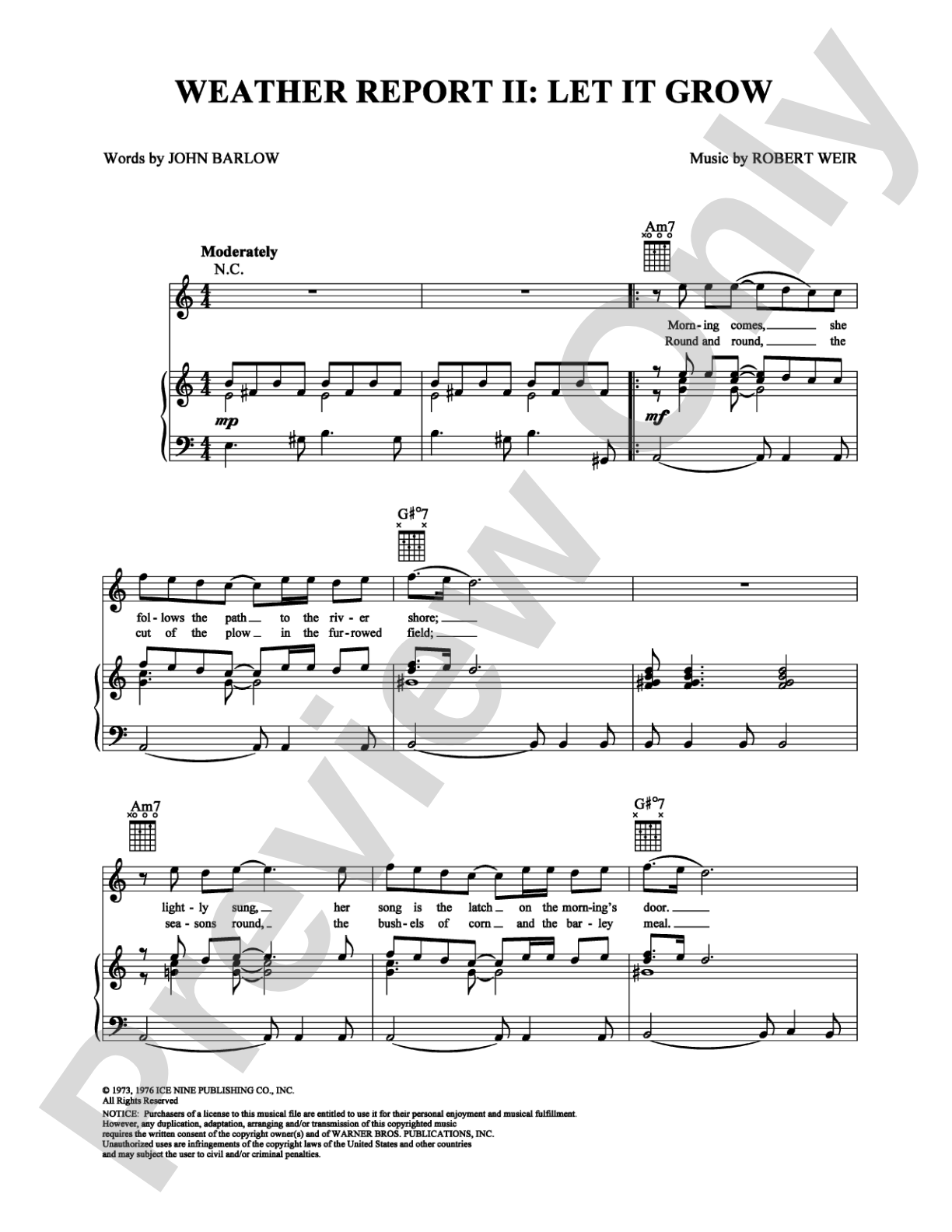
Weather Report Suite, Part 2: Let It Grow: Piano/Vocal/Chords Digital Sheet Music

Weather Report Suite, Part 2: Let It Grow: Piano/Vocal/Chords Digital Sheet Music

Grateful Dead, Bob Weir

Item: 00-PS-0005497

Digital Download
$2.95
Description

Weather Report Suite, Part 2: Let It Grow: Piano/Vocal/Chords Digital Sheet Music isn't in MakeMusic Cloud just yet...but it could be. Let us know you'd like to see it, and you'll help shape what comes next. In the meantime, start a free trial and dive into thousands of interactive titles your students can play along with today.

Sample Audio
No sample audio found.
Sample Video
Additional Details
SKU: 00-PS-0005497

More about this title

About the Artist: Grateful Dead

The Grateful Dead emerged from the San Francisco Bay Area in the mid-1960s as pioneers of improvisational rock, blending folk, blues, country, and jazz into a sound that prioritized exploration and spontaneity. Their live performances became legendary for extended instrumental passages and collaborative arrangements that gave equal weight to all band members, fundamentally reshaping how rock music could be structured and performed. The band's influence extends across genres and generations, with their approach to ensemble playing and compositional flexibility continuing to inspire musicians across all styles.

Why we love this

This tune sits in that sweet spot where rock accessibility meets genuine compositional depth. The piano/vocal/chords arrangement makes it approachable for singers and pianists who want to explore how the Dead built layered arrangements from simple harmonic foundations, and it opens conversations about extended improvisational forms in popular music.

What to expect

Spacious and optimistic, with a folk-song sensibility wrapped in rock textures. The melody unfolds gently over the piano, creating room for the voice to explore dynamics and phrasing without fighting against thick instrumentation.

Who it's for

Pianists and singers developing fluency with lead sheet playing and interested in how rock repertoire functions beyond three-chord progressions. This works equally well for music theory students studying improvisation frameworks and for performers building recital programs that honor contemporary and roots-influenced material.

How to get the most out of it

  • Listen carefully to the recorded versions to understand the rhythmic pocket and phrasing; the piano voicings support but don't dominate the vocal melody.
  • Treat the chord symbols as a framework rather than a constraint, and explore how different comping approaches change the song's texture and energy.
  • Pay attention to phrase breathing in the vocal line; these melodies breathe more like traditional songs than typical rock, giving you space to shape the narrative.
  • Experiment with tempo flexibility within the form. The song's dreamy quality invites subtle rubato that mirrors how the original arrangements let sections breathe.

How to use it

This fits naturally into a recital exploring songwriting across American musical traditions, or as a bridge piece between classical and contemporary settings. It also works as a rehearsal tool in jazz or contemporary music ensembles to study how lead sheets capture the essence of ensemble-based compositions.

Skills your students will build

  • Reading and interpreting lead sheet notation in a rock context
  • Chord-tone voice leading and jazz comping vocabulary
  • Vocal phrasing over chord changes without melodic constraint from strict piano doubling
  • Understanding structural forms built on repetition and harmonic cycling rather than traditional songform

You May Also Like