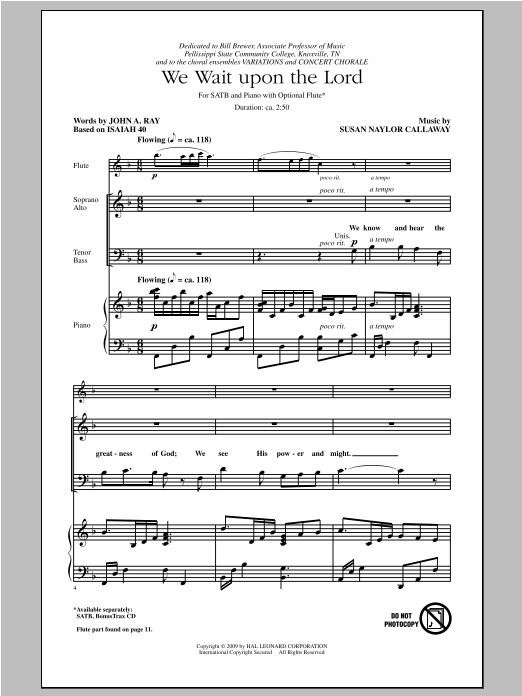
Callaway writes for voices with genuine understanding of where choirs live most comfortably, and this piece respects that while still asking for real musicianship. The text pairs with music that feels inevitable rather than ornamental, which means your singers will connect to what they're singing about.
What to expect
Quiet expectation. The piece settles into its harmony and stays there, allowing space for reflection. There's no rushing, no dramatic gesturing; instead, a patient, grounded sound that invites listeners to sit with the text.
Who it's for
Choirs with solid blend and intonation who are ready to move past unison or basic homophony. This works well for intermediate to advanced amateur ensembles and high school singers with some choral experience.
How to get the most out of it
Balance the inner voices so the harmonic progression reads clearly; without definition in the alto and tenor lines, the piece loses its architectural strength.
Find the natural breath points built into the phrasing rather than inserting breaths where notation suggests you could. This piece unfolds best when phrasing reflects the text's meaning.
Shape dynamics as a collective gesture across all four parts. Sudden shifts in volume undermine the piece's contemplative quality.
How to use it
This anchors a sacred concert or fits naturally into a longer thematic program about faith and waiting. Its modest technical demands and reflective mood make it ideal for pairing with congregational hymns or as a bridge between more elaborate works.
Skills your students will build
Sustaining blend across all four parts in close harmony
Dynamic control at soft dynamics
Text clarity without articulation obscuring legit singing
Listening to inner voices while maintaining your own line
You May Also Like
Scan to Complete Your Purchase
Use your phone's camera to scan the code below
You'll log in on your phone and the order will be added to your account