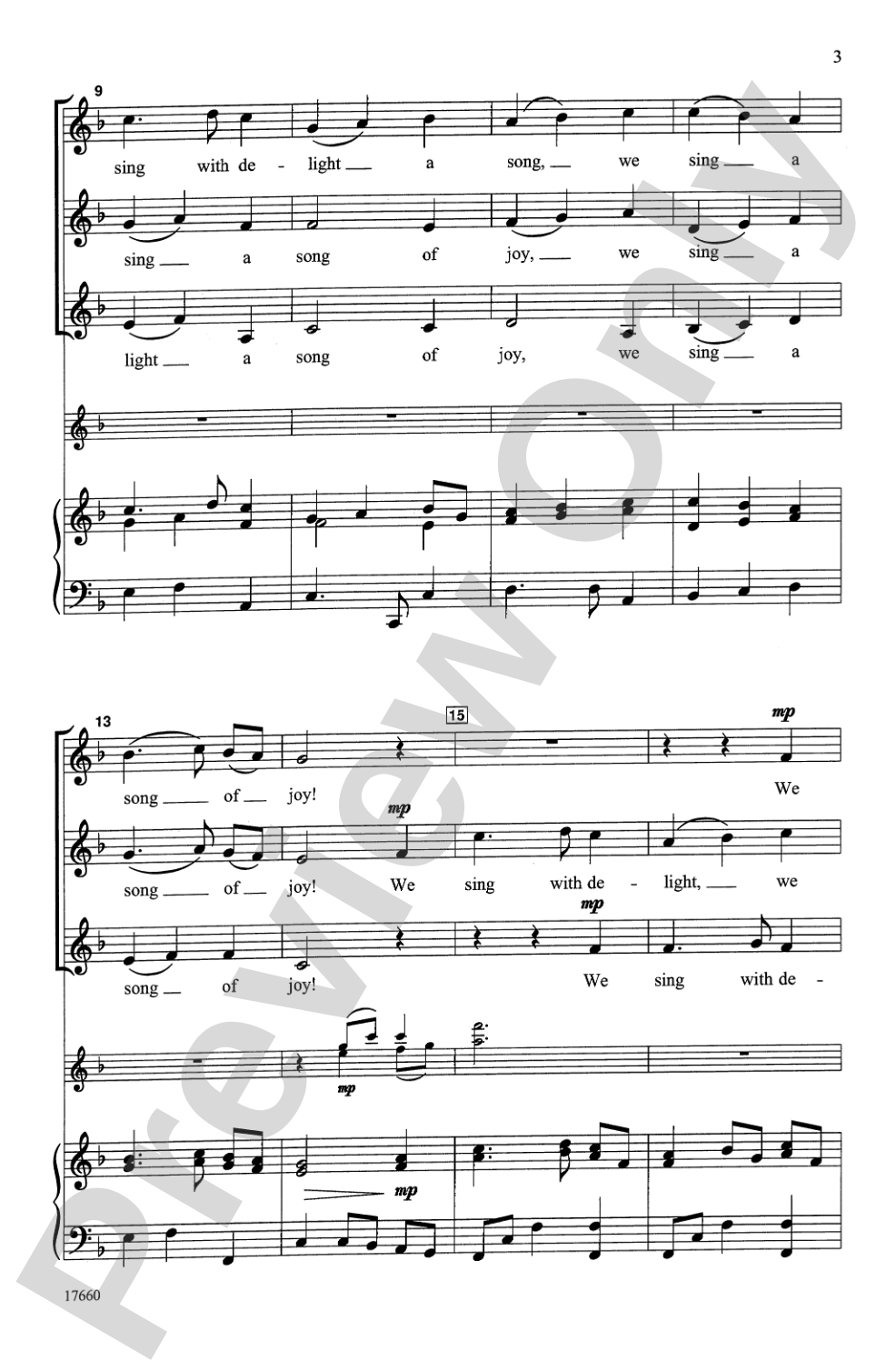
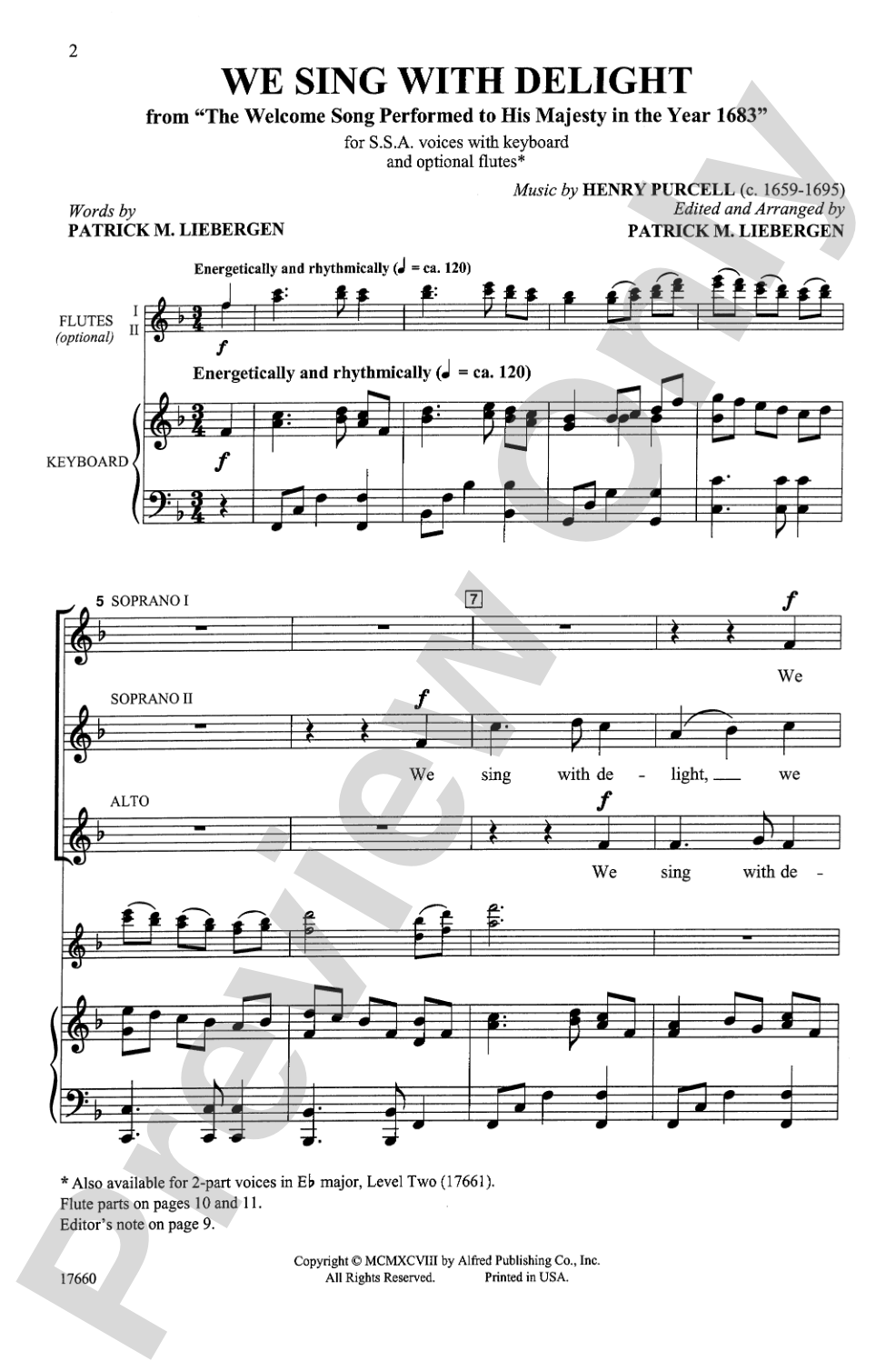
We Sing with Delight Sheet Music Preview

We Sing with Delight: SSA Choral Octavo

Music by Henry Purcell / arr. Patrick M. Liebergen

Item: 00-PO-0003999

Digital Download
$2.25

Minimum order quantity: 20 copies

Description
Treble voice masterwork edition written by Purcell in 1683 to honor England's King Charles II. Two optional flutes. Plenty of repetition makes for quick learning.

We Sing with Delight: SSA Choral Octavo isn't in MakeMusic Cloud just yet...but it could be. Let us know you'd like to see it, and you'll help shape what comes next. In the meantime, start a free trial and dive into thousands of interactive titles your students can play along with today.

Sample Audio
0:00
0:00
Sample Video
Additional Details
Series: Alfred Archive Edition: Alfred Choral Designs
Publisher: Alfred Music
Page Count: 12
SKU: 00-PO-0003999
Instrumentation: Opt. 2 Flutes

More about this title

About the Composer: Henry Purcell

Henry Purcell (1659–1695) was England's most celebrated Baroque composer and a master of vocal writing across all genres. His command of counterpoint, harmonic innovation, and text-painting made him a natural choice for royal commissions, and he served as composer to the court of King Charles II. Purcell's ability to craft memorable melodies within sophisticated musical structures set a standard for English composition that remained influential for centuries.

His sacred and secular vocal works reveal an extraordinary gift for making complex music feel inevitable and singable. Even in occasional pieces written for court celebrations, Purcell's craftsmanship elevates the music beyond its ceremonial function, creating works that reward repeated listening and performance.

Why we love this

Purcell's harmonic language feels fresh even 340 years later, and this arrangement opens his court music to treble choirs without compromising its character. The repetitive structure that makes learning efficient also creates satisfying moments of musical familiarity, letting singers focus on the elegance of Purcell's melodic lines rather than wrestling with the score.

What to expect

Stately and ceremonial, yet intimate in its construction. The piece has the weight and dignity of a royal occasion while remaining buoyant in its melodic character; singers experience both the grandeur of Purcell's harmonic palette and the joy of lines that sit naturally in the treble voice.

Who it's for

This octavo suits intermediate to advanced treble choirs looking for authentic Baroque music that doesn't require a full orchestra or soloists. It works especially well for choirs comfortable with part-independence and directors seeking repertoire that bridges the gap between accessibility and musical substance.

How to get the most out of it

  • Shape the phrases with gentle, flowing breath support rather than dramatic dynamic shifts; Baroque rhetoric values clarity of line over volume.
  • Use the optional flute parts to reinforce the melodic contour during learning phases, then consider pulling them back in performance to let the voices breathe.
  • Balance the SSA sonority so that the top line sings forward without drowning the inner voices where Purcell hides harmonic interest.
  • Attend closely to any tied notes or suspensions; Purcell uses them deliberately to create harmonic tension, and rushing through them diminishes the effect.

How to use it

Position this as a centerpiece in a Baroque program or as a statement opener that demonstrates your choir's textural control and historical awareness. It pairs naturally with other 17th-century vocal works or serves as a bridge between Renaissance polyphony and later Classical repertoire in a concert exploring the evolution of English choral writing.

Skills your students will build

  • Baroque phrasing and harmonic awareness
  • Part independence in three-voice writing
  • Reading Baroque notation and text underlay conventions
  • Sustained tone and legit voice production appropriate to the era
  • Balance and blend in SSA sonority

You May Also Like