

We're Singin' the Blues for You!: Mixed Voices Choral Octavo
Music and lyrics by Russell Robinson
Item: 00-PO-0005315
$2.95
Minimum order quantity: 20 copies
Pickup currently not available
Related Items
We're Singin' the Blues for You!: Choral Octavo SoundTrax CD |
$19.95
|
View |
Description
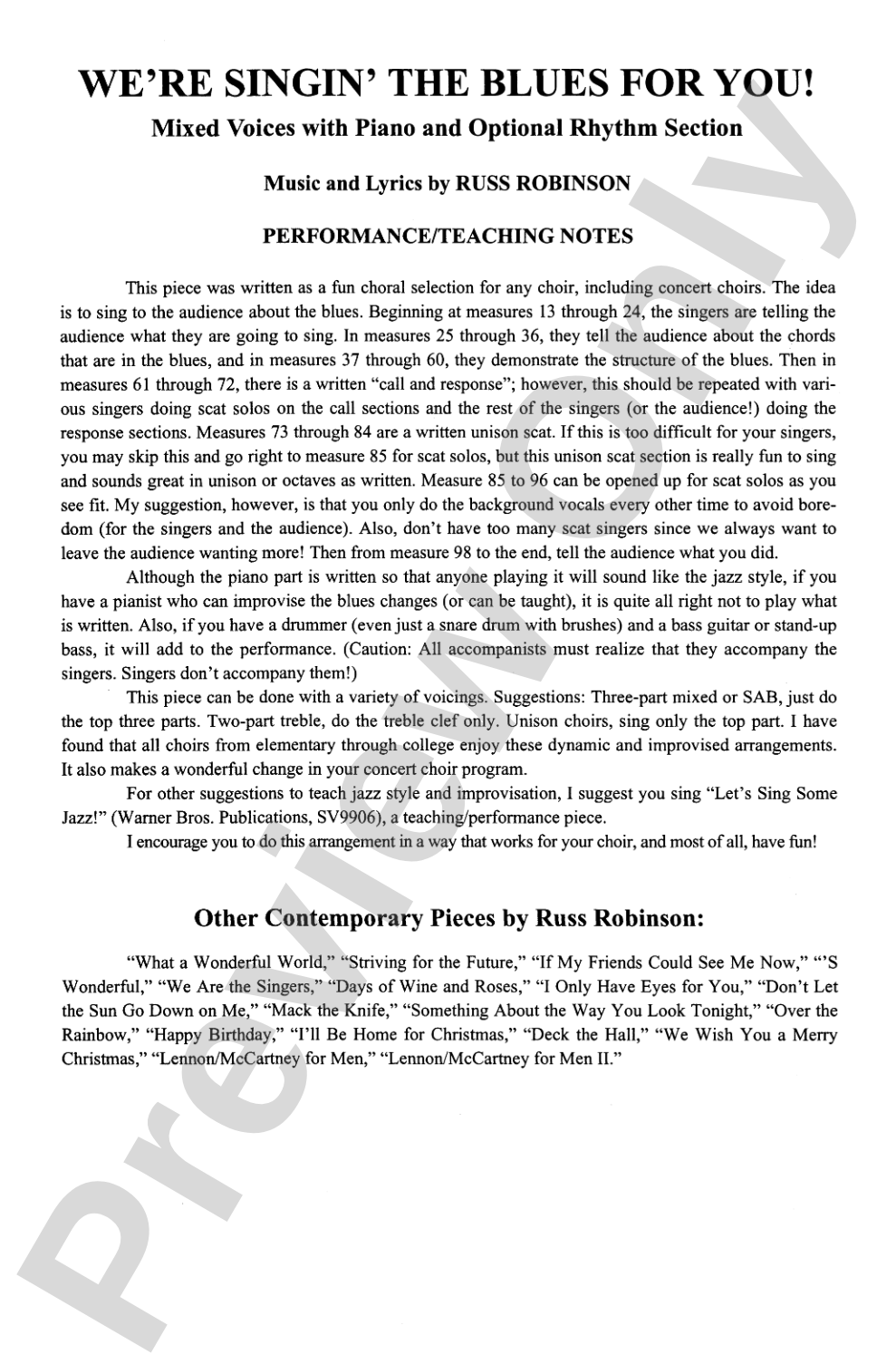
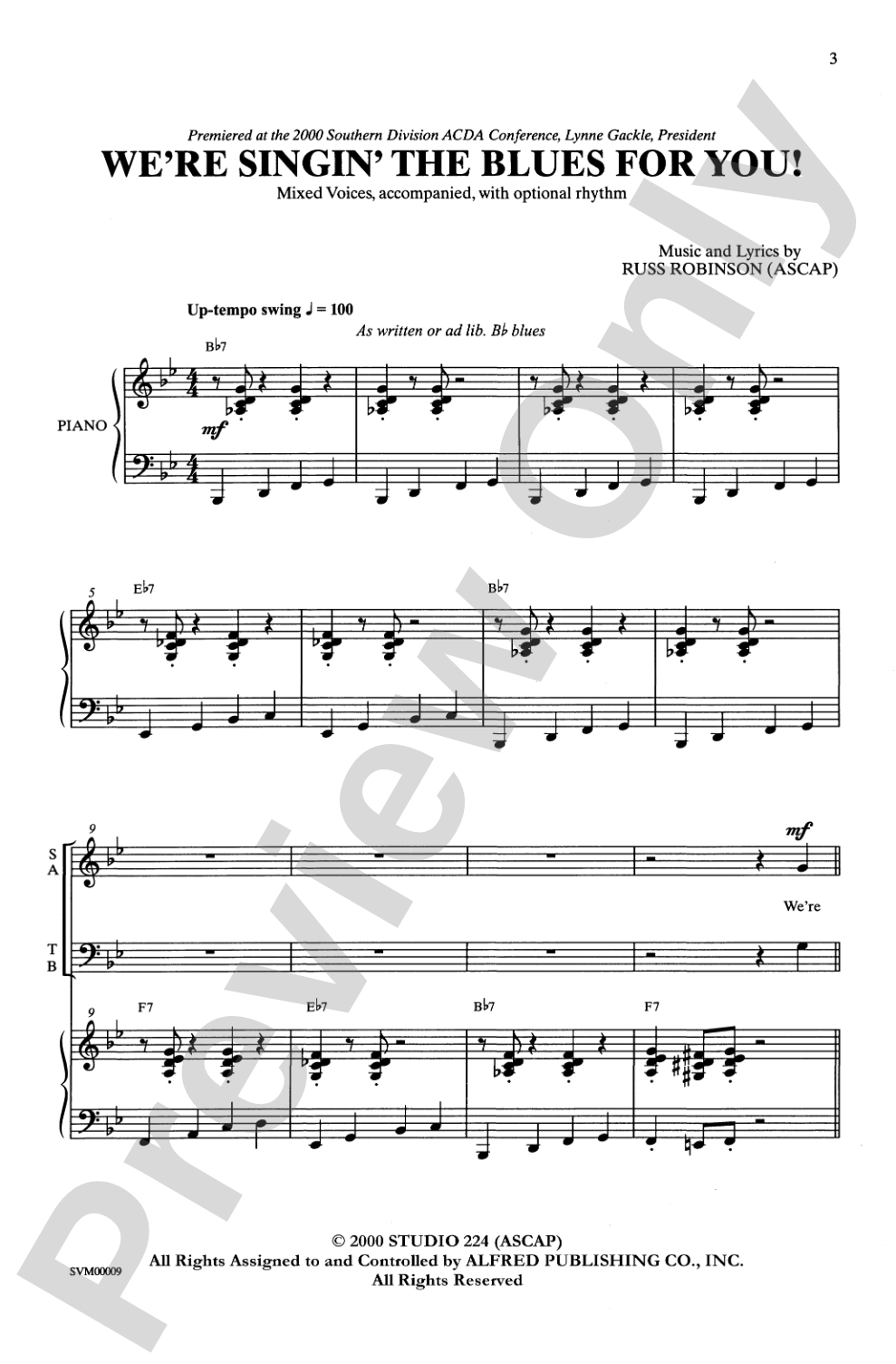
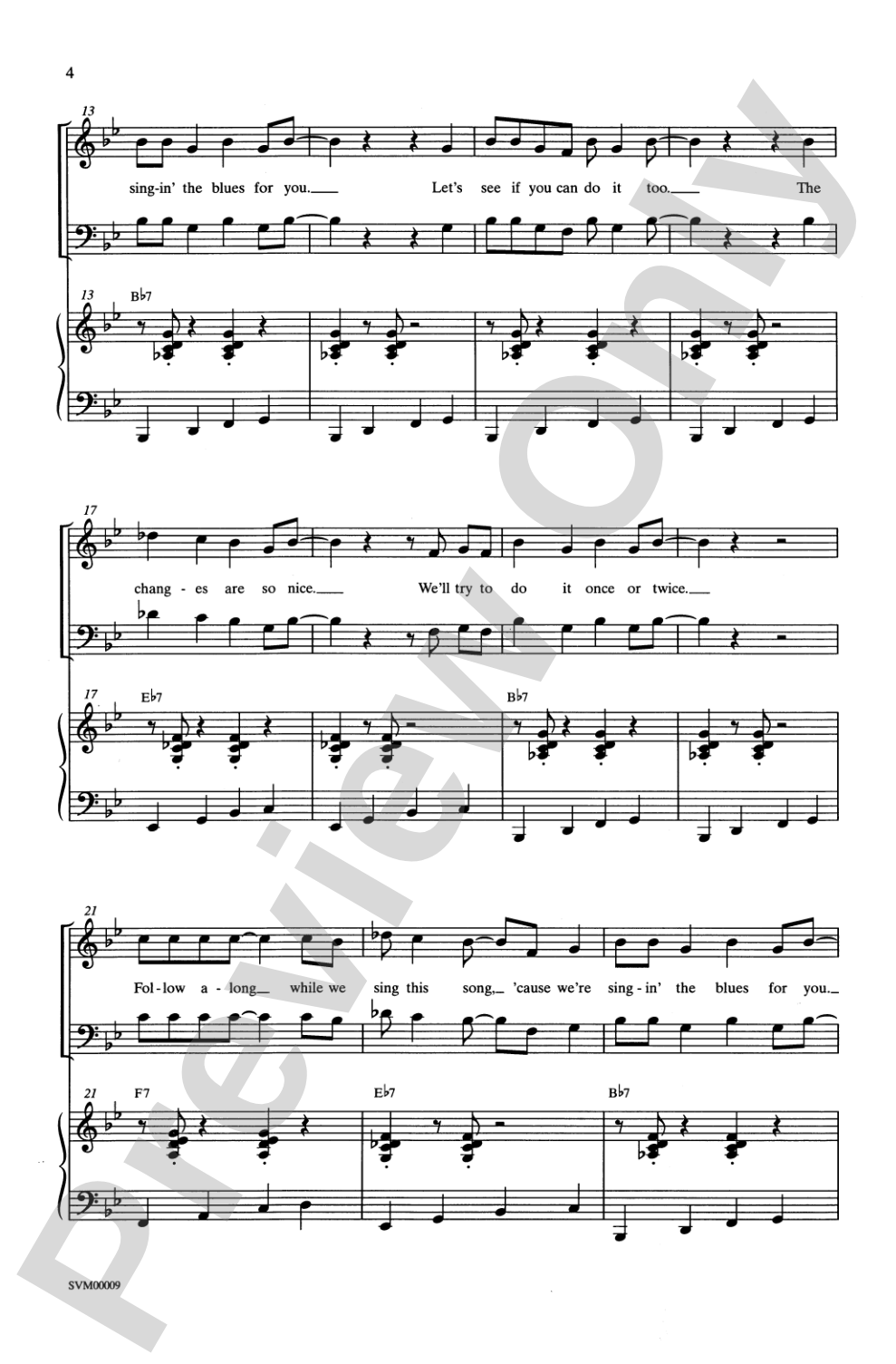
In a follow-up work to last year's "Let's Sing Some Jazz," Russ Robinson has written another winner for teaching vocal jazz style and singing. Already performed in clinics and workshops with Russ as clinician, this one is a hit!


We're Singin' the Blues for You!: Mixed Voices Choral Octavo isn't in MakeMusic Cloud just yet...but it could be. Let us know you'd like to see it, and you'll help shape what comes next. In the meantime, start a free trial and dive into thousands of interactive titles your students can play along with today.
Request This Title
Tell us you want it.
Start Your Free Trial
Explore everything that's ready to play right now.
Sample Audio
No sample audio found.
Sample Video
No sample videos found.
Additional Details
Series:
Alfred Archive Edition: Studio PR Catalog
Publisher:
Alfred Music
Page Count:
16
SKU:
00-PO-0005315
Instrumentation:
Opt. Rhythm
More about this title
About the Composer: Russell Robinson

Russell Robinson served as Emeritus Professor of Music Education at the University of Florida and has spent decades conducting and consulting at festivals, workshops, and conferences across six continents. His work has taken him to prestigious venues including Carnegie Hall, Lincoln Center, the Kennedy Center, and the White House, and he earned induction into the Florida Music Educators Association Hall of Fame in 2016.
Robinson is a prolific composer and arranger with over 500 published works spanning choral compositions, arrangements, instructional books, and DVDs. He held leadership roles as Associate Dean of the UF College of the Arts and served as National Collegiate Chair and Choral Adviser for the National Association for Music Education.
Why we love this
Robinson understands what makes vocal jazz engaging for singers at the high school level. Rather than overwhelming students with advanced harmonies or demanding swing interpretation, he builds jazz style through accessible writing that sounds authentic and lets singers discover the idiom from within the music itself. This follow-up to "Let's Sing Some Jazz" proves he's listening to what works in real rehearsals, not just what looks impressive on the page.
What to expect
The blues harmonic language and jazz inflections create a sophisticated but approachable sound that feels contemporary and genuinely musical rather than educational. Singers discover they can navigate chromatic harmony and syncopated rhythms while maintaining the lyrical warmth that makes jazz singing so compelling.
Who it's for
This piece suits mixed voice choirs in grades 9-12 with singers who have some choral experience and are ready to explore jazz as a legitimate vocal style. It works equally well for classroom singers developing jazz literacy or for ensemble singers in a dedicated jazz vocal group.
How to get the most out of it
- Treat the rhythm section parts as active ensemble voices rather than background texture. These instruments shape the groove and establish the style, so their placement and confidence matter as much as the vocal lines.
- Encourage singers to listen to recordings of vocal jazz groups before rehearsals begin. Hearing authentic phrasing, articulation, and swing feel will accelerate learning and give students a sonic target beyond the written notes.
- Work the lyrical passages with the same attention to blues inflection and bent notes you'd give to the rhythmic sections. Jazz style lives in every moment, not just the up-tempo material.
- Use the recorded accompaniment during sectional rehearsals so singers can internalize their parts against the actual harmonic and rhythmic context they'll perform with.
How to use it
Program this as a feature piece on a concert that includes other jazz or contemporary work, giving it a thematic context that builds audience expectation. If your choir performed Robinson's "Let's Sing Some Jazz" previously, this sequel deepens that exploration without repetition. It also works as a clinician piece or festival selection where students benefit from feedback on jazz interpretation and style.
Skills your students will build
- Singing jazz swing feel and inflection with bent pitches and blues notes
- Reading syncopated rhythms in a jazz context
- Blending triadic and seventh chord harmony over blues changes
- Interpreting articulation and phrasing cues specific to jazz style
- Listening and responding to rhythm section accompaniment while singing