
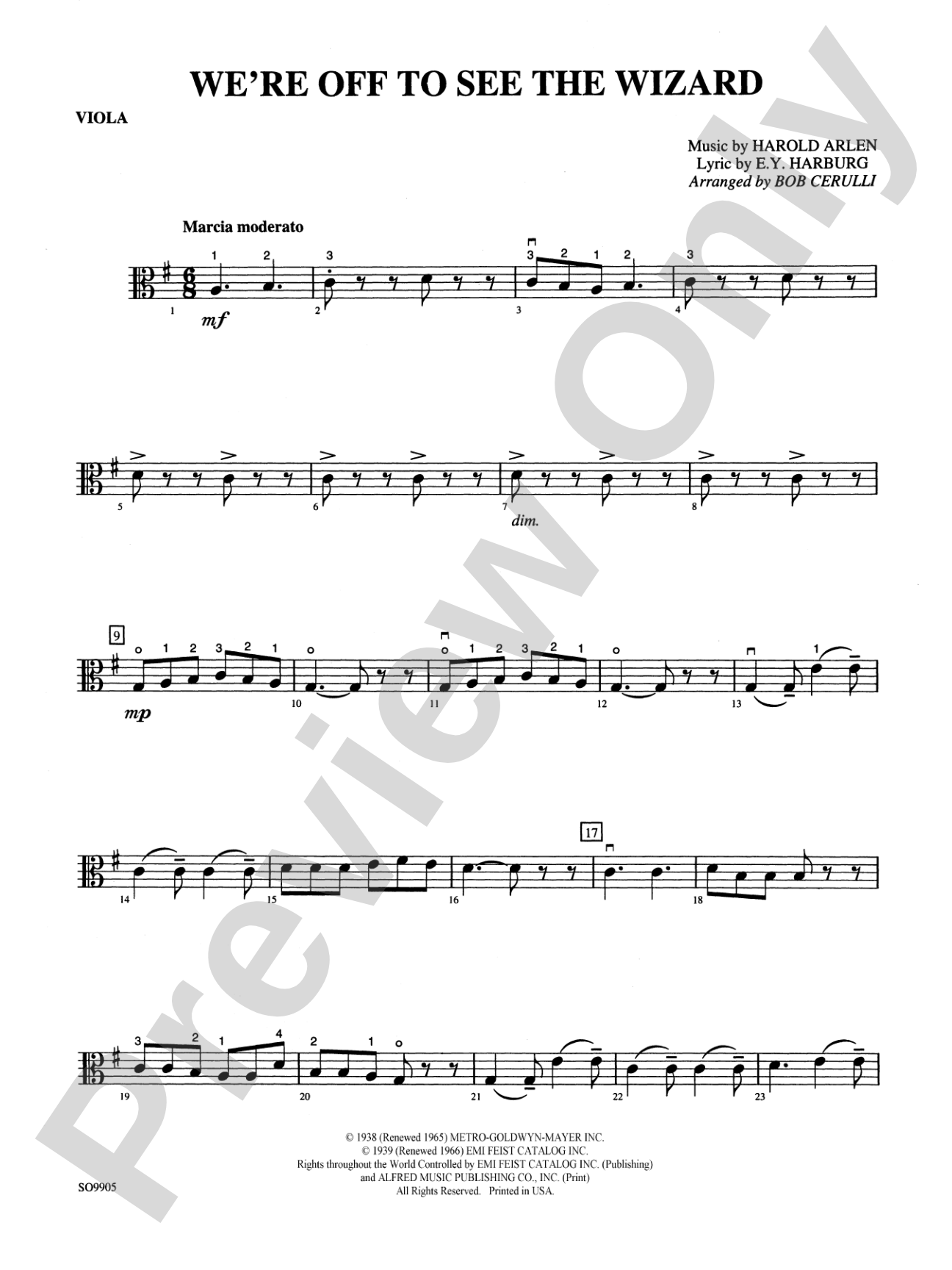

We're Off to See the Wizard: Viola
Arr. Bob Cerulli
Grade: 1
Item: 00-PC-0015256_VA1
$5.99
Pickup currently not available
Description
Three Academy Awards® were bestowed upon the film The Wizard of Oz. Is there a person alive that does not know the songs from the wonderful musical score? Join us (along with Dorothy, Toto, the Scarecrow, the Cowardly Lion, and the Tin Man) once again on the Yellow Brick Road to paradise! (1:05)


Don't just read it, hear it, play along with it, and watch your students grow with it. In MakeMusic Cloud, We're Off to See the Wizard: Viola comes alive with professional accompaniment, adjustable tempo, and built-in practice tools that turn solo practice into real progress.
Open in the Player
Jump straight in and assign it today.
Start Your Free Trial
Open this title and explore the full library in minutes.
Sample Audio
1
Audio File
--:--
0:00
0:00
Sample Video
No sample videos found.
Additional Details
Series:
Pop Beginning String Orchestra
Publisher:
Alfred Music
Page Count:
124
SKU:
00-PC-0015256_VA1
More about this title
About the Arranger: Bob Cerulli

Bob Cerulli earned his foundation in string performance at the Curtis Institute of Music, where he studied double bass under Roger Scott. He deepened his musical training with degrees in music education from the University of the Arts and conducting from the College of New Jersey, then built an active career as a freelance bassist throughout the Philadelphia and Atlantic City regions, performing alongside Broadway artists and working with legendary composers including Henry Mancini, Bill Conte, and Michel LeGrand.
Cerulli's orchestral experience includes principal bass positions with the Greater Trenton Symphony, the New Jersey Capital Philharmonic Orchestra, and the Delaware Valley Philharmonic Orchestra, as well as membership in the Buffalo Philharmonic under Josef Kripps. His own compositions have been performed by the Philadelphia Orchestra, and he brings three decades of public school music teaching experience to his current role as Senior Adjunct Professor at Rowan College at Burlington County, where he continues to conduct orchestral reading sessions and festival performances.
Why we love this
Cerulli's arrangement captures the magic of this beloved score while keeping the writing accessible enough for beginning orchestras to actually enjoy playing it rather than strain through it. The orchestration balances all four parts effectively, so every section feels essential to the music, not like anyone is just holding on to a whole note.
What to expect
Stepping onto the Yellow Brick Road yourself: the melody flows with clear purpose and childlike wonder, the harmonic progressions feel warm and uncomplicated, and the overall texture sparkles without demanding technical gymnastics from any section. There's a lightness here that lets young players feel like they're actually making music rather than decoding notes.
Who it's for
Beginning string orchestras ready to tackle something with immediate appeal and genuine orchestral sophistication. This works beautifully for groups that include students in their first or second year of instruction who still respond to familiar, joyful music.
How to get the most out of it
- Balance the melody carefully between first and second violins if both are sharing it; Cerulli's voicing assumes a light, transparent texture rather than weighted blocks of sound.
- Let the Yellow Brick Road journey breathe in the phrasing; resist rushing even though the grade level suggests younger musicians, and the tempo marking will guide you toward a natural pace.
- Attend to articulation in the cello and bass lines, especially the walking patterns that support the main theme; clear articulation here lifts the entire arrangement.
- Use the recorded accompaniment to build confidence in younger or less experienced sections before rehearsing the full score together.
How to use it
Program this for a spring pops concert or family matinee where the audience knows these melodies by heart; it's the kind of piece that connects performers and listeners instantly. It also works well as a featured arrangement within a concert celebrating film music or American classic standards, and sits naturally in a program alongside other accessible string literature at the same grade level.
Skills your students will build
- Reading simple orchestral textures with sustained notes and independent melodic lines
- Balancing individual parts within a four-part texture
- Maintaining steady tempo and phrasing across a full arrangement
- Developing fluency with common film-score articulation and bowing patterns