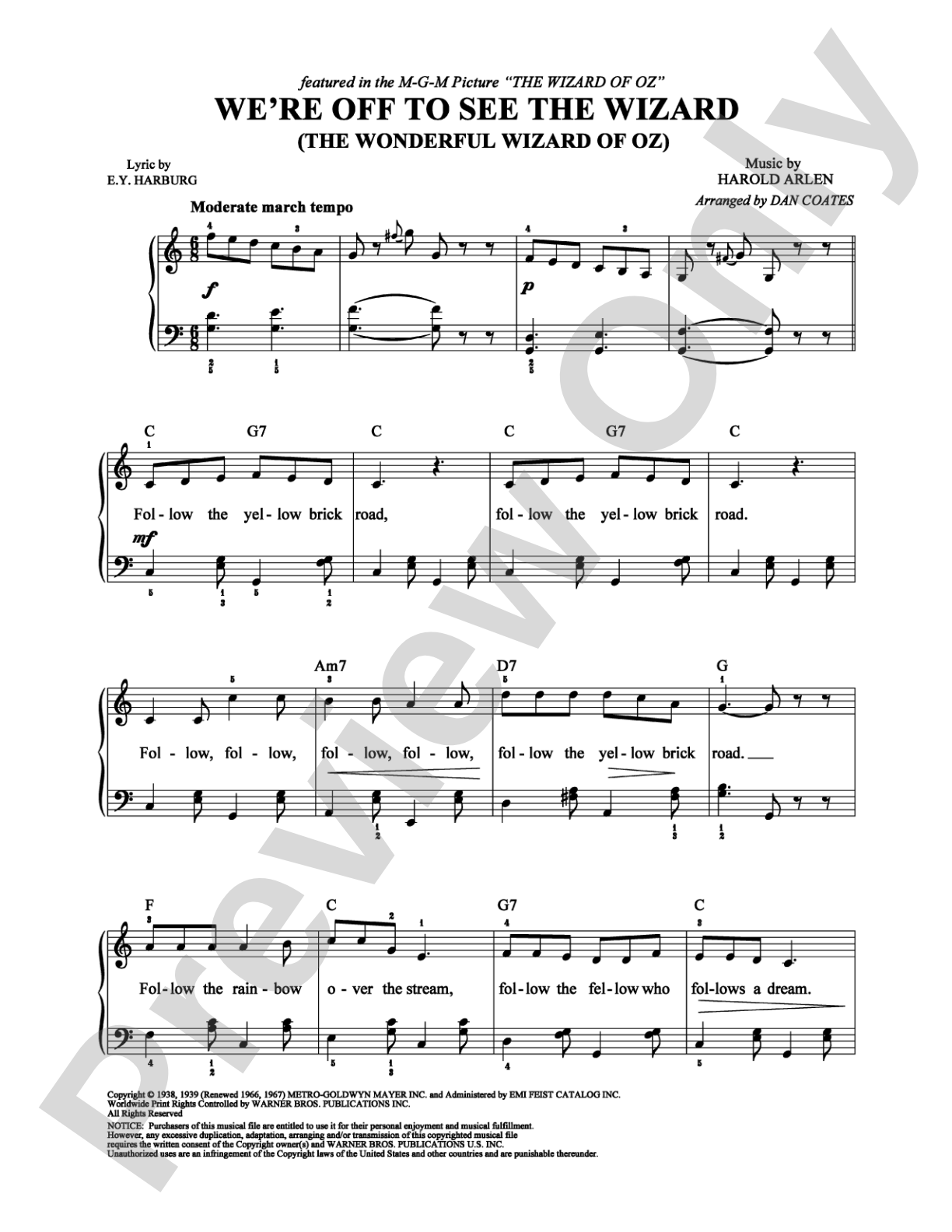
We're Off to See the Wizard: Easy Piano Digital Sheet Music

We're Off to See the Wizard: Easy Piano Digital Sheet Music

Harold Arlen, Judy Garland

Item: 00-PS-0007115

Digital Download
$3.99
Description

We're Off to See the Wizard: Easy Piano Digital Sheet Music isn't in MakeMusic Cloud just yet...but it could be. Let us know you'd like to see it, and you'll help shape what comes next. In the meantime, start a free trial and dive into thousands of interactive titles your students can play along with today.

Sample Audio
No sample audio found.
Sample Video
Additional Details
SKU: 00-PS-0007115

More about this title

About the Artist: Judy Garland

Judy Garland (1922-1969) became one of the most iconic voices in American popular music and film. Her performance of 'Over the Rainbow' in The Wizard of Oz (1939) remains one of the most celebrated vocal performances in cinema history, and her interpretive gifts shaped how generations of singers approached melody and emotional authenticity.

Beyond film, Garland was a consummate entertainer whose artistry influenced vocal pedagogy and repertoire choices in music education. Her ability to inhabit a character through song makes her work valuable for students learning how to connect lyrics with genuine feeling.

Why we love this

This easy arrangement gives young pianists access to one of the most recognizable melodies in American popular music. The simplified voicing lets students focus on phrasing and expression rather than technical complexity, making it ideal for building musicality in early elementary players. Programming it offers an immediate connection to cinema history and popular song that resonates across age groups.

What to expect

Hopeful and wistful. The melody has a timeless quality that feels both intimate and grand, with a yearning quality in the opening phrases that naturally draws listeners in. The piece invites simplicity on the surface while rewarding careful attention to tone and phrasing underneath.

Who it's for

Young pianists in early elementary grades who are ready for simple melodies with emotional depth. It also works well for students preparing for recitals, school performances, or thematic programs exploring American song. Teachers seeking accessible repertoire that connects students to cultural history will find this especially useful.

How to get the most out of it

  • Shape the melody with gentle dynamic peaks at phrase endings rather than playing it mechanically. Garland's interpretation favors rubato and emotional weight over strict metronomic precision.
  • Listen closely to a recorded version first to absorb the natural phrasing and speech-like quality of how she sings the opening. This informs how you'll voice the melody on piano.
  • Balance the left hand accompaniment softly so the melody sits forward and expressively. The goal is to let the tune breathe, not to lock it under heavy harmony.
  • Take time with the bridge section. A slight ritardando approaching the climactic moment can deepen the emotional arc students often feel in this music.

How to use it

Consider pairing this with other American songbook standards or film music to create a thematic concert. It works beautifully as an opening or closing piece for a recital, signaling accessibility without sacrificing artistic integrity. This arrangement also bridges classical piano study and popular repertoire, making it useful in mixed-level studio recitals or school assemblies.

Skills your students will build

  • Singing through a legato melody on piano
  • Phrasing awareness and emotional interpretation
  • Balanced voicing between melody and accompaniment
  • Managing tempo flexibility and rubato
  • Connecting familiar song to interpretive piano playing

You May Also Like