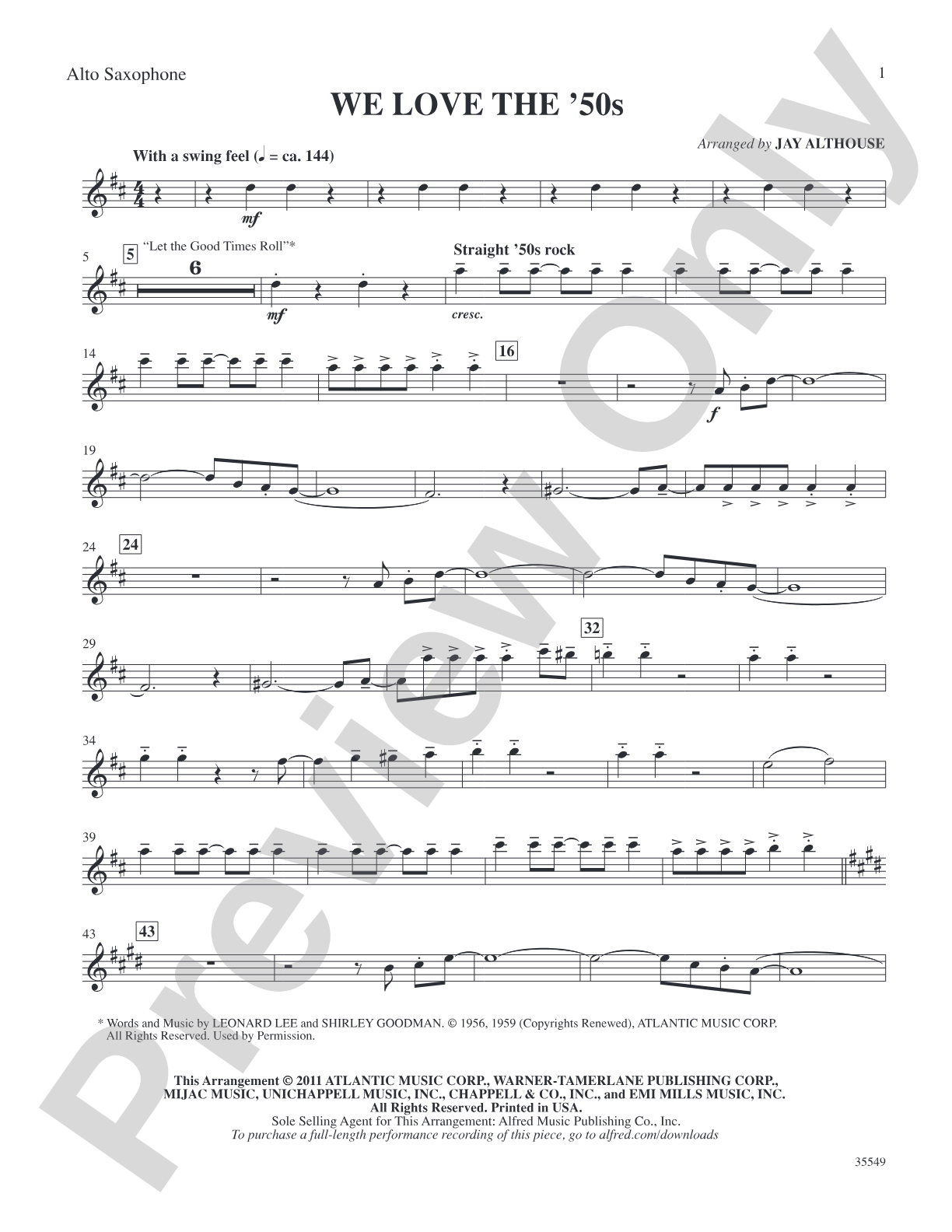
We Love the '50s: E-flat Alto Saxophone Sheet Music Preview

We Love the '50s: E-flat Alto Saxophone: Choral SoundPax

Featuring: Let the Good Times Roll / Sixteen Candles / Lipstick on Your Collar / Hold Me, Thrill Me, Kiss Me / Shake, Rattle and Roll

Arr. Jay Althouse

Item: 00-PC-0016691_AX1

Digital Download
$3.00
Description
It's a '50s hit parade! Grab a jukebox and some poodle skirts, and let the good times roll! Enjoy seven minutes of good, clean, rock-and-roll '50s fun!

Don't just read it, hear it, play along with it, and watch your students grow with it. In MakeMusic Cloud, We Love the '50s: E-flat Alto Saxophone: Choral SoundPax comes alive with professional accompaniment, adjustable tempo, and built-in practice tools that turn solo practice into real progress.

Sample Audio
0:00
0:00
Sample Video
Additional Details
Publisher: Alfred Music
Page Count: 36
SKU: 00-PC-0016691_AX1
Instrumentation: SoundPax

More about this title

About the Arranger: Jay Althouse

Jay Althouse

Jay Althouse holds degrees in Music Education and Music from Indiana University of Pennsylvania, where he later received the Distinguished Alumni award. His publishing career includes eight years as a rights and licenses administrator, during which he served on the Executive Board of the Music Publishers Association of America. He maintains active membership in ASCAP and is a regular recipient of the ASCAP Special Award for his compositional output.

With over 800 choral works in print across all difficulty levels, Althouse's music reaches choirs throughout the English-speaking world. He has co-written children's musicals with his wife Sally K. Albrecht, edited vocal solo collections including Folk Songs for Solo Singers, and authored or co-authored The Complete Choral Warm-up Book, Accent on Composers, Ready to Read Music, Sixty Music Quizzes, and One-Page Composer Bios. His choral work I Hear America Singing, co-written with Albrecht, was performed by the San Francisco Girls and Boys Choirs at President Barack Obama's 2009 Inauguration. Althouse resides in North Carolina and has contributed to the Folk Art Society of America's quarterly publication.

Why we love this

Althouse strips away the earnestness that can bog down '50s nostalgia and delivers seven minutes of genuine fun that students actually want to sing. The SoundPax format keeps rehearsal time focused on musicality rather than accompaniment logistics, and the medley structure gives you built-in energy shifts that hold attention in concert.

What to expect

Pure, unapologetic fun. The arrangement captures the innocent exuberance of rock and roll's first golden age, complete with the earmarks that made the era so appealing: hooks that stick, straightforward harmony, and a beat that makes you move. It feels like a jukebox came alive in your rehearsal room.

Who it's for

Choirs of any gender distribution looking for crowd-pleasing program material that doesn't require extensive rehearsal time. This works especially well for community choirs, youth choirs in their mid to advanced ranges, and show choirs seeking accessible pop-era repertoire.

How to get the most out of it

  • Establish clear articulation on the syllables early; the crisp diction of 1950s pop requires precision without sounding stiff.
  • Balance the humor in the text and arrangement with genuine musical commitment; restraint in the comedy makes the moments land harder.
  • Use the recorded accompaniment to establish tempo and groove, then trust your singers to maintain the pocket without over-conducting.

How to use it

Program this as a concert opener or closer to set a celebratory, energetic mood. It pairs well with other mid-century Americana repertoire or sits comfortably alongside lighter contemporary pop arrangements; the stylistic clarity means it won't feel out of place in mixed-genre programs.

Skills your students will build

  • Singing in a rock and roll idiom with appropriate rhythmic feel and articulation
  • Maintaining clear diction in fast-moving text within medley sections
  • Balancing ensemble blend while executing jazz chord voicings typical of 1950s popular music
  • Responding to recorded accompaniment cues and tempo changes

You May Also Like