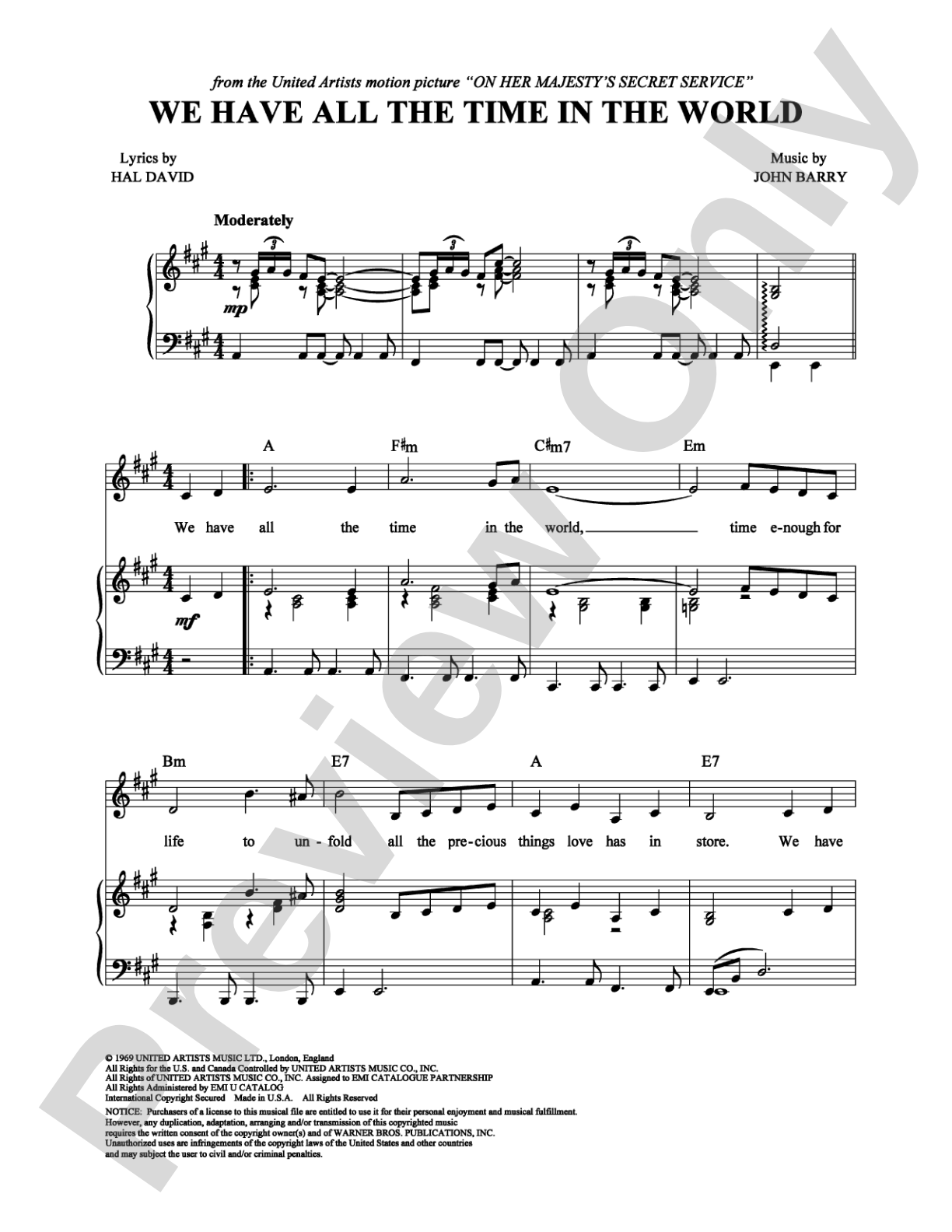
We Have All The Time In The World: Piano/Vocal/Chords Digital Sheet Music

We Have All The Time In The World: Piano/Vocal/Chords Digital Sheet Music

Louis Armstrong, John Barry

Item: 00-PS-0007087

Digital Download
$3.99
Description

We Have All The Time In The World: Piano/Vocal/Chords Digital Sheet Music isn't in MakeMusic Cloud just yet...but it could be. Let us know you'd like to see it, and you'll help shape what comes next. In the meantime, start a free trial and dive into thousands of interactive titles your students can play along with today.

Sample Audio
No sample audio found.
Sample Video
Additional Details
SKU: 00-PS-0007087

More about this title

About the Artist: Louis Armstrong

Louis Armstrong redefined what the trumpet could express and how a voice could deliver emotion. His innovations in jazz phrasing, rhythmic freedom, and melodic interpretation fundamentally shaped American music across multiple genres. For educators, Armstrong's work represents a masterclass in communication: every note serves the story, and technical brilliance never overshadows humanity.

Armstrong's influence extends well beyond jazz into popular song, film, and the American songbook. His approach to singing, where phrasing and timing matter as much as pitch, offers invaluable lessons for any vocalist learning to prioritize musicality over mechanics.

Why we love this

This track combines genuine warmth with sophisticated harmonic language, making it accessible for students yet rewarding for skilled pianists and singers to interpret. The arrangement respects Armstrong's original conception while giving performers space to inhabit the song with their own character, a rare quality in popular repertoire.

What to expect

This song carries the gentleness of reflection, a moment of contentment where time itself becomes irrelevant. Armstrong's vocal delivery is intimate yet assured, creating an atmosphere of mature ease and acceptance.

Who it's for

Vocalists preparing nostalgia repertoire for recitals, cabaret programs, or jazz vocal study will find this score essential. Pianists accompanying singers through the American songbook also benefit from having Armstrong's iconic recording paired with clear chord notation for interpretation.

How to get the most out of it

  • Honor the rubato inherent in Armstrong's phrasing; resist the urge to lock rigidly to the piano. His timing is part of the song's character.
  • Let the piano support rather than drive the tempo. The accompaniment should breathe with the vocalist, not push against them.
  • Pay attention to Armstrong's approach to lyrical vowels. His distinctive sound comes from consistent resonance and jaw relaxation, not from affecting a particular accent.

How to use it

Program this alongside other standards from the 1960s for a concert exploring vocal maturity and the evolution of popular song interpretation. It pairs well with other Armstrong arrangements or as a solo recital centerpiece when teaching singers about phrasing and emotional restraint.

Skills your students will build

  • Interpreting chord symbols for jazz and popular music contexts
  • Shaping phrase lines with minimal vibrato for clarity
  • Coordinating vocal phrasing with piano accompaniment
  • Understanding rubato and flexible timing in non-classical vocal music

You May Also Like