
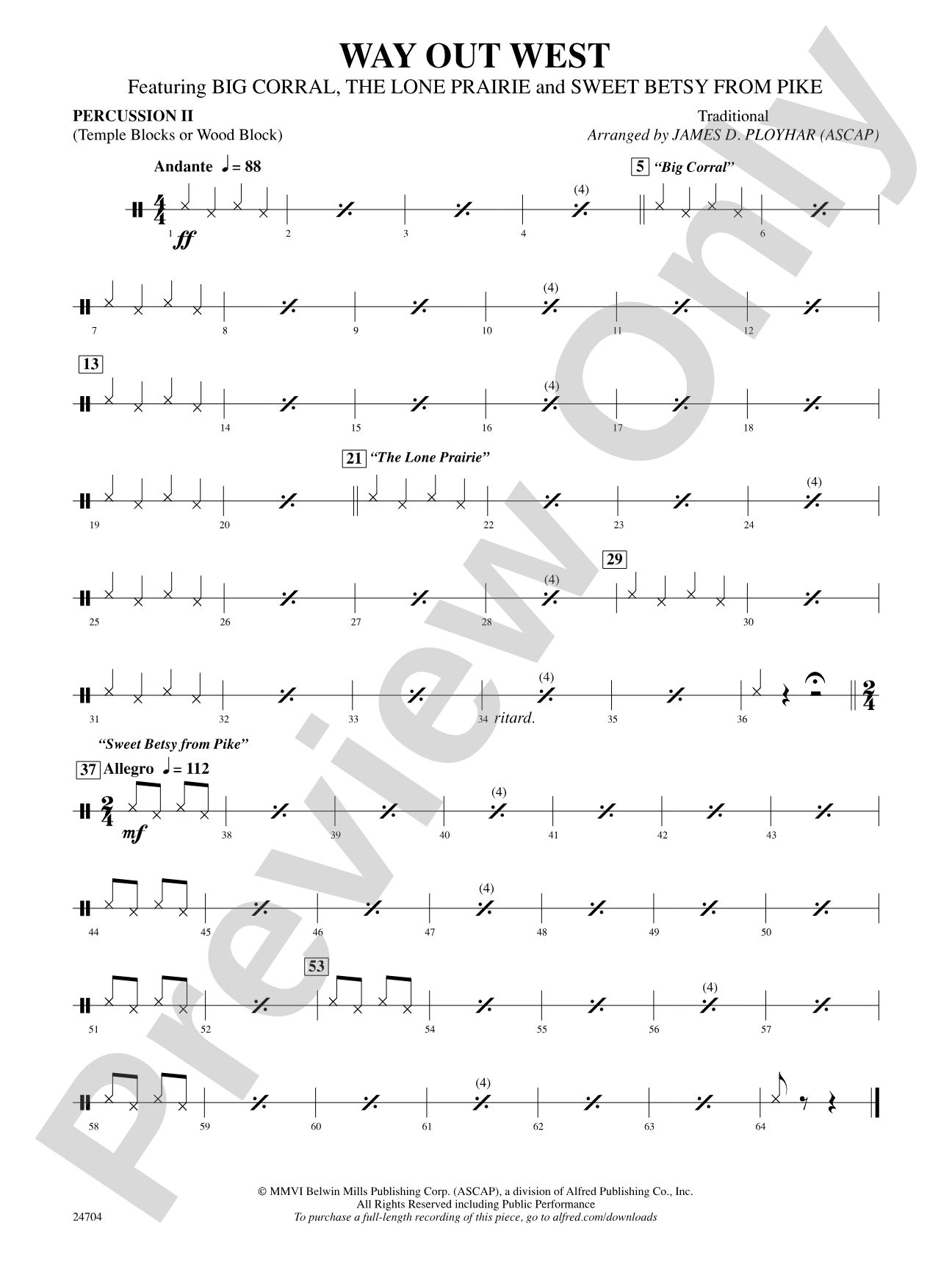

Way Out West: 2nd Percussion
Arr. James D. Ployhar
Grade: 1 (Very Easy)
Item: 00-PC-0000862_PC2
$3.00
Pickup currently not available
Description
The sound of hoof beats will transport you back in time and into the spirit of the west and James D. Ployhar combines three familiar melodies from that romantic era. Listen for "Big Corral," "The Lone Prairie" and "Sweet Betsy from Pike" which come together in the heart-warming trio.


Don't just read it, hear it, play along with it, and watch your students grow with it. In MakeMusic Cloud, Way Out West: 2nd Percussion comes alive with professional accompaniment, adjustable tempo, and built-in practice tools that turn solo practice into real progress.
Open in the Player
Jump straight in and assign it today.
Start Your Free Trial
Open this title and explore the full library in minutes.
Sample Audio
1
Audio File
--:--
0:00
0:00
Sample Video
No sample videos found.
Additional Details
Series:
Belwin Beginning Band
Publisher:
Alfred Music
Page Count:
136
SKU:
00-PC-0000862_PC2
More about this title
About the Arranger: James D. Ployhar

James D. Ployhar has shaped music education through prolific output and deep pedagogical expertise, with more than 800 published works to his name. His foundational curriculum, the Contemporary Band Course, remains in active use across multiple countries and has been translated into French and Norwegian, testimony to its enduring pedagogical value. Ployhar studied composition at California State University-Long Beach under Morris Hutchings Ruger and spent nearly two decades teaching in public schools before establishing himself as a clinician and conductor at the college and university level.
His career reflects genuine mastery of orchestration, developed through collaboration with prominent European musicians including Knud Havalde of the Danish Royal Philharmonic Orchestra. Ployhar's work has reached audiences internationally through network television broadcasts and performances across Europe, Japan, and the Pacific Rim. He has been honored with the National Band Association Citation of Excellence and the Distinguished Alumnus Award, and his frequent conducting appearances have been welcomed throughout North America and Europe.
Why we love this
This arrangement brilliantly demonstrates how a skilled arranger introduces young bands to American folk traditions without overwhelming them. The Grade 1 setting allows every section to participate meaningfully while the three-melody medley structure keeps players engaged and gives conductors multiple opportunities to shape phrasing across a complete rehearsal.
What to expect
The opening evokes a dusty landscape and distant movement through strategic use of rhythm and orchestration. As the familiar melodies enter, the piece shifts from evocative texture to genuine musical storytelling, with the trio offering a moment of warm reflection before the whole ensemble brings the journey to a satisfying close.
Who it's for
Beginning band programs at the elementary or middle school level will find this accessible entry point into concert literature that celebrates American musical heritage. The Grade 1 difficulty ensures all ability levels participate confidently while conductor and parts books support first-time arrangers of full ensembles.
How to get the most out of it
- Establish the rhythmic pulse early through the hoof beat figures; this ostinato anchors the entire piece and gives your section leaders something tangible to reinforce during sectionals.
- Balance the familiar melodies so each one emerges clearly as it appears; resist the impulse to let one section dominate simply because they have the main tune.
- Work the trio section with attention to inner harmony parts, which often carry supporting lines that younger players overlook but that create the warmth Ployhar intended.
How to use it
Program this early in the year to build ensemble cohesion through repertoire that resonates with diverse audiences. The folk melody framework also makes it suitable for educational concerts focused on American music traditions or as a thematic pairing with social studies units on westward expansion.
Skills your students will build
- Identifying and balancing multiple melodic lines within a single arrangement
- Responding to conductor shaping and phrasing across extended musical phrases
- Maintaining rhythmic precision in accompaniment figures while other sections carry melody
- Understanding how familiar material can be reimagined through orchestration and harmonic context